Why Drug Prices Vary Globally: A Country-by-Country Comparison
 Jul, 3 2026
Have you ever wondered why a simple prescription costs $50 in one country and $200 in another? If you travel abroad or follow healthcare news, this discrepancy is impossible to ignore. The price of medication is not just a number on a receipt; it reflects deep differences in how nations value health, innovation, and public welfare. For patients, these differences can mean the difference between staying healthy and going bankrupt.
The global landscape of pharmaceutical prices is defined by extreme variation. There is no single "market price" for drugs. Instead, each country operates within its own regulatory and economic framework, leading to a complex web of costs that defies simple explanation. Understanding this requires looking beyond the sticker price and examining the mechanisms that drive these numbers up or down.
The U.S. Paradox: High Brand Costs, Low Generic Savings
When people talk about expensive drugs, the United States usually leads the conversation. But the story here is more nuanced than "everything is more expensive." The U.S. has a dual pricing system that creates a paradox. On one hand, Americans pay significantly more for brand-name originator drugs. On the other, they often pay less for generic medications compared to their peers.
Data from the U.S. Department of Health and Human Services (ASPE) in 2022 showed that gross prices for all drugs in the U.S. were 278% of the average in 33 other OECD countries. For brand-name drugs specifically, U.S. prices reached 422% of international averages. This gap is driven by a lack of direct government negotiation for most medications until recently. Unlike other developed nations, the U.S. historically relied on private negotiations between insurers and manufacturers, which often failed to curb list prices.
However, a July 2024 analysis by the University of Chicago’s Energy and Climate Economics Hub (ECCHC) revealed a different side of the coin. When looking at net prices-accounting for rebates and including generics-the U.S. actually had public-sector prescription prices that were 18% lower than six peer countries (Canada, Germany, UK, France, Japan). Why? Because generics make up 90% of U.S. prescription volume but only 41% in those comparison countries. Unbranded generics are cheaper in the U.S., sitting at 67% of international prices. So, while a new cancer drug might cost triple in America, a common antibiotic might be cheaper there than in Europe.
How Other Nations Control Costs
If the U.S. relies on market forces with minimal intervention, most other developed countries use active price controls. These systems are designed to balance access for citizens with fair returns for pharmaceutical companies.
- External Reference Pricing: Many European countries look at what neighboring nations pay. If Germany sets a price for a drug, France or Italy might use that as a ceiling for their own negotiations. This creates a regional anchor that prevents any single country from paying an outlier price.
- Budget Impact Analysis: Before approving a new drug, agencies like Canada’s Canadian Agency for Drugs and Technologies in Health (CADTH) assess how much the drug will cost the national healthcare system over time. If the budget impact is too high, they negotiate harder or delay approval.
- Direct Negotiation: Countries like Japan and Australia have centralized buying power. They negotiate directly with manufacturers on behalf of the entire population. This leverage allows them to secure lower prices because they guarantee a large, stable market share in exchange for discounts.
For example, Japan consistently records some of the lowest prices for major brand-name drugs like Jardiance and Entresto. Their system mandates regular price cuts for existing drugs to keep the national health insurance fund solvent. In contrast, Germany tends to have higher prices among OECD nations, reflecting a willingness to pay more for rapid access to innovative therapies, though still far below U.S. levels.

The Impact of Medicare Negotiations
The landscape in the U.S. is shifting due to the Inflation Reduction Act of 2022. For the first time, Medicare was authorized to negotiate prices for select high-cost drugs. The results, announced in late 2023 for implementation in 2025, show progress but also limitations.
A November 2023 analysis by Health System Tracker examined 10 negotiated drugs, including Jardiance, Enbrel, and Ozempic. Even after negotiation, Medicare prices remained 2.8 times higher than the average in 11 comparable OECD countries. For instance, the negotiated price for Jardiance was $204, compared to an international average of $52. Stelara came in at $4,490 versus an international average of $2,822. While these are reductions from previous list prices, they highlight how deeply entrenched high pricing is in the U.S. system. Japan and Australia continued to offer the lowest prices for these specific medications, demonstrating the effectiveness of long-standing centralized negotiation models.
| Drug Name | U.S. Medicare Price | International Avg (11 OECD) | Price Ratio |
|---|---|---|---|
| Jardiance | $204 | $52 | 3.9x |
| Stelara | $4,490 | $2,822 | 1.6x |
| Ozempic | High List Price | Lower | >2.8x |
Global Disparities Beyond the West
While comparisons between the U.S., Europe, and Japan dominate policy debates, the reality for developing nations is starkly different. A 2024 study in JAMA Health Forum analyzed 549 essential medicines across 72 global markets. Using purchasing power parity adjustments, they found massive variations.
Lebanon had a Laspeyres price index of 18.1, meaning drug prices were roughly 18% of Germany’s base index. In contrast, Argentina had an index of 578.6, indicating prices nearly six times higher than Germany. Regionally, the Western Pacific and European regions had the lowest median prices, while the Americas region had the highest. This isn't just about wealth; it's about availability. Markets in the Eastern Mediterranean region reported the lowest availability of essential medicines, suggesting that low prices sometimes come at the cost of supply chain reliability.
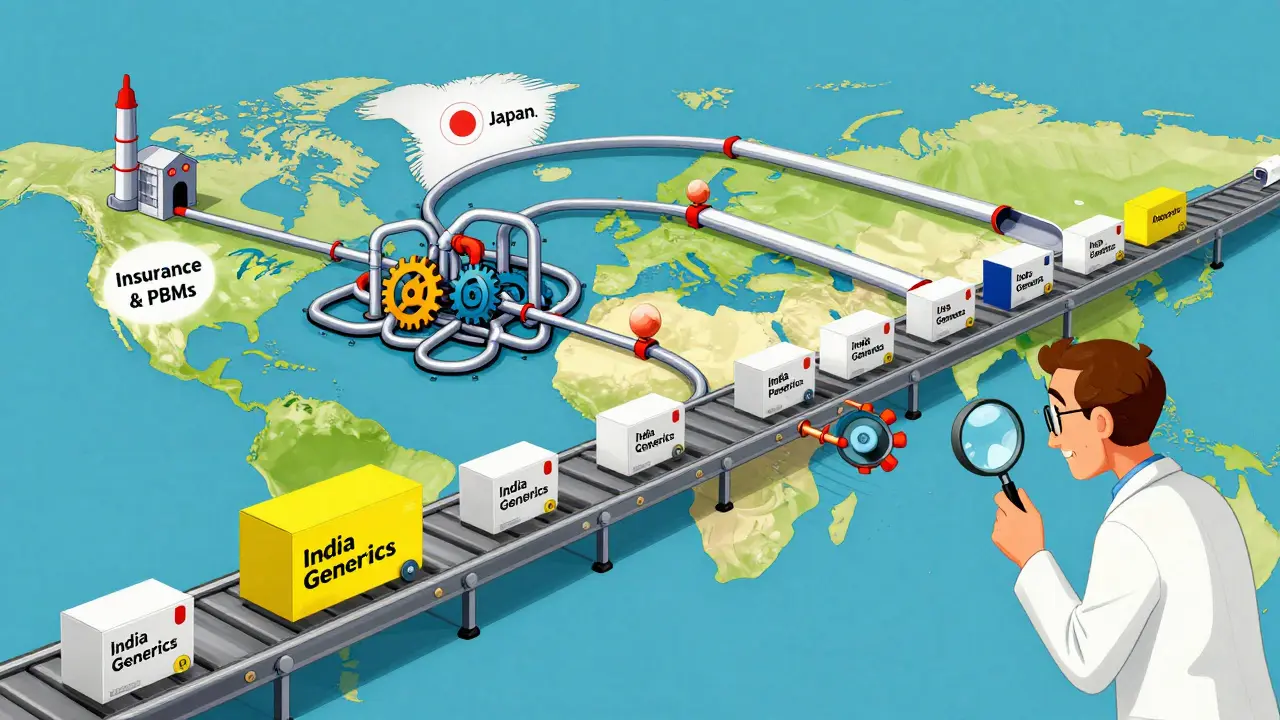
In China, national drug negotiation policies have successfully reduced prices for high-value medications, showing that even large emerging economies can exert control over pharmaceutical costs through strategic procurement. India remains a global hub for affordable generics, serving as a critical source of low-cost medicines for many low- and middle-income countries.
Why Do Prices Differ So Much?
Several key factors drive these international discrepancies:
- Regulatory Frameworks: Countries with strict price caps or reference pricing systems naturally have lower costs. The U.S. lacks these for most drugs.
- Generic Competition: The U.S. has a robust generic market that drives down costs for off-patent drugs. Some countries have slower generic adoption, keeping overall spending higher for older treatments.
- Innovation Incentives: Pharmaceutical companies argue that high prices in wealthy nations subsidize R&D. The University of Chicago economists suggest the U.S. model is "efficient" because it balances high branded drug prices (funding innovation) with low generic prices (ensuring access).
- Negotiating Power: Single-payer systems or centralized buyers have more leverage than fragmented private insurance markets.
The IQVIA Institute forecasts that global medicine spending will grow 5-8% annually on a list-price basis through 2030. This pressure is forcing governments worldwide to rethink their strategies. As new biologics and gene therapies enter the market, the debate over who pays for innovation-and how much-is intensifying.
What This Means for Patients
For individuals, these macro-level trends translate into real-world challenges. If you rely on brand-name medications, living in the U.S. likely means higher out-of-pocket costs unless you have comprehensive insurance. However, if your prescriptions are primarily generics, you may find the U.S. system surprisingly affordable compared to some European counterparts.
Patient assistance programs, manufacturer coupons, and pharmacy benefit managers (PBMs) add layers of complexity. In countries with universal coverage, the concept of a "copay" is often standardized and capped, providing predictable costs. In the U.S., costs can vary wildly depending on your specific plan, deductible status, and whether the drug is on your formulary.
As Medicare negotiations expand and more countries adopt reference pricing, we may see gradual convergence in prices. However, the fundamental tension between rewarding innovation and ensuring affordability will remain. Until then, understanding these global differences empowers patients to ask better questions about their care and seek alternatives when possible.
Why are drug prices so much higher in the US compared to other countries?
US drug prices are higher primarily due to the lack of direct government negotiation for most medications. While other countries use centralized buying power to cap prices, the US relies on private negotiations between insurers and manufacturers. Additionally, the US pays more for brand-name drugs to incentivize innovation, though it often pays less for generics due to strong competition.
Which countries have the lowest pharmaceutical prices?
Japan and France typically have the lowest prices for brand-name drugs among OECD countries. Japan uses mandatory price cuts and centralized negotiation, while France employs strict reference pricing. In developing regions, Lebanon and countries in the Western Pacific often report lower prices adjusted for purchasing power, though availability can be an issue.
Are generic drugs cheaper in the US than abroad?
Yes, unbranded generic drugs are often cheaper in the US than in many peer countries. According to a 2024 University of Chicago study, US generic prices are about 67% of international averages. This is because generics make up 90% of US prescription volume, creating a highly competitive market that drives down costs.
How does Medicare negotiate drug prices?
Under the Inflation Reduction Act, Medicare can now negotiate prices for select high-cost drugs. The process involves selecting top-spending drugs and negotiating with manufacturers to lower costs for beneficiaries. Initial results show prices are still higher than international averages but lower than previous US list prices.
What is external reference pricing?
External reference pricing is a strategy where a country sets the price of a drug based on what other countries charge. For example, if Germany and France agree on a price range, other nations might use that range as a benchmark to ensure they are not paying excessively high rates.