WHO Model Formulary: Global Standards for Essential Generic Medicines
 Dec, 23 2025
The WHO Model List of Essential Medicines isn’t just a list-it’s the backbone of affordable, life-saving treatment for billions of people worldwide. First published in 1977 and updated every two years, the 2023 edition includes 591 medicines, with nearly half (273) being generic versions. These aren’t random picks. Each one has been selected based on hard evidence: proven effectiveness, safety, and cost-effectiveness for diseases that affect the most people. The goal? Make sure every health system, no matter how poor or remote, can provide the medicines its population needs most.
What Makes a Medicine ‘Essential’?
Not every drug on the market makes the cut. The WHO doesn’t include medicines just because they’re new or popular. To be listed, a medicine must meet strict criteria. It has to treat a disease that affects at least 100 people per 100,000. It must be backed by high-quality clinical trials-usually randomized controlled studies. And it must be cheaper than alternatives without sacrificing results. The cost-effectiveness bar? It must offer better health outcomes for less than three times the country’s GDP per person.
The list is split into two parts. The core list includes medicines that work in basic health clinics-think antibiotics for pneumonia, insulin for diabetes, or antimalarials. These are the ones you’d expect to find in any village health post. The complementary list includes medicines that need special equipment or trained staff-like cancer drugs or advanced HIV treatments. These are still essential, but they require more infrastructure.
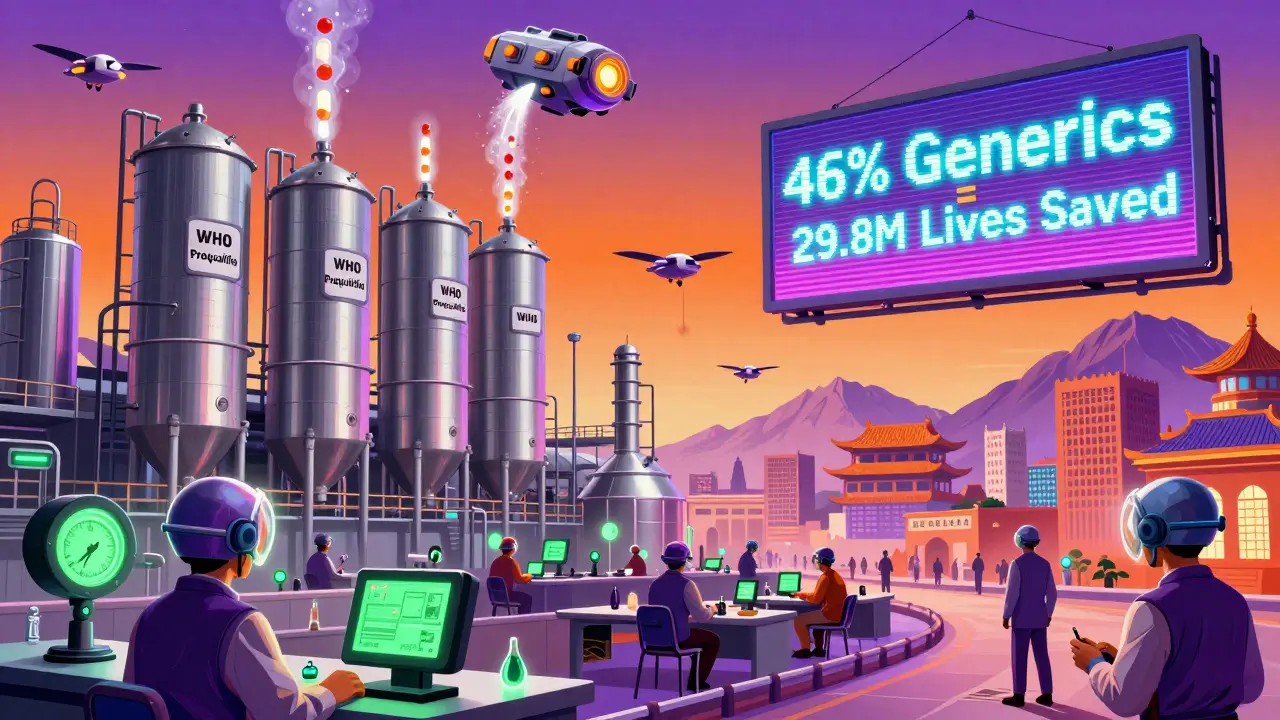
What’s striking is how few brands are included. The WHO doesn’t care if a drug comes from Pfizer or a small Indian manufacturer. It only cares if the medicine works and costs less. That’s why generics dominate the list. In fact, 46% of all medicines on the 2023 list are generics. And for those generics to be approved, they must pass WHO Prequalification-a global gold standard for quality. That means they’ve been tested to prove they deliver the same amount of active ingredient as the original brand, within strict limits: 80-125% bioequivalence for most drugs, and even tighter (90-111%) for drugs where small differences can be dangerous, like warfarin or epilepsy medications.
How Countries Use the List
Over 150 countries have built their own national essential medicines lists using the WHO Model List as a template. But adoption doesn’t mean access. In Ghana, aligning with the WHO list helped cut out-of-pocket medicine costs by 29% between 2018 and 2022. Pharmacists there say hypertension and diabetes drugs are now reliably available. In India, hospitals that followed WHO-recommended antibiotic tiers saw a 35% drop in antimicrobial spending.
But in Nigeria, a 2022 survey found only 41% of essential medicines were consistently in stock. The problem wasn’t the list-it was the supply chain. Medicine sat in warehouses in Lagos while clinics in rural areas went weeks without antiretrovirals or antibiotics. In many low-income countries, the gap isn’t in selection-it’s in delivery. Only 31% of these countries spend enough on pharmaceuticals to meet WHO’s recommended minimum of 15% of their total health budget.
High-income countries use the list differently. In the U.S., hospital pharmacies rarely consult the WHO Model List for daily decisions. Instead, they rely on domestic tools like Micromedex. But when U.S. hospitals run global health programs-say, in sub-Saharan Africa-they turn to the WHO list. It’s the only common language that works across borders.
Generics Are the Engine of Access
The real power of the WHO Model List lies in its unwavering push for generics. Generic drugs cost 80-95% less than branded versions. For HIV treatment, the price per patient per year dropped from $1,076 in 2008 to just $119 today. That’s how 29.8 million people now have access to antiretroviral therapy-up from 800,000 in 2003.
Generic manufacturers know this. Since 2018, the number of WHO-prequalified generic products has jumped 47%. Countries like India and China dominate production, making up 78% of global output. That’s efficient-but risky. During the pandemic, when supply chains broke, 62% of low-income countries reported shortages of key antibiotics. Relying on just a few suppliers creates fragility.
And not all generics are created equal. WHO surveillance found that 10.5% of essential medicine samples in low- and middle-income countries were substandard or falsified. Most were antibiotics and antimalarials. That’s why WHO Prequalification matters so much. It’s not just about price-it’s about trust. A medicine that’s cheap but ineffective is worse than no medicine at all.
How the Selection Process Works
The WHO doesn’t make these decisions alone. Every two years, a committee of 25 independent experts from 18 countries reviews over 200 proposals. They score each medicine across four areas: public health need (30%), efficacy and safety (30%), cost-effectiveness (25%), and whether it’s practical to use in real clinics (15%). A medicine needs at least a 7.5 out of 10 overall to make the list.
The process is transparent. All applications, meeting minutes, and voting records are public. But it’s not perfect. Critics point out that 45% of the evidence used in 2023 came from industry-funded trials, up from 28% in 2015. The WHO says it now requires full financial disclosures from all committee members-and it reports 100% compliance. Still, some experts worry about influence. For example, tranexamic acid was added for postpartum bleeding despite weaker evidence than other candidates-likely because of strong advocacy.
What’s New in 2023
The 2023 update introduced big changes. For the first time, it included specific rules for biosimilars-copies of complex biologic drugs like monoclonal antibodies used in cancer and autoimmune diseases. These now need to show 85-115% bioequivalence, tighter than traditional generics.
There’s also a stronger focus on kids. Forty-two percent of listed medicines now have pediatric formulations-up from 29% in 2019. That means more syrups, chewables, and lower-dose tablets instead of splitting adult pills, which can be dangerous.
The WHO also launched a free app in September 2023. It’s been downloaded over 127,000 times in 158 countries. Pharmacists in Tanzania, Bolivia, and Bangladesh use it to check dosing, alternatives, and storage requirements on the go.
Challenges and Criticisms
Despite its success, the list faces real limits. Only 12% of new drugs approved between 2018 and 2022 made it onto the 2023 list. In comparison, U.S. formularies include 35-45% of new drugs. The WHO argues it waits for proof of long-term benefit and cost-effectiveness. Critics say that delay costs lives, especially for rare diseases or cancer treatments that are expensive but life-extending.
Another issue: the list doesn’t tell countries how to implement it. It says “use this medicine,” but doesn’t say how to train staff, manage stockouts, or negotiate bulk prices. In 68% of low-income countries, health workers say they lack the tools to adapt the list to local realities. One nurse in Malawi told researchers, “We know we should use the WHO list, but we have no way to order the medicines, and no one checks if they’re expired.”
And then there’s lobbying. In Latin America, generic substitution policies are 32% less effective than in Africa, largely because branded drug companies push back harder. In some places, doctors are paid to prescribe brand-name versions-even when generics are cheaper and equally effective.
Why This Matters
The WHO Model List isn’t about controlling markets. It’s about saving lives with what works. Countries that follow it see 23-37% lower pharmaceutical spending and better health outcomes. It’s the reason a child in rural Kenya can get antibiotics for pneumonia. It’s why a mother in Bangladesh can afford insulin. It’s why global health programs can buy HIV drugs for pennies on the dollar.
Its greatest strength? It’s not tied to profit. It’s tied to need. And as long as diseases like tuberculosis, malaria, and diabetes continue to hit the poorest hardest, the WHO Model List will remain the most trusted guide for what medicines the world truly can’t do without.
Is the WHO Model List the same as a hospital formulary?
No. The WHO Model List is a global guideline for which medicines should be available based on public health need. A hospital formulary is a local list that decides which drugs the hospital will stock, often including cost tiers, approval rules, and prescribing restrictions. The WHO list informs formularies but doesn’t replace them.
Are all generics on the WHO list safe?
Only those that meet WHO Prequalification standards are included. These generics are tested to prove they’re bioequivalent to the original brand-meaning they deliver the same amount of active ingredient into the body. However, substandard or falsified medicines still enter markets outside official supply chains. WHO Prequalification is the best guarantee, but it doesn’t cover every generic on the market.
Why doesn’t the WHO list more new drugs?
The WHO waits for strong, long-term evidence on safety, effectiveness, and cost. Many new drugs are expensive and lack data on real-world use in low-resource settings. The list prioritizes medicines that help the most people, not the most novel ones. This makes it slower to update than national formularies, but more reliable for public health.
Can low-income countries afford to follow the WHO list?
Yes-that’s the whole point. The list is designed for affordability. By focusing on generics and cost-effective treatments, countries can stretch limited budgets. But the challenge isn’t the list-it’s funding supply chains, training staff, and managing stock. Without those, even the best list won’t help.
How often is the WHO Model List updated?
Every two years. The most recent update was in July 2023. The next is expected in 2025. Changes are based on new evidence, emerging diseases, and feedback from countries using the list.
Sidra Khan
December 25, 2025 AT 06:34Let’s be real-this list is basically the WHO’s way of saying ‘here’s what you’re allowed to care about.’ Meanwhile, in the U.S., we’re busy approving $200,000-a-year cancer drugs that help 3% of patients. The gap between what’s essential and what’s profitable is a canyon.
Usha Sundar
December 26, 2025 AT 17:37My cousin in Mumbai got a fake malaria pill last year. It didn’t kill him, but it nearly did. WHO prequalification saved my uncle’s life. Not everyone’s so lucky.
suhani mathur
December 27, 2025 AT 10:16Oh please. India makes 78% of these generics and you act like we’re some magical medicine fairyland. Half the time, the ‘prequalified’ batch gets rerouted to private clinics while public hospitals get the duds. The system’s rigged, not the list.
Ademola Madehin
December 29, 2025 AT 07:22Y’all talk about this list like it’s holy scripture but in Lagos, we wait 6 months for insulin and the pharmacy sells expired antibiotics like it’s Black Friday. This list is a beautiful poster on a wall while the whole damn house burns down. 🤬
Dan Gaytan
December 29, 2025 AT 20:05I work in global health logistics. The WHO list isn’t perfect, but it’s the only thing keeping millions alive. I’ve seen clinics in Malawi order via app and get the right meds in 3 weeks. That’s a miracle compared to 10 years ago. Progress isn’t perfect-it’s just real.
Andrea Di Candia
December 31, 2025 AT 00:16It’s funny how we treat medicine like it’s a product to be optimized, not a right to be protected. The WHO list doesn’t care about shareholders or quarterly earnings. It asks: who needs this? And then it says, yes, you deserve it. That’s radical in a world that measures worth in profit margins. Maybe the real crisis isn’t access-it’s our collective amnesia about what healthcare should even be.
Joe Jeter
December 31, 2025 AT 13:01Wait, so you’re telling me we shouldn’t use the latest cancer drug just because it’s expensive? That’s not evidence-based medicine-that’s rationing by ideology. If someone’s willing to pay $100K for a shot at life, why should a committee in Geneva decide they don’t deserve it? This list is paternalism dressed as altruism.
bharath vinay
December 31, 2025 AT 22:52And who funds these ‘independent experts’ again? Big Pharma pays for 45% of the evidence. You think they don’t lobby? Tranexamic acid got in because some rep flew 12 doctors to Geneva for a ‘retreat.’ The WHO’s not a saint-it’s a puppet with a UN flag.
claire davies
January 1, 2026 AT 20:14When I was in rural Zambia last year, a nurse showed me her phone with the WHO app open-she’d downloaded it after her daughter nearly died from a mis-dosed antibiotic. She didn’t know about bioequivalence percentages, but she knew that if the app said ‘use this,’ it meant her kid might live. That’s the quiet, unsexy miracle of this list: it turns abstract policy into a mother’s breath held for one more night. We forget that behind every generic pill is a child who didn’t die because someone, somewhere, refused to let profit decide who lives.
Lu Jelonek
January 2, 2026 AT 15:28There’s something quietly powerful about a list that doesn’t care who made the drug. In a world obsessed with brands-from iPhones to antidepressants-the WHO’s insistence on function over fame feels almost revolutionary. It doesn’t say ‘trust Pfizer.’ It says ‘trust science.’ And for people who’ve been burned by corporate promises, that’s more than a guideline-it’s a promise kept.