When to Test Anti-Xa Levels for LMWH: Signs That Side Effects Require Monitoring
 Jan, 18 2026
Anti-Xa Testing Decision Tool
Clinical Decision Support
This tool helps determine if anti-Xa testing is clinically indicated based on symptoms and kidney function. According to clinical guidelines, testing is not routine but required for specific complications.
Symptom Assessment
Testing Recommendation
Most people on low molecular weight heparin (LMWH)-like enoxaparin (Lovenox®), dalteparin (Fragmin®), or tinzaparin (Innohep®)-never need their blood tested for anti-Xa levels. The drug works predictably. Dosing is based on weight, and for most patients, it’s safe and effective without labs. But when things go wrong-when someone bleeds for no reason or develops a clot despite being on treatment-that’s when anti-Xa testing becomes critical.
Why Anti-Xa Testing Isn’t Routine
Anti-Xa testing measures how much LMWH is active in your blood by checking how well it blocks factor Xa, a key protein in clotting. It sounds simple, but it’s not meant for everyone. In 2021, the American College of Chest Physicians made it clear: routine anti-Xa monitoring for LMWH is unnecessary for most patients. That’s because LMWH has a stable, predictable effect in people with normal kidney function and average body weight. You don’t need a blood test to know it’s working-you just need to watch for signs it’s not.Studies show that in standard cases-like after hip surgery or for deep vein thrombosis prevention-monitoring anti-Xa levels doesn’t lower the risk of clots or bleeding. A 2015 analysis of over 12,000 patients found no benefit. And yet, many hospitals still order these tests out of habit. One audit from Ventura County Medical Center found that only 28% of anti-Xa tests were clinically justified. The rest? Routine checks after surgery, fear of liability, or misunderstanding the guidelines.
When Side Effects Demand a Blood Test
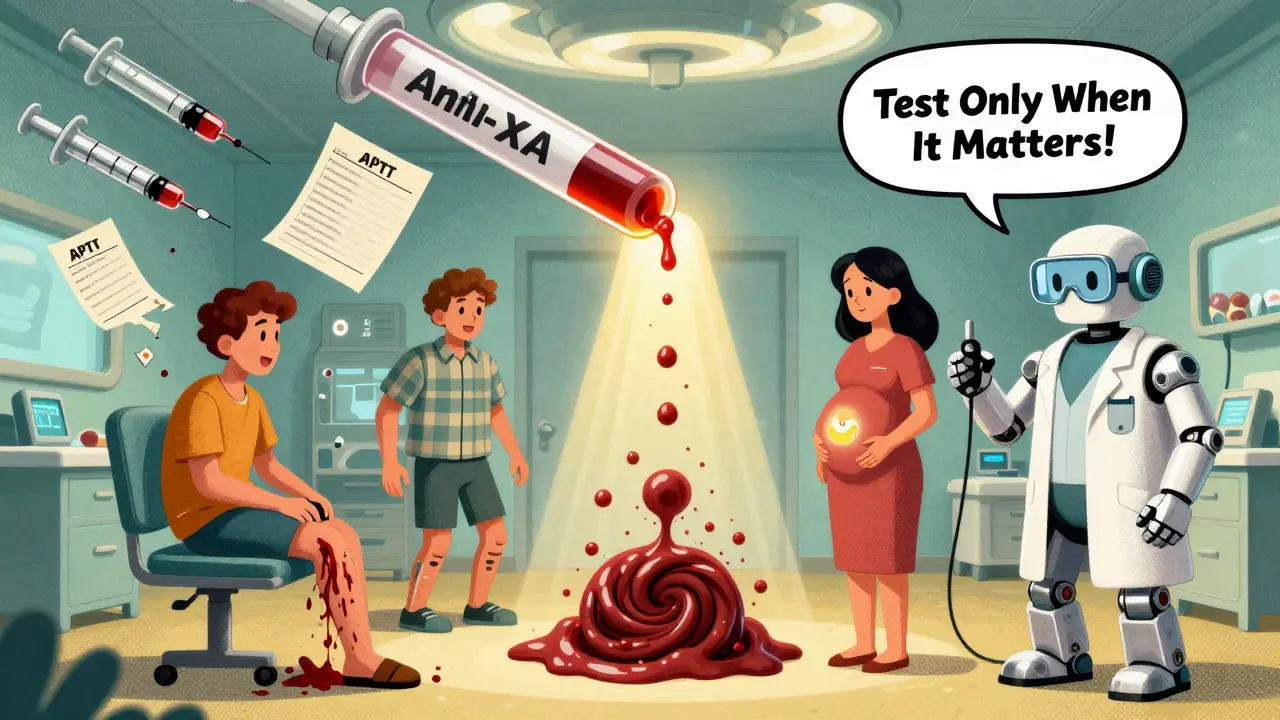
The real reason to check anti-Xa levels isn’t to confirm the drug is working-it’s to figure out why something went wrong. If you’re on LMWH and experience one of these red flags, testing should follow:- Unexplained bleeding: Bruising without injury, nosebleeds that won’t stop, blood in urine or stool, or a sudden drop in hemoglobin. Major bleeding, as defined by the International Society on Thrombosis and Haemostasis, is a clear trigger.
- Clotting despite treatment: If you develop a new blood clot-like a pulmonary embolism or deep vein thrombosis-while on a full therapeutic dose of LMWH, your levels might be too low. This is rare but serious.
- Severe kidney problems: If your creatinine clearance is below 30 mL/min, your body clears LMWH much slower. In end-stage kidney disease (CrCl <15 mL/min), the drug can build up to dangerous levels. A single dose can linger for 24 hours instead of 4-5.
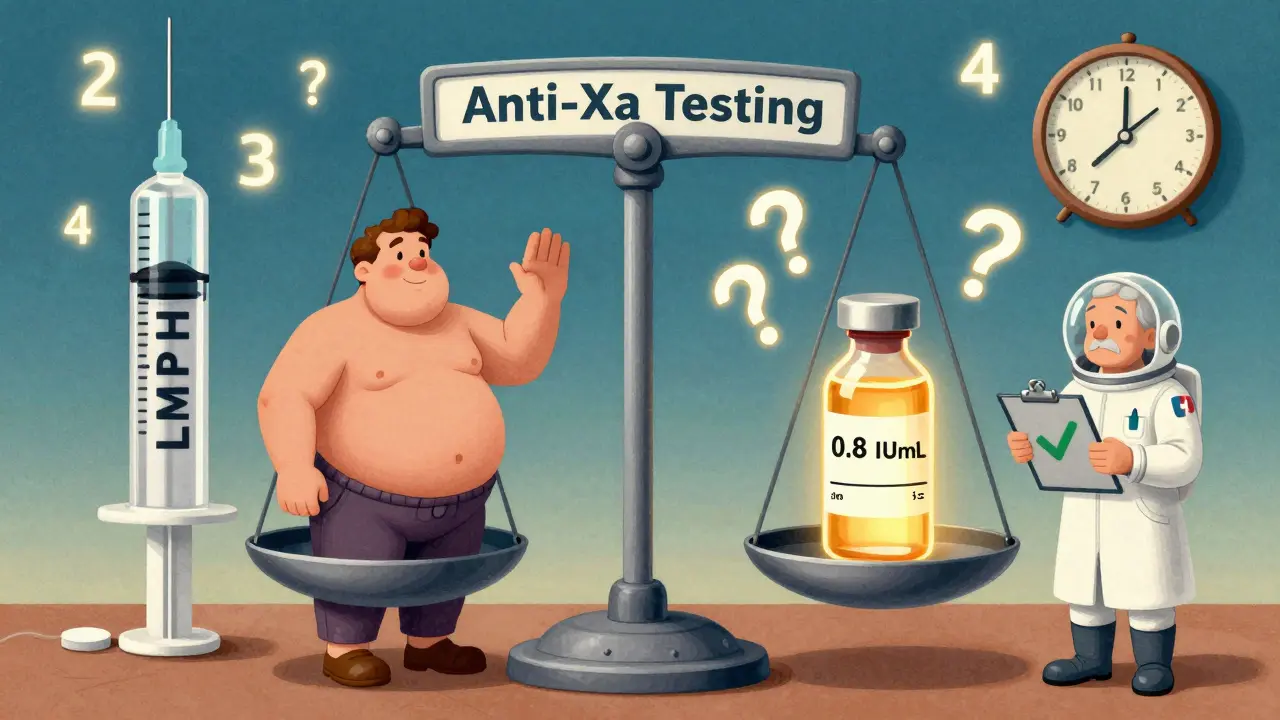
- Extreme body weight: People weighing more than 150 kg (330 lbs) or less than 40 kg (88 lbs) may not respond predictably to standard dosing. Obesity changes how the drug distributes in the body. Underweight patients may clear it too fast.
- Pregnancy: During pregnancy, especially in the third trimester, LMWH clearance increases. Target anti-Xa levels shift slightly lower (0.2-0.6 IU/mL), and monitoring helps avoid underdosing, which increases the risk of placental clots.
These aren’t theoretical concerns. In a 2018 Vanderbilt study, appropriate anti-Xa monitoring reduced bleeding complications by 37% in high-risk patients. But when doctors ordered the test without a clear reason-like checking levels after a routine knee replacement-the results often led to unnecessary dose reductions. One hospital audit found that 8% of inappropriate adjustments caused bleeding.
How the Test Works and What the Numbers Mean
Anti-Xa testing isn’t like a basic blood draw. Timing matters. You can’t just pull blood anytime. The sample must be taken 4 to 6 hours after the LMWH injection-this is the peak level. Drawing it too early or too late gives misleading results. Trough levels (right before the next dose) are rarely used for LMWH, unlike with unfractionated heparin.Here’s what the numbers mean:
- Prophylactic dose (preventing clots): Target range is 0.2-0.5 IU/mL
- Therapeutic dose (treating clots): Target range is 0.6-1.0 IU/mL
- Pregnancy (therapeutic): Target range is 0.2-0.6 IU/mL
These ranges are based on decades of research and are standardized in the 2023 CLSI H59-A guideline. But here’s the catch: not every lab measures the same way. There’s an 8-15% variation between labs due to different reagents and machines. A result of 0.8 IU/mL at one hospital might read 0.9 at another. That’s why doctors must interpret results in context-not in isolation.
Also, the test can’t tell you which LMWH you’re on. It can’t detect other blood thinners like rivaroxaban or apixaban. And it doesn’t predict bleeding risk in every patient. One study found that 41% of patients had supratherapeutic levels but no bleeding. That’s why you can’t treat a number-you have to treat the person.
Who Shouldn’t Get Tested
Anti-Xa monitoring is not a safety net for every patient on LMWH. Avoid testing in these cases:- Standard post-op prophylaxis in healthy adults
- Patients with normal kidney function and weight between 50-120 kg
- When the only reason is "we always check" or "the patient is worried"
- Before discharge if there are no symptoms
Dr. Sam Schulman, a leading expert in anticoagulation at McMaster University, puts it bluntly: "In obese patients, dosing by total body weight works fine. You don’t need to check levels unless something goes wrong." A 2017 study from Baptist Health System showed that 72% of clinical outcomes matched anti-Xa levels-but only when the test was used correctly. When ordered routinely, that number dropped to near random.
Cost is another factor. Each test runs $45-$75. In the U.S. Medicare population alone, unnecessary anti-Xa testing cost $28.7 million in 2019. That’s money spent on tests that didn’t change care.
What Happens After the Test
If your anti-Xa level is too low and you’ve had a clot, your dose may be increased. If it’s too high and you’ve bled, your dose may be lowered-or held temporarily. But here’s the key: you don’t adjust based on one number. You look at the whole picture. Did you just get a new infection? Are you on antibiotics that interact with LMWH? Did you miss a dose? Is your kidney function stable?At top hospitals like UC Davis and Vanderbilt, pharmacists lead anticoagulation review teams. They use structured algorithms to decide when to test and how to act. At one hospital, pharmacist-led order sets cut inappropriate testing by 63%. That’s not just saving money-it’s saving lives.
For example, a 320 kg trauma patient on enoxaparin might have a low anti-Xa level because the standard 40 mg dose isn’t enough. Adjusting to 60 mg twice daily based on weight and confirmed by anti-Xa testing can prevent fatal clots. On the flip side, an 80-year-old with CrCl of 18 mL/min who starts bleeding after a 40 mg dose may need to switch to a different anticoagulant entirely.
What’s Coming Next
The future of anti-Xa testing is precision-not volume. Point-of-care devices are being tested. Diagnostica Stago’s STA-R Max 3 system, for example, showed 92% accuracy compared to central labs in a 2022 study. That could mean faster decisions in the ER or ICU.But the trend is clear: fewer tests, smarter tests. By 2028, experts predict anti-Xa monitoring will be used in only 8-10% of LMWH prescriptions-focused on those who truly need it: the very obese, the very old, the very sick, and the pregnant. The goal isn’t to test everyone. It’s to test the right person at the right time.
If you’re on LMWH and feel something’s off-unusual bruising, swelling, dizziness, or pain-don’t wait for a routine check. Talk to your doctor. Ask: "Could this be related to my blood thinner? Should we check my anti-Xa level?" That’s how you avoid complications-not by testing blindly, but by responding wisely.
Do I need to get my anti-Xa levels checked regularly if I’m on Lovenox?
No, routine anti-Xa monitoring is not recommended for most people on Lovenox or other LMWHs. These drugs work predictably in patients with normal kidney function and average weight. Testing is only needed if you have unexpected side effects like bleeding or a new blood clot, or if you have severe kidney disease, extreme body weight, or are pregnant.
What’s the difference between anti-Xa and aPTT testing?
aPTT is used to monitor unfractionated heparin, which affects multiple clotting factors. LMWH works mainly through factor Xa, so aPTT is unreliable for it. Anti-Xa testing directly measures the drug’s effect on factor Xa and is the only accurate way to assess LMWH levels. Studies show anti-Xa levels correlate with outcomes 72% of the time, compared to just 58% for aPTT.
Can anti-Xa levels predict if I’ll bleed?
Not reliably on their own. Some patients have high anti-Xa levels without bleeding, and others bleed even with normal levels. The test tells you how much drug is in your blood, not whether you’re at risk for bleeding. Clinical context-like age, kidney function, recent surgery, or other medications-is just as important.
How long after my LMWH shot should the blood be drawn?
For accurate results, blood should be drawn 4 to 6 hours after your injection. This is when the drug reaches its peak level in your bloodstream. Drawing it too soon or too late can give false readings. Always tell the lab when you last took your dose.
What if my anti-Xa level is high but I feel fine?
Don’t automatically reduce your dose. A high level alone doesn’t mean you’re at risk. Many patients have supratherapeutic levels without any bleeding. Talk to your doctor about your overall health-your kidney function, recent injuries, other meds, and symptoms. Only adjust the dose if there’s a clear clinical reason.
Is anti-Xa testing covered by insurance?
Yes, if it’s medically necessary. Medicare and most private insurers cover anti-Xa testing when ordered for approved indications like renal impairment, extreme weight, pregnancy, or unexplained bleeding/clotting. Routine or inappropriate testing may be denied. Always check with your provider and ensure the reason for testing is clearly documented in your chart.
Edith Brederode
January 19, 2026 AT 13:46Been on Lovenox for 8 months post-knee surgery and never had a single test. Zero bleeding, zero clots. If it ain’t broke, don’t fix it. 🙌
clifford hoang
January 21, 2026 AT 07:16They don’t test because the pharmaceutical companies don’t want you to know. Anti-Xa tests cost money, sure-but what if they’re hiding that 40% of people are under-dosed? The system’s rigged. 🤫💉
Arlene Mathison
January 22, 2026 AT 05:56OMG YES. My uncle bled out after hip surgery because they didn’t check his levels-he had stage 4 kidney disease and no one caught it. This isn’t just theory, this saves lives. If you’re on LMWH and have any risk factors, push for the test. Seriously. 💪
Emily Leigh
January 23, 2026 AT 13:43So… you’re saying we don’t need tests? But what if… I mean, what if… we just… don’t? 😐
Carolyn Rose Meszaros
January 24, 2026 AT 06:26I work in med admin and see these tests ordered all the time for no reason. It’s like they’re checking for ghosts. But when someone’s bleeding out? Then it’s a lifesaver. 🙏
Greg Robertson
January 24, 2026 AT 14:23My nurse practitioner always says, ‘Watch for signs, not numbers.’ And honestly? She’s right. I’ve had three friends on LMWH-none had tests, all did fine. Just pay attention to your body. 😊
Renee Stringer
January 26, 2026 AT 03:14People are so careless with anticoagulants. This isn’t aspirin. You’re playing with fire if you assume it’s ‘fine’ without monitoring. This post is dangerously oversimplified.
Courtney Carra
January 27, 2026 AT 05:30There’s a philosophical tension here: the illusion of control versus the reality of predictability. We test because we fear the unknown, not because the unknown needs knowing. Anti-Xa levels are a ritual, not a necessity. The body knows what it’s doing. We just forget to listen.
Thomas Varner
January 27, 2026 AT 10:12Had a roommate in med school who got a pulmonary embolism on Lovenox. Turned out his creatinine clearance was 22-he was in renal failure and no one checked. That’s the exact moment you need the test. Don’t wait until it’s too late.
Manoj Kumar Billigunta
January 28, 2026 AT 13:27My cousin in India was on dalteparin after stroke. He had kidney issues. Doctor tested anti-Xa-turns out he was over-dosed. Saved him from internal bleeding. This isn’t just Western medicine-it’s global truth. Always check if kidneys are weak. Simple. Safe. Smart.
Nadia Watson
January 29, 2026 AT 08:19While the evidence supports non-routine monitoring, it is imperative to acknowledge that clinical discretion, particularly in the presence of comorbid renal impairment, remains a cornerstone of patient safety. Oversight in such contexts may constitute a deviation from best practices.
thomas wall
January 30, 2026 AT 11:31It is not merely negligence-it is a systemic failure of medical education. To assume LMWH is ‘predictable’ is to ignore the variability of human physiology. This is not science. It is complacency dressed in guidelines.
Jacob Cathro
January 31, 2026 AT 20:07LMWH? More like LAMEWH. Why do hospitals even have these tests if they’re ‘not needed’? Sounds like a money grab to me. Also, ‘CrCl’? Bro, spell it out. I’m not a lab tech.