Sterile Manufacturing: Special Requirements for Injectable Pharmaceuticals
 Jun, 15 2026
Imagine a single microbe entering your bloodstream. It doesn't just cause an infection; it can trigger sepsis, organ failure, or death. This is why sterile manufacturing is the pharmaceutical production process conducted in environments completely free from microorganisms and particulates, specifically designed for products that bypass the body's natural defenses. Unlike oral pills, which face the harsh acid of your stomach, injectables go straight into your veins. There is no second chance. If a vial of insulin or a bag of IV fluids is contaminated, the consequences are immediate and severe.
The stakes have always been high. In the 1920s, contaminated insulin caused patient deaths, sparking early calls for stricter controls. Later, the 1955 Cutter Laboratories polio vaccine incident led to the FDA’s Good Manufacturing Practice (GMP) regulations in 1963. Today, the World Health Organization (WHO) demands that injectables have a contamination probability of less than one in one million-a metric known as the Sterility Assurance Level (SAL) of 10^-6. This isn't just bureaucracy; it’s a lifeline. The 2012 New England Compounding Center meningitis outbreak, which infected 751 people and killed 64, remains a stark reminder of what happens when these standards slip.
Two Paths to Sterility: Terminal vs. Aseptic Processing
When manufacturers produce injectables, they generally choose between two methods: terminal sterilization or aseptic processing. Each has distinct advantages, costs, and limitations.
Terminal sterilization is a method where the product is sealed in its final container before being exposed to heat, radiation, or chemicals to kill all microbes. Think of it like pressure-cooking food until every pathogen is dead. Steam at 121°C for 15-20 minutes or gamma radiation at 25-50 kGy doses are common techniques. The FDA prefers this method because it provides a robust safety net. However, only about 30-40% of injectable products can survive such intense treatment. Heat-sensitive biologics, like monoclonal antibodies (mAbs), would denature and become useless if subjected to high temperatures.
For those sensitive drugs, manufacturers rely on aseptic processing is a manufacturing technique that maintains sterility throughout production without a final sterilization step. Here, every component-water, containers, stoppers-is sterilized individually before assembly. The filling itself happens in ultra-clean zones where not even a speck of dust is tolerated. While this preserves the drug’s integrity, it carries higher risk. According to Oakwood Labs (2022), terminal sterilization costs around $50,000 per batch for a 1,000L bioreactor run, whereas aseptic processing jumps to $120,000-$150,000 due to stricter facility requirements and extensive testing.
| Feature | Terminal Sterilization | Aseptic Processing |
|---|---|---|
| Sterility Method | Heat/Radiation after sealing | Controlled environment during assembly |
| Applicability | 30-40% of injectables (heat-stable) | Biologics, mAbs, heat-sensitive drugs |
| Cost per Batch (1,000L) | ~$50,000 | $120,000 - $150,000 |
| Risk Profile | Low (post-process validation) | Higher (depends on human/environmental control) |
| FDA Preference | Preferred | Accepted when terminal sterilization is impossible |
The Cleanroom Environment: ISO Standards and Airflow
You can’t make sterile drugs in a regular factory. You need a controlled environment governed by ISO 14644 cleanroom standards define international benchmarks for air cleanliness based on particle counts per cubic meter. These standards classify rooms from ISO 8 (least clean) to ISO 1 (cleanest). For injectables, the progression is strict:
- ISO 8 (Class 100,000): Used for gowning areas where workers don their protective suits.
- ISO 7 (Class 10,000): Support areas like vial washing or preparation.
- ISO 5 (Class 100): The core aseptic filling zone where the product is exposed. This area must maintain fewer than 3,520 particles ≥0.5μm per cubic meter.
Airflow is critical. Unidirectional airflow moves at 0.3-0.5 meters per second, sweeping contaminants away from the product. Pressure differentials of 10-15 Pascals between adjacent rooms ensure air flows from cleaner to less clean areas, preventing backdrafts. Temperature stays between 20-24°C, and humidity is controlled at 45-55% RH to prevent static electricity and microbial growth.
Water quality is equally vital. Water for Injection (WFI) is high-purity water used in pharmaceutical manufacturing that meets strict endotoxin limits. Under USP <85>, WFI must contain less than 0.25 Endotoxin Units (EU) per mL. To achieve this, facilities often use multi-stage purification systems including reverse osmosis and distillation. All containers must also be depyrogenated-heated to 250°C for 30 minutes-to destroy pyrogens, substances that can cause fever even if the bacteria themselves are dead.
Technology Barriers: RABS vs. Isolators
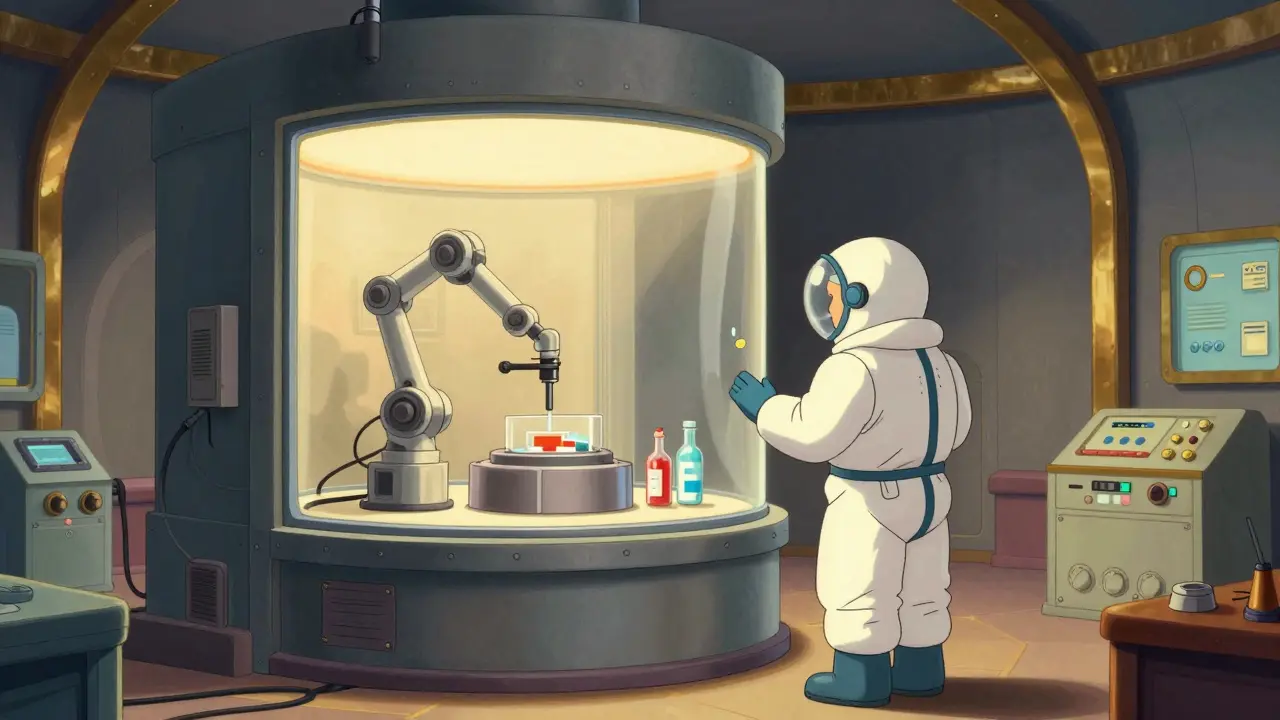
Human error is the biggest threat in aseptic processing. To mitigate this, manufacturers use physical barriers. Two main technologies dominate: Restricted Access Barrier Systems (RABS) and isolators.
Restricted Access Barrier Systems (RABS) are enclosures with glove ports that separate operators from the critical zone while allowing manual intervention. They offer a balance of flexibility and protection. However, gloves can tear, and operator movements can disrupt airflow. A senior manager at a top pharma company reported three media fill failures in Q2 2023 due to glove defects in their RABS, costing $450,000 in lost batches.
Isolators are completely enclosed, gas-tight chambers where all operations are performed via robotic arms or integrated glove ports. Dr. James Akers notes that isolators reduce contamination risk by 100-1,000 fold compared to traditional cleanrooms. Renpharm’s 2023 whitepaper claims isolators achieve 0.01 CFU/m³ versus 0.1 CFU/m³ for RABS. But there’s a catch: capital investment is 40% higher, and automation complexity increases. The Parenteral Drug Association (PDA) argues that properly operated RABS can match isolator performance with less operational hassle. The choice depends on budget, product sensitivity, and volume.
Validation and Monitoring: Proving Sterility
How do you prove a process is sterile? You can’t test every single vial. Instead, you validate the entire system. Media fill simulations are the gold standard. Operators simulate the filling process using nutrient broth instead of drug solution. If any bacteria grow in the broth after incubation, the process fails. The FDA states that media fill failure rates above 0.1% indicate inadequate process control.
Environmental monitoring is continuous. Particle counters measure airborne dust, while microbial air samplers check for viable organisms. In ISO 5 areas, the alert level is 1 Colony Forming Unit (CFU) per cubic meter, and the action level is 5 CFU/m³. Dr. Jeanne Moldenhauer emphasizes that viable particle monitoring must achieve <1 CFU per 1,000L air sampled during actual manufacturing. Recent updates to EU GMP Annex 1 (2022) mandate continuous monitoring rather than periodic checks, reflecting a shift toward real-time data analytics.
Personnel training is non-negotiable. Workers undergo 40-80 hours of aseptic technique training and must pass semi-annual media fill qualifications. The FDA’s 2023 Form 483 observations show that 22% of deficiencies stem from inadequate personnel training. Humans are unpredictable; protocols must account for fatigue, distraction, and variability.
Regulatory Landscape and Market Trends
The regulatory framework for sterile manufacturing is global but fragmented. Key standards include:
- FDA 21 CFR Parts 210 & 211: US regulations governing current GMP for finished pharmaceuticals.
- EU GMP Annex 1 (Revised 2022): Stricter European guidelines emphasizing continuous monitoring and Quality Risk Management (ICH Q9).
- WHO Technical Report Series No. 961: Global benchmark for sterility assurance and inspection practices.
Market demand is soaring. The global sterile injectables market reached $225 billion in 2023, growing at an 8.2% CAGR. Biologics drive 65% of this growth, with monoclonal antibodies representing 32% of new drug approvals. Over 40% of new drugs require sterile formulations. Contract Manufacturing Organizations (CDMOs) now handle 55% of production, with Catalent, Lonza, and Thermo Fisher Scientific dominating the space.
Yet, compliance is harder than ever. FDA inspection citations for sterile manufacturing rose from 1,245 in 2019 to 1,872 in 2022. Emerging markets like China and India are expanding capacity, but only 28 of 1,200 Chinese facilities passed FDA inspections in 2022. Facilities must invest $15-25 million in Annex 1 compliance upgrades by 2025, according to EY analysis.
Future Innovations: Automation and Digital Twins
The future of sterile manufacturing lies in reducing human interaction. McKinsey projects a 40% growth in robotic filling systems by 2027. Closed processing systems, adopted by 65% of new facilities in 2023, eliminate manual interventions entirely. Rapid microbiological methods are cutting test times from 14 days to 24 hours, speeding up batch release.
Digital twins-virtual replicas of physical processes-are emerging for simulation and predictive maintenance. The FDA’s 2024-2026 strategic plan aims to reduce deficiencies by 25% through AI-driven inspection tools. As technology advances, the goal remains unchanged: zero contamination. Because in sterile manufacturing, perfection isn’t optional-it’s survival.
What is the difference between terminal sterilization and aseptic processing?
Terminal sterilization involves sterilizing the product after it is sealed in its final container using heat or radiation. Aseptic processing keeps the product sterile throughout manufacturing by assembling pre-sterilized components in a controlled environment. Terminal sterilization is preferred by regulators but cannot be used for heat-sensitive biologics.
Why are cleanrooms classified by ISO standards?
ISO 14644 standards classify cleanrooms based on the number of particles allowed per cubic meter. Higher classes (like ISO 5) have stricter limits to prevent contamination. For injectables, ISO 5 is required in filling zones to ensure minimal particulate exposure.
What is a media fill simulation?
A media fill is a validation test where operators simulate the manufacturing process using nutrient broth instead of the drug. If bacteria grow in the broth, it indicates potential contamination risks in the actual process. Failure rates above 0.1% signal inadequate control.
How much does it cost to set up a sterile manufacturing facility?
Setting up a small-scale sterile facility requires $50-100 million in capital investment. Additional costs include ongoing environmental monitoring, personnel training, and compliance upgrades, which can add $15-25 million for recent regulatory changes.
What role do isolators play in sterile manufacturing?
Isolators are fully enclosed chambers that separate operators from the product, significantly reducing contamination risk. They are more expensive than RABS but offer superior protection, especially for high-value biologics.
Frank Polster
June 17, 2026 AT 03:46Oh, look at us, playing god with syringes. Because nothing says 'trust the process' like hoping your monoclonal antibody didn't pick up a hitchhiker in an ISO 5 cleanroom while some guy named Dave sneezed in his gown three rooms away. The cost difference is hilarious too. You want to pay triple for the privilege of having a human being manually fill vials in a bubble? Sure, why not. Let's just throw money at the problem instead of fixing the fact that humans are inherently dirty.
Hema Khimasia
June 18, 2026 AT 01:55The epistemological framework of sterile manufacturing rests on the paradoxical nature of proving a negative; one cannot empirically verify sterility through destructive testing of the final product without rendering it useless, thus necessitating reliance on probabilistic models and environmental controls rather than direct observation. The distinction between terminal sterilization and aseptic processing is not merely technical but philosophical, representing a divergence between the certainty of post-process validation and the inherent uncertainty of maintaining a state of non-contamination throughout dynamic assembly. This dichotomy forces manufacturers to choose between the robustness of heat-induced lethality, which compromises thermolabile biologics, and the precarious elegance of aseptic technique, where the Sterility Assurance Level (SAL) of 10^-6 serves as a statistical promise rather than an absolute guarantee. The historical precedents, such as the Cutter Laboratories incident, underscore the catastrophic potential when these abstract probabilities fail to materialize into safety, reminding us that regulatory frameworks are often reactive constructs born from tragedy rather than proactive safeguards. Furthermore, the implementation of Restricted Access Barrier Systems (RABS) versus isolators introduces a layer of operational complexity that challenges the traditional boundaries of human-machine interaction in pharmaceutical production, raising questions about the extent to which automation can truly eliminate the variable of human error. The economic implications, with aseptic processing costing significantly more per batch, reflect the premium placed on preserving the structural integrity of complex molecules over the simplicity of thermal sterilization. Ultimately, the pursuit of sterility is a continuous negotiation between scientific rigor, economic feasibility, and the ethical imperative to prevent harm, a balance that remains perpetually unstable in the face of evolving biological threats and manufacturing scales.
Tucker Brown
June 19, 2026 AT 00:10They tell you it's about safety, but have you ever noticed how every major update to GMP regulations coincides with new patent expirations or consolidation among big pharma? It's convenient how 'contamination risks' suddenly spike right before generics enter the market. I don't trust the FDA's preference for terminal sterilization; it's just a way to keep smaller players out who can't afford the massive infrastructure required for those high-pressure steam systems. They want you scared so you buy their expensive, 'safe' branded drugs instead of questioning why the supply chain is so fragile.
krystal Live
June 20, 2026 AT 15:42omg this is soo important!! i wasnt aware that water quality had to be that strict. like wow. we need to make sure our doctors are doing everything right!! 💉✨
Stephanie Cree
June 21, 2026 AT 14:46It is absolutely scandalous! 😡 How dare they risk our health?! The very idea that a single microbe could enter our bloodstream is terrifying! We must demand better! Better standards! Better oversight! I simply cannot believe that any reputable facility would even consider aseptic processing without triple-checking every glove port! It’s negligent! Unforgivable! And don’t get me started on the humidity levels-45-55% RH? Who decided that?! It should be ZERO moisture! Zero tolerance! If you’re not sweating bullets in that cleanroom, you’re not trying hard enough! 🙄💅
Bruno Sarri
June 23, 2026 AT 09:16I appreciate the detailed breakdown here. It’s easy to overlook the sheer amount of engineering and protocol that goes into something as simple as a vial of insulin. For those working in QA or production, the stress of media fill failures is real. That $450k loss mentioned for glove defects isn’t just a number; it’s months of work and team morale taking a hit. It’s crucial we support the teams managing these environments because the margin for error is genuinely non-existent. Respect to everyone maintaining those ISO 5 zones.
ankit agarwal
June 24, 2026 AT 12:40The paradigm shift towards isolators is inevitable given the stochastic nature of human intervention in RABS environments. While the capital expenditure is prohibitive, the long-term ROI through reduced batch rejection rates and enhanced data integrity makes the transition logical for high-value biologics. We must leverage automation not just for compliance but for strategic competitive advantage in the global supply chain. The future belongs to those who can decouple sterility assurance from human variability entirely. Let’s optimize!
Alyssa Smith
June 25, 2026 AT 08:46This is such a fascinating look behind the curtain! It really highlights how much science and care goes into keeping us safe. I’m always amazed by the precision required in these facilities. Thank you for sharing this informative piece!