Statins and Antifungals: What You Need to Know About This Dangerous Drug Interaction
 Feb, 1 2026
When you’re taking a statin to manage your cholesterol and then get a fungal infection-maybe a stubborn yeast infection or toenail fungus-it’s easy to assume your doctor will just write you a prescription for an antifungal and you’re good to go. But here’s the thing: statins and some antifungals can dangerously mix. This isn’t a minor side effect. It’s a real risk for muscle breakdown, kidney failure, and even death.
Why This Interaction Happens
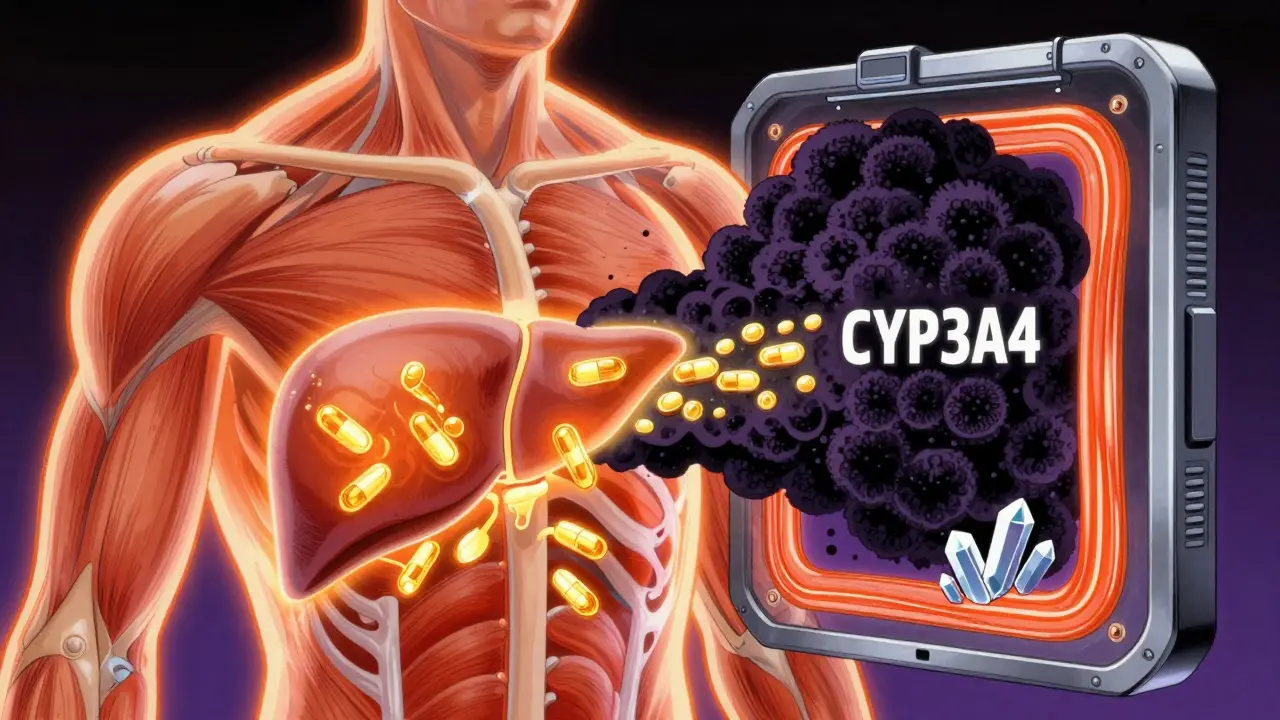
Statins like simvastatin, atorvastatin, and lovastatin don’t just lower cholesterol. They’re broken down in your liver by a group of enzymes called CYP3A4. Azole antifungals-drugs like itraconazole, ketoconazole, and voriconazole-are powerful at killing fungi because they block a different enzyme in fungal cells. But here’s the catch: they also block your CYP3A4 enzymes. When that happens, your body can’t clear the statin properly. The statin builds up in your blood like a clogged drain.That buildup leads to a condition called rhabdomyolysis. Your muscles start breaking down, releasing a protein called myoglobin into your bloodstream. Your kidneys can’t handle it. CK levels-the marker doctors check-can spike over 15,000 U/L in severe cases. Normal is under 200. One patient in a 2023 case report had CK levels over 15,000 after starting fluconazole while on simvastatin. They ended up in the ER.
Not All Statins Are Created Equal
This isn’t a blanket warning for every statin. Some are much safer to take with antifungals because they don’t rely on CYP3A4 to break down.- High risk: Simvastatin, lovastatin, atorvastatin (all metabolized by CYP3A4)
- Moderate risk: Fluvastatin (metabolized by CYP2C9-fluconazole can interfere here too)
- Low risk: Pravastatin, rosuvastatin (mostly cleared by the kidneys, not the liver)
That’s why doctors often switch you from simvastatin to rosuvastatin if you need an antifungal. The change isn’t just a formality-it’s life-saving. A 2022 survey found that 87% of patients who made this switch stayed in control of their cholesterol without any muscle pain or complications.
Which Antifungals Are the Worst Culprits?
Not all antifungals are equal either. Some are far more dangerous when paired with statins.- High danger: Itraconazole, ketoconazole, voriconazole (strong CYP3A4 blockers)
- Moderate danger: Fluconazole (blocks CYP2C9, affects fluvastatin more than others)
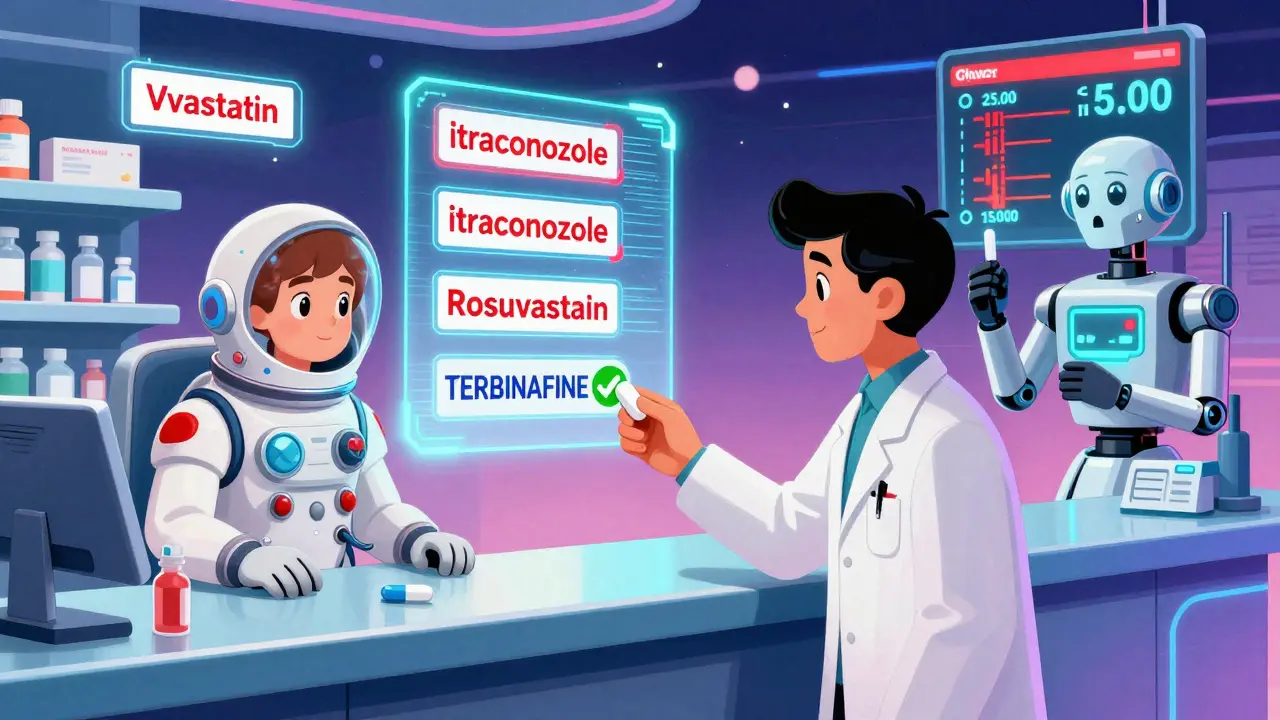
- Safer options: Terbinafine, nystatin, clotrimazole (topical or non-CYP inhibitors)
Terbinafine is often the go-to for toenail fungus because it doesn’t interfere with statins at all. Topical treatments like clotrimazole cream or nystatin mouthwash are even safer-they barely enter your bloodstream. If you have a skin yeast infection, ask your doctor: “Can we try a cream first?” Many times, the answer is yes.
What Happens If You Don’t Take Action?
A 2016 BMJ Case Report documented a man on simvastatin who took itraconazole for a fungal lung infection. Within two weeks, he couldn’t walk. His muscles were in constant pain. His CK levels were 10 times higher than normal. A muscle biopsy confirmed rhabdomyolysis. He spent 12 days in the hospital. He survived, but he’ll never take that combo again.It’s not rare. Pharmacists in Vancouver and Toronto report catching 10-15 dangerous combinations each month. Most involve simvastatin and itraconazole-often prescribed for what seems like a simple fungal nail infection. The problem? Many doctors don’t know the details. A 2023 JAMA study found only 42% of primary care physicians could correctly identify which statin-azole pairs are dangerous.
What You Should Do Right Now
If you’re on a statin and your doctor wants to prescribe an antifungal, don’t just say yes. Ask these questions:- Is this antifungal really necessary? Could a topical cream work instead?
- Which antifungal are you prescribing? Is it itraconazole, fluconazole, or something else?
- Which statin am I on? Is it simvastatin, atorvastatin, or another?
- Can we switch me to pravastatin or rosuvastatin during this treatment?
- If we can’t switch, should I pause my statin for a few days before and after the antifungal?
The Dybro protocol-temporarily stopping the statin 2 days before and 2 days after antifungal use-is a proven safety net. It’s not perfect, but it’s better than risking muscle damage.

The Silver Lining: A Potential Benefit
Here’s something surprising: some research suggests statins might actually help fight fungi. Studies from 2012 and 2020 show that statins like fluvastatin and atorvastatin can weaken Candida yeast when used with azoles. In lab tests, the combo was more effective than either drug alone. That’s why a major NIH trial called STATIN-AF is now recruiting 2,500 patients to see if combining these drugs could treat drug-resistant Candida auris infections.But here’s the catch: that benefit only shows up in controlled, monitored settings. At home, with no lab oversight, the risk of toxicity far outweighs any possible benefit. Don’t try to self-experiment. This isn’t a DIY treatment.
What’s Changing in 2026
Electronic health records are finally catching up. Epic Systems rolled out automated alerts in late 2024 that warn doctors when they try to prescribe itraconazole with simvastatin. That’s a big step. But alerts aren’t foolproof. If your doctor doesn’t use Epic-or if they’re in a rush-they might still miss it.Regulators are paying attention too. The FDA tightened simvastatin labeling in 2022, explicitly banning it with itraconazole. The EMA did the same in 2023. But those rules mean nothing if you’re not aware of them.
Bottom Line: Don’t Guess. Ask.
You’re not being difficult if you ask your doctor about this interaction. You’re being smart. Millions of people take statins. Millions more get fungal infections every year. The overlap is huge-and the consequences are serious.Don’t wait for symptoms like muscle pain, weakness, or dark urine. Those are red flags, but by then, damage may already be done. If you’re on a statin and need an antifungal, make this your first question: “Could this interact with my cholesterol medicine?”
And if your doctor says, “It’s fine,” ask for the name of the antifungal and look it up yourself. A quick search for “[drug name] + statin interaction” will show you the facts. You’re your own best advocate.
Can I take fluconazole with my statin?
It depends on which statin you’re taking. Fluconazole is less dangerous than itraconazole, but it still interferes with fluvastatin and can slightly raise levels of atorvastatin. If you’re on simvastatin or lovastatin, avoid fluconazole. If you’re on pravastatin or rosuvastatin, it’s usually safe. Always check with your doctor or pharmacist.
What are the signs of rhabdomyolysis?
Severe muscle pain, especially in the shoulders, thighs, or lower back; muscle weakness; dark, tea-colored urine; and unexplained fatigue. If you have these symptoms while taking a statin and an antifungal, go to the ER immediately. CK levels above 5,000 U/L are a medical emergency.
Is there a safe statin to take with itraconazole?
No. Itraconazole is a strong CYP3A4 inhibitor and should never be taken with simvastatin, lovastatin, or atorvastatin. If you need itraconazole, your doctor should switch you to pravastatin or rosuvastatin first. Never take itraconazole with any CYP3A4-metabolized statin.
Can I use antifungal cream instead of pills?
Yes, and you should ask about it. For skin, vaginal, or oral yeast infections, topical creams like clotrimazole or nystatin are often just as effective as pills-and they don’t enter your bloodstream enough to interact with statins. For toenail fungus, terbinafine pills are a safer oral option than fluconazole or itraconazole.
Should I stop my statin if I’m prescribed an antifungal?
Only if your doctor advises it. For high-risk combinations like simvastatin and itraconazole, the safest approach is to switch to pravastatin or rosuvastatin. If that’s not possible, your doctor may ask you to pause your statin for 2-5 days around the antifungal course. Never stop your statin on your own without medical guidance-it can cause your cholesterol to spike.
Solomon Ahonsi
February 2, 2026 AT 23:51This is why I stopped trusting doctors after my cousin ended up in the ICU over a simple toenail fungus script. They just slap on prescriptions like it’s a vending machine. Statins? Antifungals? Whatever. Just take it. No one checks for interactions unless you scream about it first.
George Firican
February 4, 2026 AT 16:38It’s fascinating how medicine still operates like a series of isolated silos-cardiologists prescribe statins, dermatologists prescribe antifungals, and somehow the liver is expected to mediate the ceasefire on its own. The CYP3A4 enzyme isn’t just a metabolic pathway; it’s a battlefield where pharmaceuticals wage silent war, and patients are the collateral. We’ve mechanized treatment but forgotten integration. The fact that 58% of primary care physicians can’t recall which statin-azole combos are lethal speaks less to ignorance and more to systemic fragmentation. If your body’s biochemistry is this complex, shouldn’t our prescribing protocols reflect that? We’re treating symptoms with disconnected tools while ignoring the symphony of physiology beneath.
Matt W
February 5, 2026 AT 01:27Thank you for posting this. My mom was on simvastatin and got prescribed fluconazole for a yeast infection last year. She started feeling like she’d been hit by a truck-muscles aching, dark urine, couldn’t climb stairs. We rushed her to urgent care and they found her CK at 12,000. Switched her to rosuvastatin and terbinafine for the fungus. She’s fine now, but it scared the hell out of us. Please, if you’re on statins, ask before you take anything new. Seriously.
Anthony Massirman
February 6, 2026 AT 00:21Don’t take pills for toenail fungus. Just cut it off and use tea tree oil. Done.
Ellie Norris
February 6, 2026 AT 14:29Just a quick note-terbinafine isn't always safe either. I had a friend who got liver toxicity from it after 3 weeks. Always get baseline LFTs before starting. Also, rosuvastatin can still cause muscle pain in some folks, even if it's not CYP3A4 related. Just sayin'-don't assume 'low risk' means 'no risk'. :)
Akhona Myeki
February 7, 2026 AT 13:02In South Africa, we don’t have the luxury of choosing between rosuvastatin and simvastatin-most clinics only stock the cheapest. Your ‘life-saving switch’ is a Western privilege. Meanwhile, patients are told to ‘take both and hope’. This isn’t medical negligence-it’s economic brutality. Your blog post reads like a luxury guide for those who can afford to ask questions. For the rest of us, it’s just another footnote in a system that doesn’t care if we live or die.
Bridget Molokomme
February 8, 2026 AT 12:52So let me get this straight-your doctor prescribes you a pill to lower cholesterol, then another pill to kill fungus, and you’re supposed to know which one might melt your muscles? And the system expects you to Google it like a detective? This isn’t healthcare. It’s Russian roulette with a prescription pad.
Becky M.
February 9, 2026 AT 01:04my dr just switched me from atorvastatin to pravastatin before my fluconazole course and i was so relieved. i didnt even know this was a thing until i read your post. thank you. i’ve been having weird muscle twitches lately and now i think it was the combo. i’ll be more careful from now on. also, topical clotrimazole for vaginal yeast is a game changer-no pills, no risk. i wish more people knew this.
Hannah Gliane
February 10, 2026 AT 12:23OMG I can’t believe people still take itraconazole with statins 😭 I mean, really? Are we still in 2010? The FDA banned this combo YEARS ago. If your doctor is still doing this, fire them. And if you’re one of those people who says ‘but my cousin took it and lived’-congrats, you’re the outlier. The rest of us don’t want to be your cautionary tale. 🚫💊🩸