Single-Source vs Multi-Source Drugs: What Patients Need to Know About Cost, Choice, and Confidence
 Feb, 11 2026
When you pick up a prescription, you might not realize there are two very different kinds of medications on the shelf. One is made by a single company with no competitors. The other has dozens of manufacturers making the exact same thing. Knowing the difference between single-source and multi-source drugs can save you hundreds of dollars a year-and help you avoid surprises at the pharmacy counter.
What Exactly Is a Single-Source Drug?
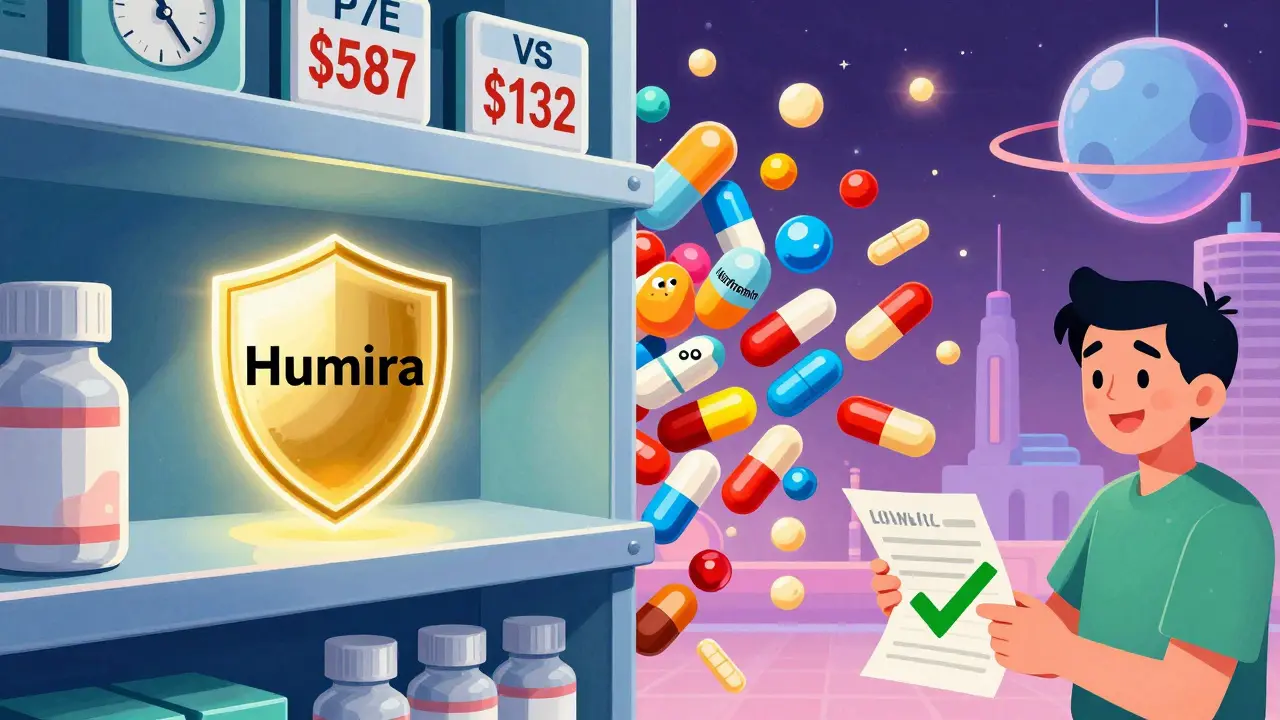
A single-source drug is a medication made by only one company. It might be a brand-new drug still under patent, or an older drug where no other company has been able to legally copy it. These drugs don’t have generic versions available. You won’t find any other brand or generic label that does the same thing. If your doctor prescribes one of these, you usually get the brand name-no alternatives.Think of drugs like Humira (for rheumatoid arthritis) before 2023, or newer cancer treatments like Keytruda. These drugs cost a lot because there’s no competition. Manufacturers can set high prices, and insurers often have to pay them. The average monthly cost for a single-source drug is around $587, according to a 2022 Kaiser Family Foundation survey. That’s more than four times what most multi-source drugs cost.
Even worse, you might not even know you’re paying for a single-source drug. Insurance plans often put these on higher tiers, meaning you pay more out of pocket. Some plans require you to try cheaper options first-called step therapy-before approving the brand-name version. If you’re on a single-source drug, you might get hit with surprise bills or prior authorization forms you didn’t expect.
What Are Multi-Source Drugs?
Multi-source drugs are the opposite. They’re medications that have both a brand-name version and multiple generic versions made by different companies. These are the drugs you see in bulk at pharmacies-usually labeled with a generic name like metformin or lisinopril, but sometimes also with a brand name like Lantus (insulin) even when generics are available.The FDA requires every generic version to meet strict standards. The active ingredient must be identical. The dose, how it’s taken (pill, injection, etc.), and how fast it gets into your bloodstream must be within 80-125% of the brand-name drug. This is called bioequivalence. It’s not a guess. It’s tested in labs with real patients.
Here’s the kicker: 86% of all prescriptions filled in the U.S. are for multi-source drugs, according to the National Center for Biotechnology Information. But they only make up 23% of total drug spending. That’s because generics cost way less. On average, a multi-source drug costs $132 per month-less than a quarter of the price of a single-source drug.
Why Do Prices Differ So Much?
It’s not just about who makes the drug. It’s about how the system works.Single-source drugs have no competition. So manufacturers can raise prices without fear. They also work with pharmacy benefit managers (PBMs) to offer big rebates. Those rebates go to the insurer or PBM-not to you. In fact, for every dollar the manufacturer raises the list price, the rebate goes up by nearly the same amount. That means your out-of-pocket cost stays high, even if the insurer gets a discount.
Multi-source drugs are different. When multiple companies make the same generic, they compete. One company lowers its price to win the contract. Others follow. This drives down the average cost. PBMs set a Maximum Allowable Cost (MAC)-the most they’ll pay for a generic. That number is often 50-60% lower than the brand-name price. Insurers use MAC to control costs, and you benefit.
But here’s what patients rarely hear: even when a drug becomes multi-source, the brand name might still be priced high. Some insurers stop covering the brand entirely. You might be forced to switch to a generic-even if you’ve been on the brand for years.
Are Generics Really the Same?
This is the big question. If a generic is cheaper, is it really just as good?The FDA says yes. Every approved generic must meet the same standards as the brand. But patient experiences tell a different story.
On Drugs.com, multi-source drugs have an average rating of 4.2 out of 5. Single-source drugs score 4.5. That gap isn’t huge-but it’s there. Why? Because 68% of negative reviews for generics mention “inconsistent effectiveness” between different manufacturers.
Here’s what’s happening: two generics can be bioequivalent and still have different inactive ingredients. One might use a different filler or coating. For most people, that doesn’t matter. But for some, especially with drugs that have a narrow therapeutic index (like warfarin, thyroid meds, or seizure drugs), even tiny changes can affect how the body responds.
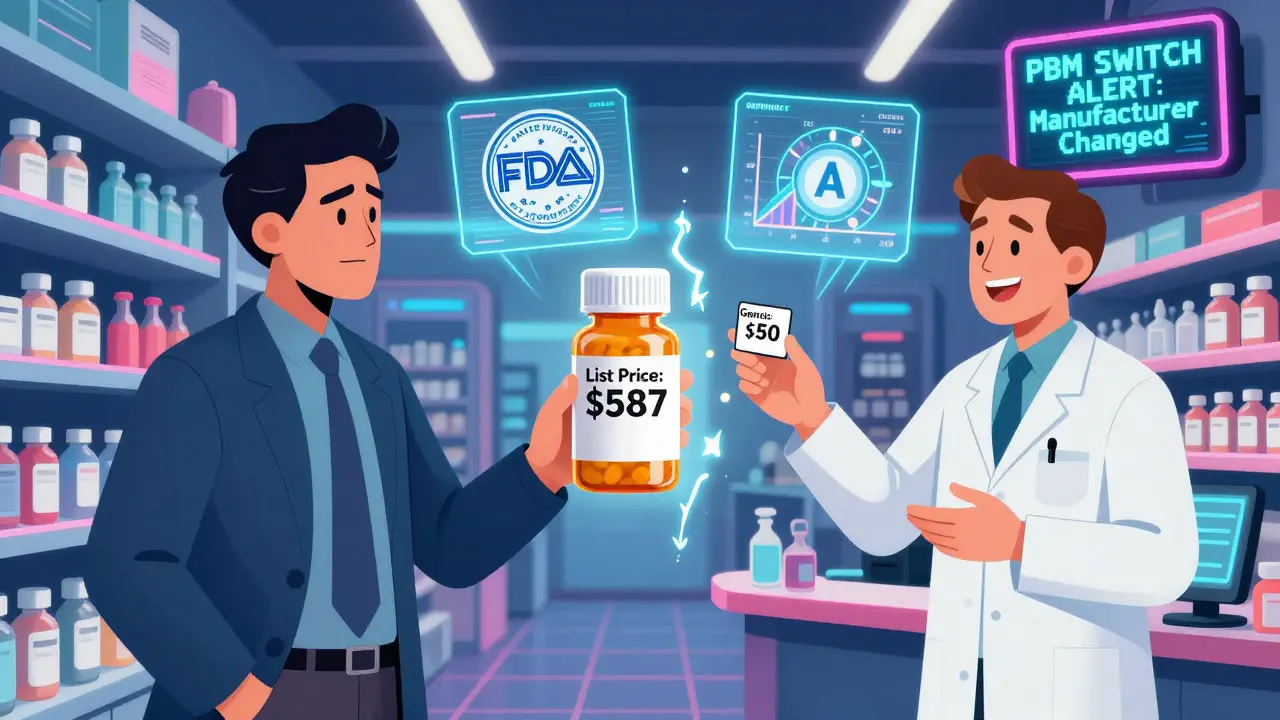
Also, PBMs switch generic suppliers all the time to get the lowest price. A 2022 report found that 63% of patients on multi-source drugs had their generic switched at least once in a year. You might get a different-looking pill. A different color. A different name on the bottle. You might feel like it’s not working as well. But the FDA says it’s the same.
Bottom line: most people won’t notice a difference. But if you’ve been on the same generic for years and suddenly feel off after a switch, talk to your pharmacist. Ask if the manufacturer changed. You might be able to request the same one.
How Insurance and Formularies Affect Your Choice
Your insurance plan decides which drugs are covered and at what cost. Most plans have a list called a formulary. Single-source drugs are often on Tier 3 or 4-higher cost-sharing tiers. Multi-source drugs are usually on Tier 1, with the lowest copay.Some plans don’t cover brand-name drugs at all if a generic exists. That’s called non-formulary exclusion. You might be told, “We’ll cover the generic, but not the brand.” That’s legal-and common.
And if your drug is single-source? You might need prior authorization. That means your doctor has to prove to your insurer that you’ve tried and failed on cheaper options first. It can take days. Or weeks. Some patients skip doses or stop taking meds altogether because they can’t get approval.
Medicare Part D beneficiaries filled 82% of their prescriptions with generics in 2022. That’s up from 73% in 2017. More people are choosing generics. And insurers are pushing them harder.
What You Can Do
You don’t have to accept whatever your doctor or insurer gives you. Here’s what actually works:- Ask if there’s a generic. Always. Even if your doctor says “this one doesn’t have one,” double-check. New generics come out all the time.
- Check your formulary. Log into your insurance portal. Look up your drug. See what tier it’s on. See if there’s a cheaper alternative.
- Ask your pharmacist. Pharmacists know what’s covered, what’s switched, and what’s about to change. They can tell you if your generic was switched last week.
- Use the FDA’s Orange Book. It’s online. Search your drug. If it has an “A” code, it’s rated equivalent. If it has no code, it’s single-source.
- Request a specific generic. If you’ve had problems with one manufacturer, ask your pharmacist to fill your prescription with the same one. They can sometimes do it.
- Ask about patient assistance programs. Many single-source drug makers offer coupons or free programs for low-income patients.
What’s Changing in 2026?
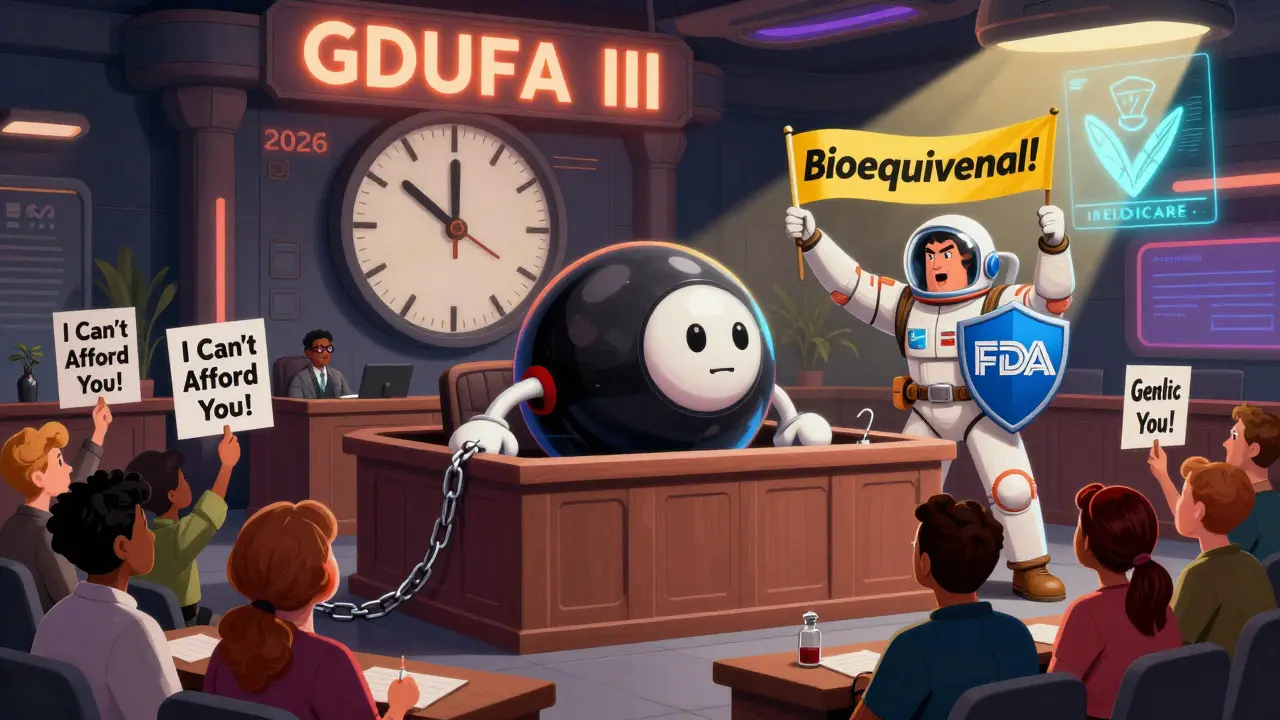
The FDA is speeding up generic approvals. Under the new GDUFA III rules, they aim to approve generics in just 10 months by 2025. That means more single-source drugs will become multi-source faster.Companies are also using tricks to delay generics. One common tactic: releasing their own “authorized generic”-a version made by the brand company but sold under a generic label. It’s still expensive, but it looks like a generic. PBMs often prefer it because it’s easier to manage.
And don’t forget the Inflation Reduction Act. Starting in 2023, Medicare started penalizing drug makers for raising prices on single-source drugs faster than inflation. That’s starting to slow price hikes-but it doesn’t help patients who pay out of pocket.
Final Thought: You Have More Power Than You Think
Most patients assume they have no control over what drug they get. But you do. You can ask. You can check. You can push back.Single-source drugs aren’t bad. They’re often breakthrough treatments for serious conditions. But they shouldn’t cost five times more than a drug that works the same way.
Multi-source drugs aren’t perfect. Switching manufacturers can be confusing. But they’re saving the U.S. healthcare system over $1.7 trillion every decade. And they’re making life affordable for millions of people.
If you’re paying hundreds a month for a drug that could cost $50, you’re not being lazy. You’re just not informed. Start asking questions. Talk to your pharmacist. Look up your drug online. You might be surprised how much you can save-and how much control you really have.
Are generic drugs as safe as brand-name drugs?
Yes. The FDA requires generic drugs to have the same active ingredients, strength, dosage form, and route of administration as the brand-name version. They must also meet strict bioequivalence standards, meaning they deliver the same amount of medicine into your bloodstream at the same rate. Generic manufacturers must follow the same quality controls as brand-name makers. Millions of people take generics safely every day.
Why does my generic look different every time I refill?
Pharmacy benefit managers (PBMs) contract with different generic manufacturers to get the lowest price. When one contract ends, they switch to another. That’s why your pill might change color, shape, or even the name on the label. The FDA says this doesn’t affect effectiveness. But if you notice new side effects or changes in how you feel, tell your pharmacist. You can sometimes request the same manufacturer.
Can I be forced to switch from my brand-name drug to a generic?
Yes-if a generic exists and your insurance plan excludes the brand. Many insurers won’t cover the brand unless you’ve tried the generic first (step therapy) or your doctor proves it’s medically necessary. If your doctor believes the brand is essential, they can file an exception. But you’ll need their support.
Do single-source drugs ever become multi-source?
Yes. Once a drug’s patent or exclusivity period ends (usually 10-12 years), other companies can apply to make generics. The FDA approves them after testing. For example, Humira became multi-source in 2023 after being single-source for 14 years. This is why drug prices often drop sharply after a patent expires.
How do I find out if my drug is single-source or multi-source?
Check the FDA’s Orange Book online-search by drug name. If it has an “A” code, it’s multi-source. If it has no code, it’s single-source. You can also ask your pharmacist or call your insurance company. If you’re on Medicare, use the Medicare Drug Coverage website to look up your drug’s status.
Robert Petersen
February 11, 2026 AT 18:02Just wanted to say this post hit home. I’ve been on Humira since 2019 and when the generics finally dropped last year, my out-of-pocket dropped from $800 to $45. I didn’t even know I could ask for the generic version - my doctor just said ‘this is what works.’ Pharmacy told me to ask next time. Lesson learned.
Ernie Simsek
February 13, 2026 AT 02:45lol so the pharma companies are just playing monopoly? 🤡
Joanne Tan
February 14, 2026 AT 09:22OMG YES! I switched from brand insulin to generic and thought I was gonna die… turned out I was just paranoid. My sugar’s actually more stable now. Don’t let them scare you with pill color changes lol 💊✨
Reggie McIntyre
February 15, 2026 AT 23:45Imagine if we treated meds like we treat coffee - ‘Oh, this Starbucks latte costs $7, but this Dunkin’ version is $2 and tastes basically the same?’ We’d all be drinking Dunkin’ and laughing. Why is healthcare so weird? The science says they’re identical. The system says one’s a luxury. Wild.
I once had a generic blood pressure pill that was neon green. Looked like a gummy vitamin. Took it anyway. Still alive. Still normotensive. Also, the FDA doesn’t lie. They’ve got labs, not lobbyists.
Also, shoutout to pharmacists. They’re the unsung heroes who catch the switch before you do. I texted mine last week: ‘Why does my metformin taste like cardboard now?’ She replied: ‘New maker. They changed the coating. Want me to call your doc for the old one?’ Yes. Yes I did.
And yes, some people do react differently - especially with thyroid meds or seizure drugs. But 90% of us? We’re fine. The fear is manufactured. The savings are real.
Stop being scared of a different-shaped pill. Your wallet will thank you.
Carla McKinney
February 17, 2026 AT 04:12Let’s be clear: generics are not ‘the same.’ The FDA’s bioequivalence range is 80-125%. That’s a 45% variance. One pill could deliver 20% less drug than another. That’s not medicine. That’s roulette.
And don’t get me started on PBMs. They’re middlemen who profit from the chaos. They don’t care if you feel weird. They care about the lowest bid. This system is broken.
If you’re taking warfarin or levothyroxine and your generic switches - you’re at risk. I’ve seen patients hospitalized over this. It’s not paranoia. It’s pharmacology.
Ojus Save
February 18, 2026 AT 05:42yea i got my generic switched like 3 times last year. pill changed color, size, even the lettering. i just took it. still alive. 🤷♂️
Stacie Willhite
February 19, 2026 AT 19:35I just wanted to say thank you for writing this. I’ve been too afraid to ask my doctor about switching. I thought if I asked, they’d think I was cheap or not serious about my health. But reading this made me feel like it’s okay to care about cost - and that I’m not alone.
I called my pharmacy today and asked if they could fill my lisinopril with the same maker I’ve been on for 3 years. They said yes. I cried a little. It’s just a pill. But it felt like a win.
Rob Turner
February 21, 2026 AT 10:30Interesting how the system incentivizes complexity over clarity. In the UK, we have the BNF - British National Formulary - which tells you exactly which generics are interchangeable. No guessing. No surprise switches.
Here, it’s a minefield. And yet, we’re told to ‘take responsibility’ for our care. But the information is deliberately opaque. PBMs don’t publish their contracts. Manufacturers don’t disclose inactive ingredients. It’s not negligence - it’s architecture.
Maybe the real issue isn’t generics. It’s trust. Do we trust the system to protect us? Or just to optimize profit?
Gabriella Adams
February 21, 2026 AT 23:17As a pharmacist with 18 years in community pharmacy, I can confirm: 95% of patients experience zero difference between generics and brands. The other 5%? Usually have anxiety, a history of adverse reactions, or are on narrow-therapeutic-index meds.
But here’s the thing: when a PBM switches your generic, they don’t notify you. No consent. No paperwork. Just a new bottle. That’s not patient-centered care. That’s cost-cutting disguised as efficiency.
I always ask: ‘Do you want the same manufacturer as last time?’ If yes, I call the wholesaler. Sometimes they can hold it. Sometimes not. But you have to ask. And if your doctor won’t write ‘Dispense as Written’ - push back. It’s your right.
Also - check the Orange Book. It’s free. It’s public. It’s your weapon.
Brad Ralph
February 23, 2026 AT 01:35so the system is rigged. and we’re supposed to be grateful for the crumbs? 🙃
christian jon
February 23, 2026 AT 07:55THIS IS A SCAM. A FULL-ON, BIG PHARMA, PBMs, INSURANCE, DOCTORS, FDA - THEY’RE ALL IN ON IT! YOU THINK THEY WANT YOU TO BE HEALTHY? NO! THEY WANT YOU DEPENDENT! THEY MAKE BILLIONS OFF CHRONIC ILLNESS! THEY DON’T WANT YOU TO KNOW ABOUT GENERICS BECAUSE THEN YOU’D STOP PAYING $800 A MONTH FOR A PILLS THAT COSTS 3 CENTS TO MAKE! THEY’RE LYING TO YOU! I’VE SEEN THE DOCUMENTS! THEY’RE SELLING SICKNESS! AND YOU’RE STILL BUYING IT!
CALL YOUR SENATOR. POST ON TWITTER. BURN YOUR INSURANCE CARD. THIS IS WAR.
Autumn Frankart
February 23, 2026 AT 17:16Did you know the FDA allows generics to have up to 10% more impurity than brand-name drugs? And the ‘A’ code? It’s not a guarantee. It’s a suggestion. They’ve approved generics from factories with 14 violations. I’ve got the reports. This isn’t healthcare. It’s a Ponzi scheme with a stethoscope.
Sophia Nelson
February 23, 2026 AT 18:43Why are you even talking about this? Just get your meds and shut up. You’re making it worse for everyone else by spreading fear.