Safe Use of Cough and Cold Products in Kids Under 6: What Parents Need to Know
 Dec, 11 2025
Every winter, parents face the same frustrating question: Should I give my child cough and cold medicine? For kids under six, the answer isn’t just ‘be careful’-it’s ‘don’t.’ Despite what you might see on store shelves or hear from well-meaning relatives, over-the-counter (OTC) cough and cold products are not safe for young children, and they don’t actually work the way most people think they do.
Why OTC Cough and Cold Medicines Are Risky for Kids Under 6
These medications aren’t just ineffective-they can be dangerous. Between 1969 and 2006, U.S. health officials documented more than 120 deaths linked to OTC cough and cold products in children under two. Thousands more ended up in emergency rooms with symptoms like rapid heartbeat, seizures, and trouble breathing. The FDA didn’t take this lightly. In 2007, they issued a formal warning, and by 2008, manufacturers agreed to label all products with: ‘Do not use in children under 4 years.’
But here’s the thing: the risks don’t stop at age four. The American Academy of Pediatrics, the CDC, the Mayo Clinic, and Cincinnati Children’s Hospital all agree: OTC cough and cold medicines should not be used in children under six. Why? Because young bodies process these drugs differently. A child’s liver and kidneys aren’t fully developed. For example, kids under two have only 23% of the adult enzyme activity needed to break down dextromethorphan, a common cough suppressant. That means even a small dose can build up in their system and cause serious harm.
And it’s not just about the medicine itself. Most products contain multiple active ingredients-antihistamines, decongestants, cough suppressants, and expectorants-all mixed together. Parents often don’t realize they’re giving their child two products with the same ingredient. One for fever, one for congestion. Both contain acetaminophen. That’s how accidental liver damage happens.
What Happens When Kids Get Too Much
Parents aren’t trying to hurt their kids. They’re trying to help. But the side effects of these drugs in young children can be scary-and sometimes deadly.
- Hyperactivity and insomnia: Antihistamines like chlorpheniramine can make some kids wired instead of sleepy. One parent on Reddit described their 3-year-old becoming hyperactive for 12 hours after a single dose of Children’s Dimetapp.
- Respiratory depression: Decongestants like pseudoephedrine can slow breathing, especially in infants. This is why the FDA warns these products can be life-threatening for kids under two.
- High blood pressure and hallucinations: Overdoses of cough suppressants or decongestants have led to erratic behavior, tremors, and even hallucinations in toddlers.
- Constipation and urinary retention: Antihistamines dry up secretions-but they also affect the bladder and bowels.
A 2015 study found that 67% of medication errors in children under six involved wrong dosing. And nearly one-third of those errors happened because parents used kitchen spoons instead of the measuring cup that came with the bottle. A teaspoon isn’t a milliliter. A tablespoon isn’t a dose. One wrong spoonful can be enough to send a child to the ER.
What to Do Instead: Safe, Proven Alternatives
You don’t need medicine to help your child feel better. In fact, the best treatments are the simplest ones.
- For babies under 6 months: Use saline nasal drops and a bulb syringe to clear nasal congestion. Run a cool-mist humidifier in their room. Keep them hydrated with breast milk or formula. Never give any OTC medicine-not even acetaminophen-without talking to your pediatrician first.
- For babies 6 months to 2 years: Acetaminophen (Tylenol) is safe for fever and discomfort at 10-15 mg per kg of body weight, every 4-6 hours, no more than five doses in 24 hours. But only if your doctor says it’s needed. Don’t use it just because your child has a runny nose.
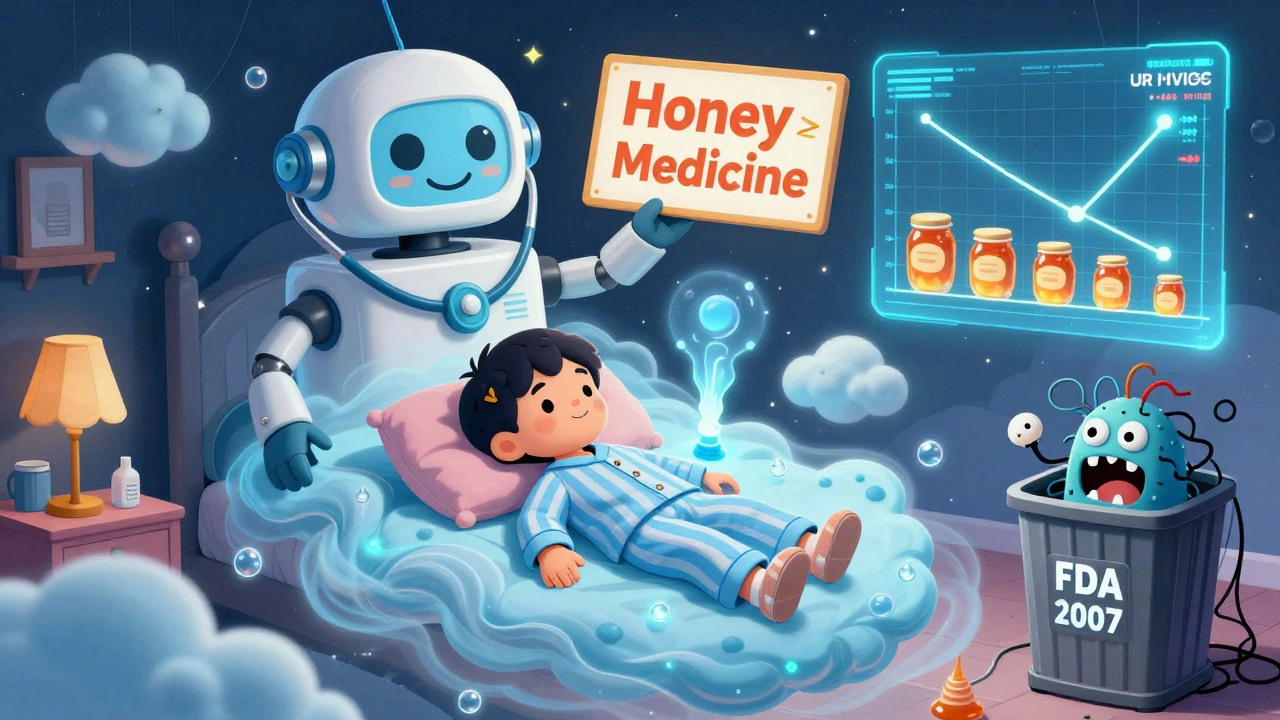
- For children 1 year and older: Honey is the #1 recommended cough remedy. Give ½ to 1 teaspoon before bed. Studies show it works as well as, or better than, dextromethorphan at reducing nighttime coughing. It thins mucus and soothes the throat. Just never give honey to babies under 12 months-it can cause infant botulism.
- For all ages: Keep the air moist. Use a cool-mist humidifier (not warm mist-it can make nasal swelling worse). Offer extra fluids. Elevate the head of the crib slightly to help with breathing. Saline nasal sprays are safe and effective at any age.
One parent in Vancouver shared that her 20-month-old’s cough cleared up in 48 hours after using saline drops and honey-no medicine at all. She said it was the first time she felt truly confident she wasn’t risking her child’s health.
What About Older Kids? (Ages 4-6)
Even if your child is four or five, the advice is still: Ask your doctor first. The FDA and AAP say these medications aren’t proven to work in children under six. That means the benefits are uncertain, but the risks aren’t. Some pediatricians may allow a single dose of a single-ingredient product if symptoms are severe-but only after ruling out other causes like asthma or allergies.
And if you do get a recommendation? Stick to one product. Never combine cough medicine with fever reducers or allergy pills. Always use the measuring device that comes with the bottle. Never use a kitchen spoon. And always check the active ingredients. If two products say ‘acetaminophen’ or ‘dextromethorphan’ on the label, don’t give both.
Why Do So Many Parents Still Use These Medicines?
It’s not because they’re careless. It’s because they’re desperate.
A 2022 survey found that 42% of parents of children under six still give OTC cold medicine, even after reading the warnings. Why? Because they believe it will help their child feel better faster. They see ads. They hear grandparents say, ‘I gave my kids this when I was young.’ They’re tired. They’re worried. They want to fix it.
But here’s what most people don’t know: colds are viral. They run their course in 7-10 days. Medicine doesn’t speed that up. It just masks symptoms-sometimes dangerously. The real goal isn’t to eliminate the cough. It’s to keep your child comfortable and safe until their body heals.
What’s Changed Since the 2007 Warning?
There’s good news. Since the FDA’s 2007 advisory, emergency visits for OTC medication overdoses in kids under two dropped by 45%. That’s because more parents learned the truth.
But there’s still work to do. A 2021 FDA inspection found that 22% of children’s cold products still didn’t have the proper ‘do not use under 4’ labels. Some parents still buy adult formulations and guess the dose. Others use expired medicine. Some even crush pills to mix into applesauce-another dangerous habit.
And disparities remain. Black and Hispanic children are more likely to end up in the ER for these kinds of overdoses than white children. That’s not because of cultural differences-it’s because access to clear, trustworthy health information isn’t equal.
What You Can Do Today
You don’t need to wait for your next doctor’s visit to make your home safer.
- Remove all OTC cough and cold medicines from your medicine cabinet for kids under six.
- Replace them with saline drops, a bulb syringe, a cool-mist humidifier, and a small bottle of honey (for kids over 1).
- Write down your child’s weight and keep it on the fridge. That way, if you ever need acetaminophen, you can calculate the right dose quickly.
- When in doubt, call your pediatrician. A quick phone call can save you from a trip to the ER.
The best medicine for a child’s cold isn’t in a bottle. It’s time, rest, fluids, and a parent who knows when not to reach for the medicine cabinet.
Can I give my 3-year-old Children’s Tylenol Cold & Cough?
No. Even though it says ‘Children’s,’ this product contains multiple active ingredients like dextromethorphan and phenylephrine, which are not safe for kids under six. The FDA and American Academy of Pediatrics strongly advise against using any combination cold medicine in children under six. Stick to single-ingredient acetaminophen or ibuprofen only if needed for fever or pain, and only after talking to your doctor.
Is honey really safe for toddlers?
Yes-for children one year and older. Honey has been shown in multiple studies to reduce nighttime coughing better than some OTC cough syrups. Give ½ to 1 teaspoon before bed. Never give honey to babies under 12 months. It can cause infant botulism, a rare but serious illness.
What if my child has a fever? Can I use Advil or Tylenol?
Yes, but only if needed. Acetaminophen (Tylenol) is safe for children over 2 months at 10-15 mg per kg of body weight every 4-6 hours, no more than five doses in 24 hours. Ibuprofen (Advil) is safe for children over 6 months. Always use the measuring device that comes with the bottle. Never use adult versions or guess the dose. And never give both acetaminophen and a cold medicine that also contains acetaminophen-that can cause liver damage.
Why do pharmacies still sell these products if they’re unsafe?
They’re still sold because they’re legal for children six and older, and manufacturers are required to label them with age restrictions. But many parents don’t read labels carefully. Some products still lack clear warnings. The FDA has pushed for better labeling, but enforcement is inconsistent. That’s why it’s up to parents to know the guidelines: no OTC cough and cold medicine for kids under six, no matter what the bottle says.
Are natural remedies like vapor rubs or essential oils safe?
Vapor rubs containing camphor, menthol, or eucalyptus can be irritating to young children’s airways and are not recommended for kids under two. Essential oils are not regulated and can be toxic if ingested or applied directly to skin. Stick to proven, simple methods: saline drops, humidifiers, and honey (for kids over 1). If you’re unsure, ask your pediatrician before trying anything new.
Final Thought: Less Medicine, More Care
It’s hard to watch your child cough and struggle to sleep. You want to fix it. But the most powerful thing you can do isn’t giving medicine-it’s being present. Holding them. Keeping the air moist. Offering sips of water. Reading a book. Waiting it out.
Colds aren’t emergencies. They’re part of growing up. And the safest way to get through them isn’t with a bottle of syrup-it’s with knowledge, patience, and a calm, informed parent.
wendy b
December 12, 2025 AT 14:16soooooo... i just read this whole thing and like... wow. i mean, who even thinks it's okay to give a 3-year-old dimetapp?? like, the fact that this is still a thing?? i swear, my neighbor gave her kid a whole spoonful of 'children's cold medicine' last winter and he was bouncing off the walls for 8 hours. it's not medicine, it's a party drug for toddlers. also, honey works?? mind. blown.
Laura Weemering
December 12, 2025 AT 18:51It’s not merely a pharmacological issue-it’s a systemic epistemological failure of modern parenting culture. We’ve outsourced our intuition to corporate pharmaceutical marketing, mistaking symptom suppression for healing. The body is not a machine to be calibrated with chemical levers. The cough? It’s a defense mechanism. Suppressing it is ontologically violent. And yet… we reach for the bottle because we’re terrified of discomfort. Not just our child’s… but our own.
Levi Cooper
December 13, 2025 AT 06:41Look, I get it. But back in my day, we got cough syrup and we didn’t complain. My mom gave me Robitussin when I was five and I turned out fine. Now we’re treating kids like lab rats because some FDA bureaucrat got scared of a lawsuit. This country’s gone soft. If your kid gets a cold, give ‘em the medicine. If they get sick, they get sick. Stop overthinking everything.
Ashley Skipp
December 13, 2025 AT 17:19My kid got a fever last week and I gave him Tylenol and he was fine. Why are you acting like everyone’s a monster if they give medicine
Nathan Fatal
December 14, 2025 AT 21:49Let’s clarify something important: the issue isn’t acetaminophen or ibuprofen for fever or pain. It’s multi-ingredient cold syrups with antihistamines, decongestants, and cough suppressants. Those are the dangerous ones. The AAP and FDA guidelines are crystal clear: avoid combination products under six. Single-ingredient, dosed by weight, with a proper syringe? That’s safe and responsible. The problem isn’t medicine-it’s misinformation and sloppy dosing. And yes, honey really works better than dextromethorphan for nighttime coughs. The evidence is solid.
Audrey Crothers
December 15, 2025 AT 04:05OMG YES!! I used honey for my 2-year-old and he slept through the night for the first time in a week 😭 I felt like a superhero. Also, saline drops + humidifier = magic. No more ER visits. Just love, patience, and a little honey. You got this, mama 🌿💧
Reshma Sinha
December 16, 2025 AT 10:08As an Indian mom, we’ve always used ginger-honey mixtures and steam inhalation for coughs. No syrup needed. The science confirms what traditional wisdom has known for centuries. Why do we ignore ancestral knowledge when modern medicine agrees? Maybe because we’ve been conditioned to trust bottles over wisdom. Let’s reclaim our instincts.
Lawrence Armstrong
December 16, 2025 AT 19:35My pediatrician told me the same thing. I was skeptical until I saw my 4-year-old’s cough improve in 2 days with saline + honey. No meds. No side effects. Just quiet nights. I keep a small honey jar next to the humidifier now. 🍯❄️
Donna Anderson
December 17, 2025 AT 10:04i used to give my kid the cold medicine cause everyone said it helped but now i just use honey and its way better and he actually sleeps and i dont feel like im poisoning him 😅
Robert Webb
December 19, 2025 AT 07:14This post is one of the most important pieces of public health information I’ve read in years. It’s not just about avoiding dangerous chemicals-it’s about reclaiming trust in our bodies, in nature, and in our own judgment as caregivers. We’ve been sold the illusion that illness requires intervention, when often what’s needed is simply time, comfort, and presence. The real tragedy isn’t the child with a cough-it’s the parent who feels powerless because they’ve been told they need a pill to love their child well. The most radical act of parenting these days might just be saying no to the medicine cabinet.
nikki yamashita
December 20, 2025 AT 00:10Just gave my kid honey and he smiled at me. That’s the best medicine.