Post-Market Surveillance: How the FDA Monitors Generic Drugs After Approval
 Mar, 12 2026
When you pick up a generic pill at the pharmacy, you expect it to work just like the brand-name version. But how does the FDA make sure it does-especially after it’s already on the shelf? Unlike new drugs, generics don’t go through years of clinical trials. Instead, they prove they’re bioequivalent to the original-meaning they deliver the same amount of active ingredient at the same rate. That’s enough for approval. But what happens once millions of people start taking it? That’s where post-market surveillance comes in.
Why Surveillance After Approval Matters
Generics make up over 90% of all prescriptions filled in the U.S. That’s more than 4 billion prescriptions a year. With numbers like that, even rare side effects can affect thousands of people. Clinical trials before approval usually involve a few thousand patients over months or a couple of years. But real-world use? That’s millions of people, with different ages, health conditions, and medications. Something that didn’t show up in trials can pop up later.
Take a complex generic, like an inhaler or a topical cream. Small differences in how the drug is absorbed or released can matter. A 2021 report from the National Academies found that for these types of products, bioequivalence doesn’t always mean therapeutic equivalence. That’s why the FDA doesn’t just approve and walk away. It watches.
The Tools the FDA Uses
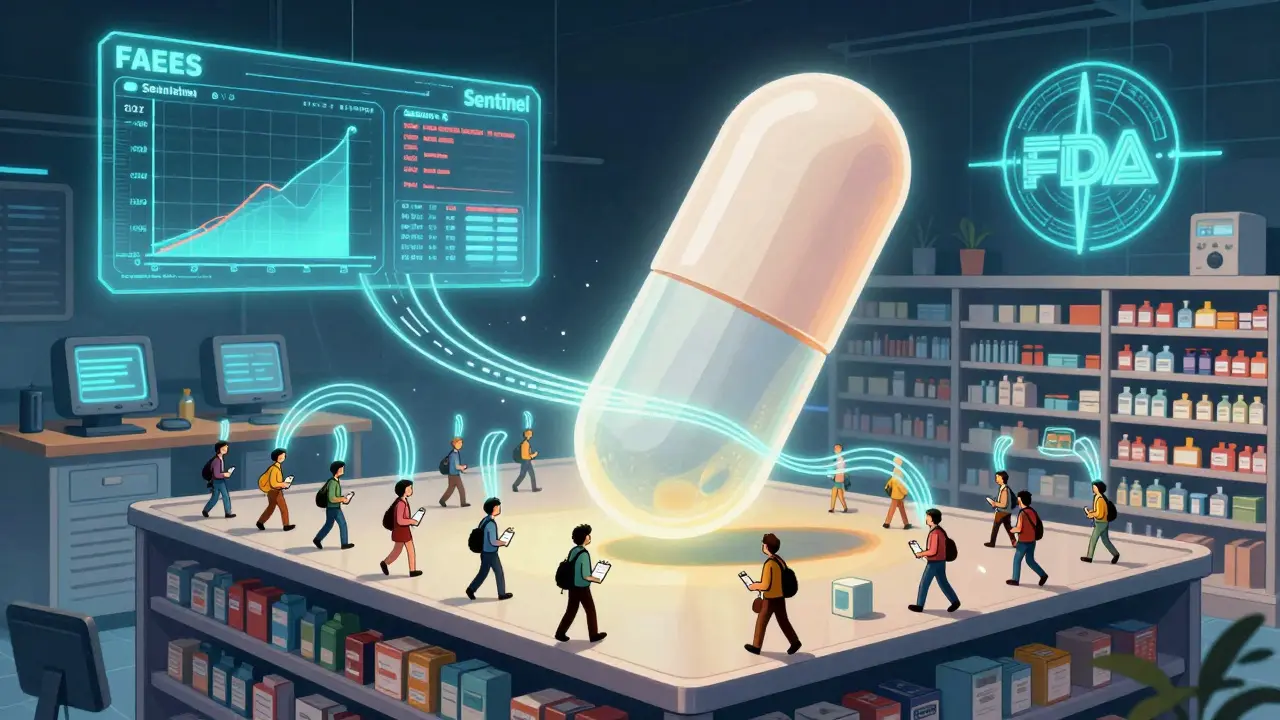
The FDA doesn’t rely on guesswork. It uses three main systems to track what’s happening after a generic drug hits the market.
- FDA Adverse Event Reporting System (FAERS): This is the backbone. Health professionals, patients, and pharmacists report side effects, allergic reactions, or when a drug seems to stop working. In 2023 alone, FAERS received over 2 million reports for all drugs-about half of them involving generics. The system doesn’t prove causation, but it flags patterns. If 50 people report the same unusual reaction to a specific generic version, that’s a signal.
- The Sentinel Initiative: This is the FDA’s real-time data network. It pulls anonymized information from insurance claims, hospital records, and electronic health systems covering over 200 million Americans. Instead of waiting for reports, Sentinel actively scans for spikes in hospitalizations, ER visits, or lab results tied to specific drugs. In 2023, it helped identify a potential link between a generic statin and muscle damage in older adults-weeks before FAERS caught the trend.
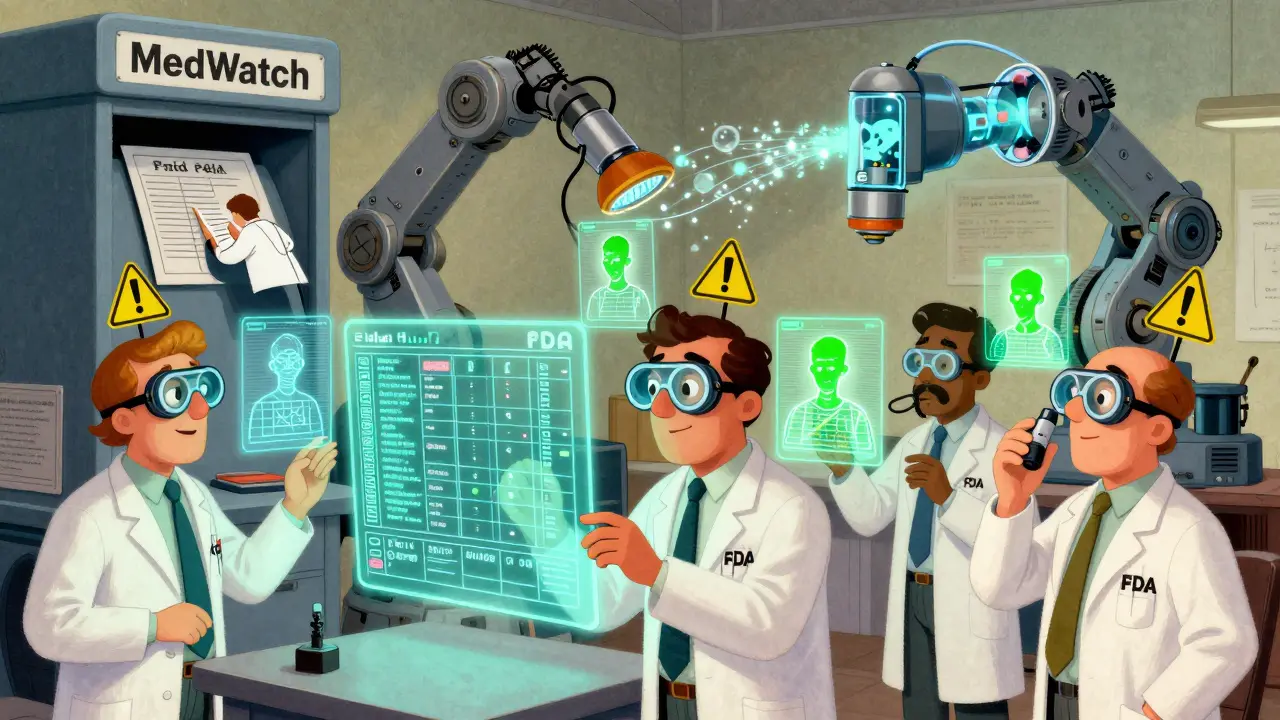
- MedWatch: This is the public-facing portal. Anyone can report a problem: a pill that looks different, a blister pack that falls apart, or a patient who got worse after switching. These reports go straight to the Office of Generic Drugs (OGD) for review.
These systems don’t work in isolation. The FDA’s Office of Surveillance and Epidemiology combines data from all three. If FAERS shows a spike in headaches with a certain generic, Sentinel checks whether ER visits for headaches spiked in the same region. MedWatch might reveal that patients were switched from one manufacturer to another. Together, they build a picture.
How the FDA Responds to Red Flags
Finding a problem is only half the battle. What happens next?
When a safety signal emerges, the FDA’s Office of Generic Drugs launches an investigation. Teams of pharmacologists, epidemiologists, and data scientists dig into the data. They ask: Is this a drug issue? Or is it something else?
For example, in 2022, reports poured in that a generic version of a blood pressure medication wasn’t working as well as the brand. Sentinel data showed no increase in hospitalizations for hypertension. FAERS reports were mostly from patients who’d recently switched. Interviews with doctors revealed many patients had stopped taking the pill because they thought it wasn’t working-due to the nocebo effect. The FDA didn’t pull the drug. Instead, it updated the labeling to warn prescribers about patient perceptions and provided educational materials.
But sometimes, the issue is real. In 2021, a generic version of a heart medication was linked to a rare but serious arrhythmia. Sentinel data showed a 40% increase in cases among users of that specific generic. FAERS confirmed it. The FDA requested a voluntary recall. The manufacturer changed the inactive ingredients, and the new version was retested.
Actions can include:
- Updating the drug label to add new warnings
- Issuing a "Dear Healthcare Provider" letter
- Requesting a recall
- Requiring the manufacturer to conduct post-market studies
Challenges with Complex Generics
Not all generics are created equal. Simple pills-like metformin or lisinopril-are easy to copy. But complex ones? That’s where things get tricky.
Modified-release tablets, inhalers, nasal sprays, and topical creams have ingredients and delivery systems that are hard to replicate exactly. A small change in particle size, coating thickness, or solvent can alter how the drug behaves in the body. The FDA admits current methods aren’t perfect at catching these differences.
That’s why it launched the Center for Research on Complex Generics (CRCG) in 2020, partnering with the Universities of Maryland and Michigan. The goal? To develop better testing methods. In 2023, the FDA allocated $5.2 million to research AI and machine learning tools that could analyze real-world data faster and predict risks before they become widespread.
The Role of Patient Perception
It’s not all about chemistry. Sometimes, the problem is in the mind.
A 2019 JAMA Internal Medicine study looked at 47,000 patient reports. About 15% claimed their generic wasn’t working as well as the brand. But lab tests showed identical drug levels. What was happening? The nocebo effect-where expecting a problem causes symptoms. Patients who’d switched from a familiar brand to a generic often blamed the new pill for side effects they’d always had.
Doctors report this too. A patient says, "This generic makes me feel weird." But they’ve been on the same dose for years. The real issue? A new sleep pattern, a change in diet, or stress. Still, the FDA takes these reports seriously-not because they’re always drug-related, but because they signal a loss of trust. And trust affects adherence. If patients stop taking their meds because they think the generic is "inferior," that’s a public health risk.
What’s Next? AI and Real-Time Monitoring
The FDA isn’t standing still. By 2027, experts predict AI-driven surveillance could cut the time to detect safety issues for complex generics by 60-70%.
Imagine a system that automatically flags: "In the last week, 120 patients in Ohio taking Generic X had elevated liver enzymes-unusual for this drug class." That’s not science fiction. The Sentinel system is already testing algorithms that scan EHRs in near real time. The FDA is also working on product-specific surveillance protocols-for inhalers, patches, and other complex forms-that will require manufacturers to submit ongoing data after approval.
And it’s not just about catching bad drugs. It’s about making sure good ones stay available. By improving surveillance, the FDA hopes to reduce unnecessary recalls and keep safe, affordable generics in circulation.
What You Can Do
You don’t need to be a scientist to help. If you notice something off-your medication looks different, you feel worse after switching, or the pill doesn’t seem to work-report it.
Go to MedWatch (or ask your pharmacist). Fill out the form. Even if you’re not sure, report it. The FDA doesn’t need you to diagnose the problem. Just describe what happened.
And if you’re a healthcare provider: when a patient complains, don’t assume it’s "all in their head." Document it. Report it. Your input helps shape the next generation of drug safety.
Do generic drugs have the same side effects as brand-name drugs?
Generally, yes. Generic drugs must meet FDA standards for bioequivalence, meaning they deliver the same active ingredient at the same rate as the brand-name version. This means their side effect profile is expected to be nearly identical. However, inactive ingredients (like fillers or dyes) can differ, and in rare cases, these may cause allergic reactions or affect absorption-especially with complex generics like inhalers or topical products. The FDA tracks these differences through post-market surveillance.
Can the FDA remove a generic drug from the market?
Yes. If post-market surveillance reveals a serious safety risk-such as unexpected side effects, contamination, or failure to deliver the correct dose-the FDA can require a recall. This has happened multiple times. For example, in 2018, a batch of generic valsartan was recalled due to a cancer-causing impurity. The FDA doesn’t act on single reports, but when patterns emerge across FAERS, Sentinel, and MedWatch, they investigate and take action.
Why do some patients say generics don’t work as well?
Sometimes, it’s not the drug-it’s perception. The "nocebo effect" can make people feel worse after switching, even if the medication is identical. Other times, differences in inactive ingredients affect absorption, especially with complex formulations. A 2019 study found 15% of patient reports cited perceived reduced efficacy, but lab tests rarely confirmed a pharmacological difference. Still, the FDA takes these reports seriously because they impact adherence and health outcomes.
How often does the FDA inspect generic drug manufacturers?
The FDA conducts unannounced inspections of manufacturing facilities regularly. For generic drugmakers, inspections occur every 2 to 3 years on average, but high-risk facilities or those with prior violations may be inspected more often. The FDA inspects both U.S. and international sites-over 80% of generic active ingredients come from overseas. In 2023, the agency inspected over 1,200 generic manufacturing sites worldwide.
Is the FDA improving its surveillance for generics?
Yes. The FDA is investing heavily in AI and machine learning to analyze real-world data faster. Projects like the Sentinel Initiative now cover over 200 million Americans, and the agency is developing product-specific surveillance protocols for complex generics like inhalers and topical creams. In 2023, $5.2 million was allocated to AI-based surveillance research, with the goal of detecting safety signals weeks or months earlier than current methods.
Final Thoughts
Generic drugs save the U.S. healthcare system over $1 trillion every decade. But their safety isn’t guaranteed by approval-it’s maintained by constant vigilance. The FDA’s post-market system isn’t perfect, but it’s evolving. From FAERS to Sentinel to AI-powered analytics, the tools are getting sharper. And every report from a patient, every alert from a doctor, every data point from an electronic health record adds to the picture.
What’s clear is this: once a generic is approved, the job isn’t done. The real test happens in the real world. And the FDA is watching.
Dylan Patrick
March 12, 2026 AT 20:45Generics saved my ass after I lost insurance. Never thought twice until I read this. Now I get it-FDA’s not just waving goodbye after approval. They’re watching.
Kathy Leslie
March 13, 2026 AT 14:37I switched to a generic blood pressure med last year. Thought I was going crazy when I felt weird-but now I know it might’ve been stress, not the pill. Thanks for the nocebo breakdown. 😌
Elsa Rodriguez
March 14, 2026 AT 00:02So let me get this straight-the FDA has a whole team just to make sure cheap pills don’t kill people? And we still let pharma make them in India? 🤡
Serena Petrie
March 14, 2026 AT 01:30Just report it. That’s it. No need to overthink.
Buddy Nataatmadja
March 15, 2026 AT 08:41As someone who grew up in Jakarta, I’m glad generics exist. In places where $200 pills are luxury, this system is life. Not perfect, but way better than nothing.
mir yasir
March 15, 2026 AT 16:39The notion that bioequivalence equates to therapeutic equivalence is a dangerous oversimplification. One must consider pharmacokinetic variance, excipient interactions, and batch-to-batch variability-factors inadequately addressed by current regulatory paradigms.
Richard Harris
March 16, 2026 AT 11:49Didn’t know about Sentinel. That’s actually kinda cool. Hope they keep it going. 🙏
Tim Schulz
March 16, 2026 AT 13:10So the FDA spends millions to prove that a $0.50 pill isn’t secretly a death trap… and we still let Walmart sell them? 😂
Alex MC
March 17, 2026 AT 20:33It’s wild how much trust we put into invisible systems. We don’t even know how the FDA tracks this stuff-and yet, we rely on it every day. Kinda beautiful, in a bureaucratic way.
Stephanie Paluch
March 18, 2026 AT 00:19My grandma takes 7 generics. She swears one makes her dizzy. I reported it on MedWatch last month. Didn’t think it mattered. Now I feel like I did something. 🌿
Jinesh Jain
March 18, 2026 AT 08:09Interesting how the system works. In India, we don’t have this level of oversight. But the generics still work. Maybe we need less regulation, not more?
Kandace Bennett
March 19, 2026 AT 08:20USA makes the best drugs. Why are we letting China and India make our generics? This is a national security issue. 🇺🇸
Amisha Patel
March 20, 2026 AT 04:47So if I feel weird after switching, I should report it even if I’m not sure? Just in case? 🤔