Pharmacy Reimbursement Models: How Laws Control Generic Drug Payments
 Jan, 16 2026
When you pick up a generic prescription at the pharmacy, you might think the price is simple: lower cost, same medicine. But behind that $4 copay is a tangled web of federal laws, state regulations, and profit-driven systems that decide exactly how much the pharmacy gets paid-and how much you pay out of pocket. These aren’t just behind-the-scenes details. They directly affect whether you can afford your meds, whether your local pharmacy stays open, and even whether new generic drugs ever reach the market.
How Generic Drugs Got Their Price Tag
The modern system for paying pharmacies for generic drugs started with the Hatch-Waxman Act of 1984. Before this law, brand-name drug makers held monopolies for years after patent approval, keeping prices high. Hatch-Waxman changed that by creating a faster, cheaper path for generic manufacturers to get FDA approval through the Abbreviated New Drug Application (ANDA) process. It didn’t just make generics possible-it made them profitable for manufacturers and essential for insurers trying to cut costs.But here’s the catch: just because generics are cheaper to make doesn’t mean pharmacies get paid enough to cover their costs. That’s where reimbursement models come in. The two main ways pharmacies get paid for generic drugs are Average Wholesale Price (AWP) minus a percentage, and Maximum Allowable Cost (MAC) lists.
AWP was once the standard. It’s a list price set by manufacturers, often inflated and not tied to what pharmacies actually pay. But for generics, most plans now use MAC. This is a fixed amount-set by pharmacy benefit managers (PBMs)-that represents the highest reimbursement a pharmacy will get for a specific generic drug. If the pharmacy buys the drug for $2.50 but the MAC is $2.20, they lose 30 cents per prescription. No margin. No profit. Just break-even at best.
Who Controls the Reimbursement Rules?
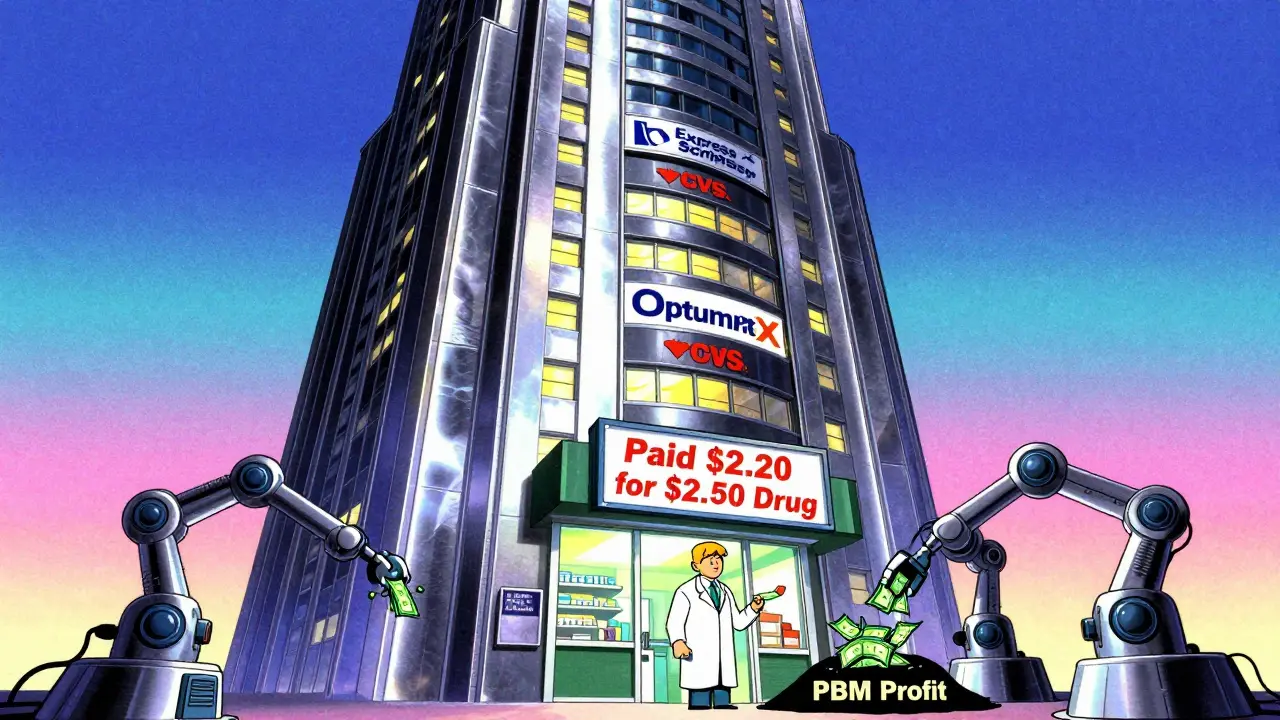
The real power in this system doesn’t sit with doctors, pharmacists, or patients. It sits with Pharmacy Benefit Managers (PBMs). These are middlemen hired by insurance companies to manage drug benefits. Three companies-CVS Caremark, Express Scripts, and OptumRX-control over 80% of the market. They negotiate rebates with drug makers, set MAC lists, and decide which drugs go on formularies.PBMs make money in two big ways. First, they take a cut of the rebates drug makers pay them to get their drugs on preferred lists. Second, and more controversially, they use spread pricing. That’s when the PBM tells the insurer, "This drug costs $10," but tells the pharmacy, "We’ll pay you $7." The $3 difference? That’s their profit. And because pharmacies are often contractually forced to accept these terms, they can’t tell patients they could pay $7 cash and avoid the insurance claim entirely. That’s called a "gag clause"-and while it was banned in 2018, the financial imbalance it created still lingers.
Medicare Part D and the Generic Gap
For seniors on Medicare Part D, the system gets even more complicated. Part D covers outpatient prescriptions, and while 84% of prescriptions filled are generics, they only account for 27% of total spending. Why? Because brand-name drugs, even when generics exist, often come with higher list prices-and higher rebates for PBMs.Part D plans have formularies with tiers. Generics usually sit on Tier 1, with the lowest copay. But even then, 28% of Part D plans required prior authorization for at least one generic drug in 2022. That means your pharmacist has to call your doctor, wait for approval, and sometimes you end up waiting days just to get a drug you’ve been taking for years.
And then there’s the "donut hole"-the coverage gap where you pay more out of pocket after hitting your initial coverage limit. Though the Inflation Reduction Act of 2022 capped out-of-pocket spending at $2,000 starting in 2025, many seniors still face high deductibles. For those without Extra Help, a $4.50 generic copay can quickly turn into a $20 bill if their plan’s deductible hasn’t been met.
Medicaid and State-Level Laws
Medicaid, covering 85 million Americans, operates under the Medicaid Drug Rebate Program (MDRP). Manufacturers must pay quarterly rebates to states, which then use that money to offset drug costs. States also create Preferred Drug Lists (PDLs) to steer patients toward cheaper, clinically effective options. These lists are updated yearly and often require prior authorization for non-preferred drugs-even if they’re generic.But state laws vary wildly. As of 2023, 44 states passed laws regulating PBM practices, including rules that force PBMs to disclose their reimbursement rates to pharmacies and prohibit spread pricing. Some states, like California and New York, now require PBMs to reimburse pharmacies at or above the actual acquisition cost. Others still let PBMs set MAC lists that don’t reflect real market prices.
The $2 Drug List: A New Model for Medicare
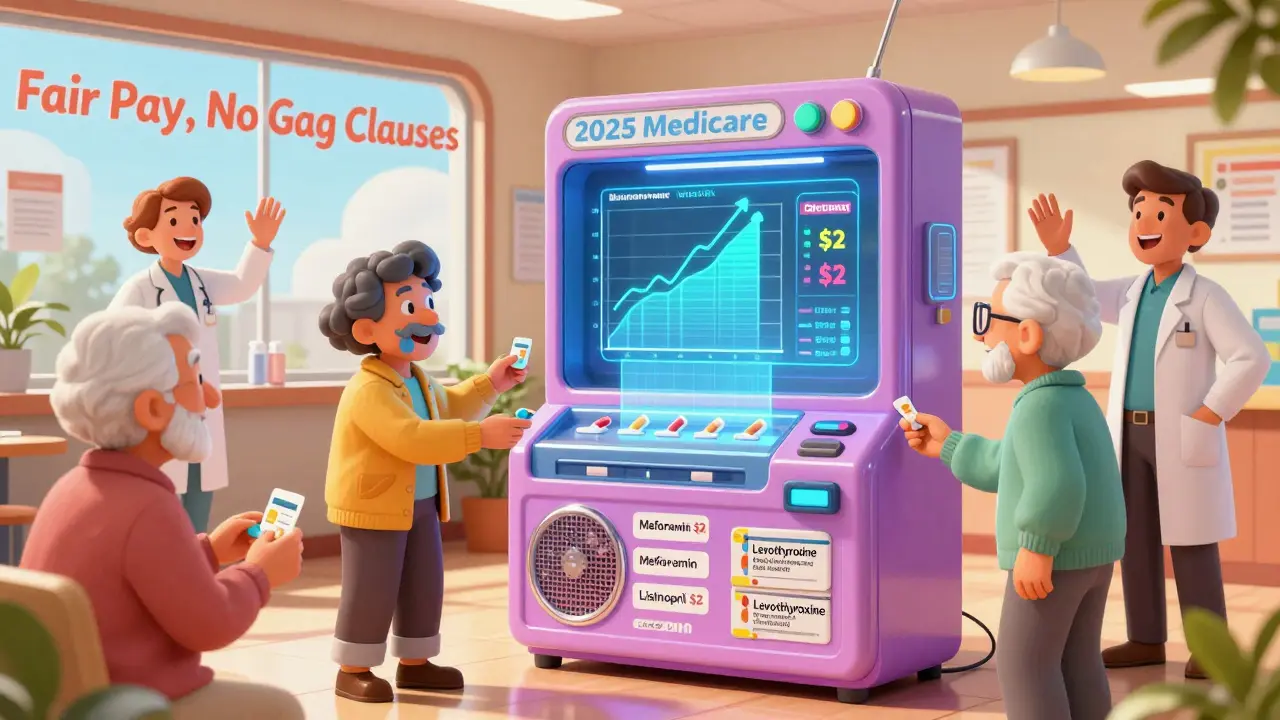
In 2025, the Centers for Medicare & Medicaid Services (CMS) launched a voluntary pilot called the Medicare $2 Drug List Model. It’s simple: select about 100-150 low-cost, high-use generic drugs and cap patient copays at $2. No deductible. No formulary restrictions. Just flat pricing.These drugs are chosen based on three criteria: clinical importance (does it treat a common condition?), frequency of use (is it prescribed often?), and cost (is it already priced low?). Think metformin for diabetes, lisinopril for blood pressure, or levothyroxine for thyroid issues.
Pharmacies love it. Patients love it. And it’s modeled after what big retailers like Walmart and Costco already do-offering $4 generics to cash-paying customers. The difference? This model is designed for Medicare Part D, so it integrates with insurance, avoids gag clauses, and ensures pharmacies are paid fairly. Early data shows improved adherence and lower overall spending.
Why Pharmacists Are Struggling
Independent pharmacies are on the brink. In 2018, the average profit margin on generic drugs was 3.2%. By 2023, it dropped to just 1.4%. Some pharmacies are losing money on every generic script they fill. Why? Because MAC lists haven’t kept up with wholesale prices. And when a pharmacy gets paid less than it pays for the drug, it’s not sustainable.On top of that, pharmacists spend hours on prior authorizations, phone calls with PBMs, and dealing with formulary changes. The American Medical Association found that office staff spend nearly 20 hours a week just handling prior auths. For a small pharmacy, that’s one full-time employee tied up in paperwork-not helping patients.
What’s Next for Generic Drug Payments?
The pressure is building. The Federal Trade Commission is cracking down on "pay-for-delay" deals, where brand-name companies pay generic makers to delay launching cheaper versions. ICER forecasts generic prices will keep falling 5-7% a year through 2027. That’s good for patients-but deadly for pharmacies if reimbursement doesn’t rise too.Value-based payment models are coming. Instead of paying per pill, insurers might pay for better health outcomes. But that’s years away. In the short term, the $2 Drug List Model could be a blueprint. If it proves successful, it could expand to all Part D plans-and eventually influence commercial insurance too.
Until then, the system remains broken. Laws were written to lower drug costs. But without transparency, fair reimbursement, and real competition, those laws often end up hurting the very people they were meant to help: patients and pharmacists.
Joni O
January 18, 2026 AT 00:53Just filled my mom’s levothyroxine today-$2 at CVS. She cried. Not because she’s emotional, but because she’s been skipping doses for months trying to stretch her budget. This $2 model? It’s not a policy tweak. It’s a lifeline.
Pharmacists aren’t heroes. They’re just doing their job while the system eats them alive.
Jake Moore
January 18, 2026 AT 18:48MAC lists are a joke. I worked at a pharmacy for 8 years. We’d buy a 90-day supply of metformin for $18.50. MAC? $17. So we lost 80 cents per script. And we had to pay to print the prior auth forms, too.
PBMs don’t care if you stay open. They care if their quarterly report looks pretty.
Chuck Dickson
January 19, 2026 AT 21:08Look, I get it-generic drugs are supposed to be cheap. But if the pharmacy loses money on every script, what happens? They close. Then you drive 20 miles for insulin.
We need to stop pretending this is a free market. It’s a rigged game where the middlemen win and the people who actually hand you the pills lose.
Dayanara Villafuerte
January 21, 2026 AT 20:54So let me get this straight: the system that was supposed to make drugs affordable now makes pharmacists choose between paying rent or paying for their own meds?
😂👏👏👏
Bravo, America. You’re doing great.
Jay Clarke
January 21, 2026 AT 21:47This whole thing is a scam. PBMs are just glorified insurance brokers who got rich off a loophole that was never meant to exist. The fact that they can hide spread pricing behind ‘formulary management’ is criminal.
And don’t even get me started on how they blacklist generics that don’t pay enough kickbacks. It’s not healthcare. It’s Wall Street with a white coat.
Wendy Claughton
January 22, 2026 AT 08:24My cousin’s a pharmacist in rural Ohio. She told me last week she cried after filling a $4 script because the pharmacy got paid $3.75 for it-and the insulin she gave the kid next door? That one cost her $22 to buy. She had to swallow the loss.
It’s not about greed. It’s about survival. And we’re letting it happen because it’s ‘just generics.’
💔
Max Sinclair
January 22, 2026 AT 15:13The $2 Drug List is the first real step toward fixing this. It’s not perfect, but it’s transparent, patient-focused, and rewards pharmacies instead of punishing them.
If we can do it for Medicare, why not for commercial insurance? Why not for Medicaid? The infrastructure’s already there. The will isn’t.
Praseetha Pn
January 23, 2026 AT 08:50Oh, so now you’re surprised PBMs are evil? 😏 Let me tell you something-you think this is bad? Wait till you find out how the FDA approves generics with 10% less active ingredient and calls it ‘bioequivalent.’
They’re not saving you money-they’re making you sicker with cheaper poison. And the government? They’re in on it. Just look at the revolving door between CMS and CVS Caremark. 👀
christian Espinola
January 24, 2026 AT 14:59Everyone’s acting like this is new. It’s not. The entire pharmaceutical supply chain has been a Ponzi scheme since the 1990s. PBMs? Just the latest layer of the onion.
Meanwhile, real doctors and pharmacists are left cleaning up the mess while the CEOs buy yachts. Wake up. This system was designed to fail you.
Ryan Otto
January 25, 2026 AT 22:44Let me be the only one to point out the elephant in the room: the real problem isn’t reimbursement. It’s the fact that the FDA allows generic manufacturers to use fillers and binders that are not bioequivalent to the original formulation. The system is not broken-it’s engineered. PBMs are just the visible hand of a deeper, darker machine designed to keep you dependent, compliant, and medicated.
Who benefits? Not you. Not the pharmacist. The state. The state always benefits.