Pediatric Vision Screening: Early Detection and Referral for Healthy Eyes
 Feb, 9 2026
When a child squints to see the TV, rubs their eyes constantly, or closes one eye to look at something, it’s not just a habit-it could be a sign their vision is struggling. Vision problems in kids don’t always show up as blurry sight. Often, they show up as frustration, poor focus in school, or even clumsiness. The good news? Most of these issues can be caught early, treated effectively, and sometimes even prevented-with the right screening.
Why Screening Before Age 5 Matters
The human visual system develops rapidly in the first few years of life. By age 7, most of that development is complete. If a child has a vision problem like amblyopia (lazy eye) or strabismus (crossed eyes), and it’s not caught before then, the brain starts ignoring signals from the weaker eye. Once that happens, correcting the problem becomes much harder. Studies show that when amblyopia is treated before age 5, 80-95% of children regain normal vision. After age 8, that number drops to just 10-50%. That’s not a small difference-it’s the difference between seeing clearly for life or living with permanent vision loss.What Gets Screened and When
Pediatric vision screening isn’t one-size-fits-all. It changes as kids grow. Here’s what happens at each stage:- Newborn to 6 months: The red reflex test is used. A light is shined into each eye to check for reflections. Normal reflections mean the back of the eye is clear. Abnormal ones can signal cataracts, retinoblastoma, or other serious conditions.
- 6 months to 3 years: Doctors look for eye alignment, pupil response, and how well the eyes track movement. Red reflex testing continues. If a child won’t cooperate with an eye chart, this is the stage where instrument-based tools like the Retinomax or a handheld autorefractor that measures how light focuses in the eye come in handy.
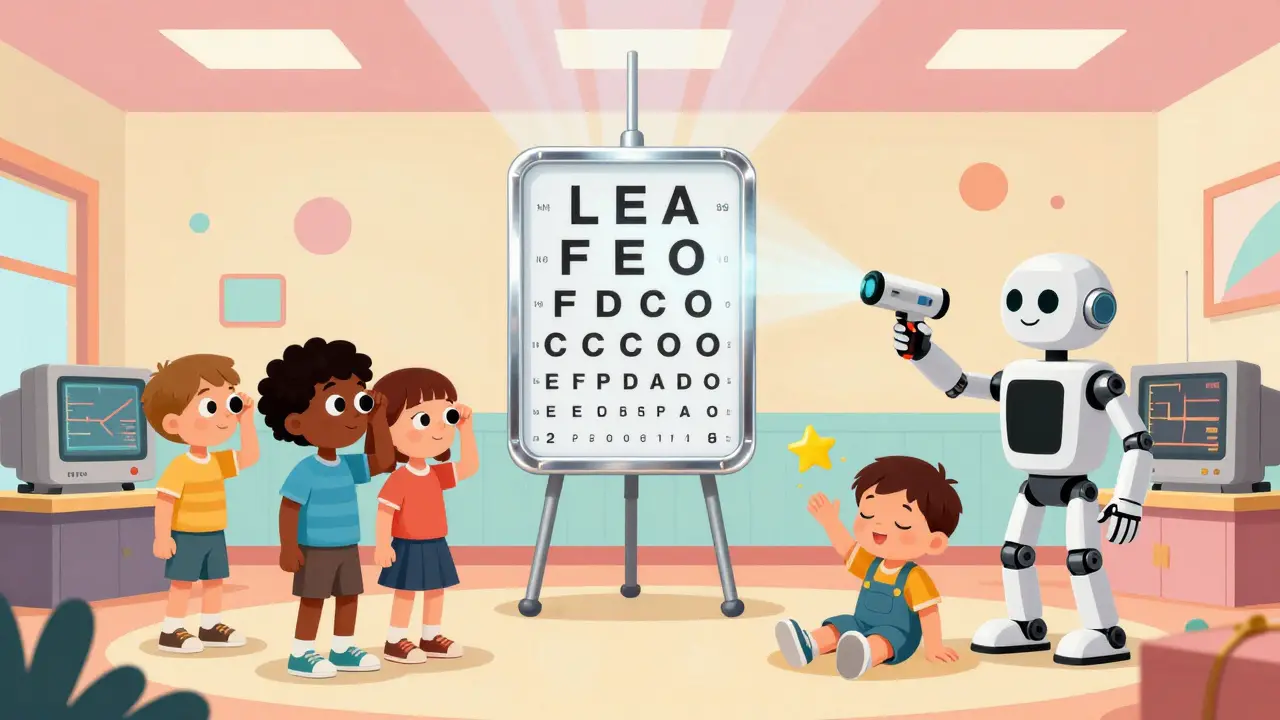
- Ages 3-5: This is the critical window. Visual acuity testing begins using charts with shapes or letters. The LEA Symbols or a set of simple shapes like apples, houses, and circles are preferred because even toddlers can point to them. At age 3, kids should be able to read the 20/50 line. At age 4, it’s 20/40. By age 5, they should hit 20/32.
- Ages 6 and up: Sloan letters (clean, sans-serif letters) replace older Snellen charts. These are easier for kids to read accurately. Screening continues every 1-2 years during well-child visits.
Instrument-Based vs. Chart-Based Screening
There are two main ways to screen kids: with charts or with machines.Chart-based screening (like the LEA Symbols or HOTV chart) needs a child who can focus, point, and respond. About 10-25% of 3- and 4-year-olds just won’t cooperate. That’s where instrument-based screening shines. Devices like the blinq™ scanner take a quick photo of the eyes and use AI to detect signs of misalignment, refractive errors, or other red flags. It takes less than a minute. The blinq™ got FDA clearance in 2018 after testing showed it caught 100% of referral-worthy cases with 91% accuracy.
But here’s the catch: machines can sometimes flag kids who don’t need treatment. A small amount of nearsightedness or farsightedness is normal in young children. Too many false positives mean unnecessary trips to the eye doctor. That’s why experts don’t recommend replacing chart-based screening entirely-especially for kids 5 and older. The best approach? Use instrument-based tools for younger or uncooperative kids, and switch to charts when they’re ready.
How Screening Is Done Right
Even the best tools won’t help if they’re used wrong. Many screenings fail because of simple mistakes:- Testing too close or too far from the chart. Distance matters. The 20/50 line must be 10 feet away.
- Not testing each eye separately. Covering one eye at a time catches problems the brain hides when both eyes work together.
- Poor lighting. If the chart is too dim or too bright, kids can’t see clearly.
- Using the wrong chart. Snellen letters (the tall, skinny ones) are harder for young kids than Sloan or LEA symbols.
Training helps. Health providers need just 2-4 hours to learn proper technique. Many state health departments, like California’s CHDP program, offer free online training. Over 15,000 providers have completed these modules since 2016.
Who Gets Screened-and Who Doesn’t
In the U.S., about 85% of children get some kind of vision screening during well-child visits. That’s thanks to the Bright Futures guidelines, adopted by 47 state Medicaid programs. But gaps remain. Hispanic and Black children are 20-30% less likely to be screened than white children, according to the National Survey of Children’s Health (2019). Language barriers, lack of access to pediatric care, and unawareness among parents all play a role.That’s why screening shouldn’t just happen in clinics-it needs to be part of preschools, Head Start programs, and community health events. The cost of not acting is high. The U.S. Preventive Services Task Force estimates vision screening saves $1.2 billion a year in lifetime costs by preventing untreated amblyopia. That’s a return of $3.70 for every $1 spent.
What Happens After a Positive Screen
A failed screening doesn’t mean your child needs glasses or surgery. It means they need a full eye exam by a pediatric ophthalmologist or optometrist. That’s the next step. Many insurance plans cover this under preventive care. The goal isn’t to scare parents-it’s to catch problems early so treatment can be simple: patching, glasses, or even eye drops. In many cases, kids are back to seeing normally in just a few months.What’s Next for Pediatric Vision Screening
The future is moving faster. The blinq™ scanner was the first FDA-cleared AI-powered device for kids. More are coming. The National Eye Institute is funding research to improve accuracy in diverse populations. And studies published in 2022 show instrument-based screening can work as early as 9 months. Guidelines may soon recommend screening starting at age 1 instead of age 3.For now, the message is clear: don’t wait. If your child is 3 or older and hasn’t had a vision screening, ask their pediatrician. If they’re younger and you notice signs-eye turning inward or outward, frequent squinting, sitting too close to the TV-don’t assume it’s normal. Get it checked.
Is vision screening the same as an eye exam?
No. Vision screening is a quick check to find kids who might have problems. It doesn’t diagnose. A full eye exam by an eye doctor looks at eye health, checks for diseases like glaucoma or cataracts, and gives a precise prescription if needed. Screening tells you if you need an exam-not what’s wrong.
Can my child’s school screen their vision?
Some schools do, but they’re not always reliable. School screenings often use outdated charts, don’t test each eye separately, and may miss subtle problems like amblyopia. They’re a supplement, not a replacement. Always follow up with a pediatrician or eye doctor.
My child passed the screening-do they still need an eye exam?
If they have no symptoms and no family history of eye disease, a screening may be enough for now. But if there’s a family history of lazy eye, cataracts, or early glasses use, or if your child squints, rubs eyes, or complains of headaches, an exam is still a good idea. Screening can miss mild cases.
What if my child won’t cooperate during the screening?
That’s common, especially with 3- and 4-year-olds. Don’t give up. Try again in a few months. In the meantime, ask your pediatrician about instrument-based screening. Devices like the blinq™ or SureSight don’t require a child to respond-they just need a quick photo of the eyes.
Are vision screenings covered by insurance?
Yes. Under the Affordable Care Act, pediatric vision screening is a required benefit in most health plans. Many state Medicaid programs cover it as part of well-child visits. If you’re unsure, call your provider-they’re required to tell you.
What Parents Can Do Today
You don’t need to be an expert to protect your child’s vision. Just remember these three things:- Ask about vision screening at every well-child visit starting at age 3.
- If your child fails, don’t wait. Schedule a full eye exam within 1-2 months.
- If you notice unusual eye behavior-even if they passed screening-trust your gut. Get it checked.
Early detection doesn’t just mean better vision. It means better learning, better balance, better confidence. And for most kids, it means a lifetime of seeing the world clearly.
Tatiana Barbosa
February 10, 2026 AT 19:23And yeah, the blinq™? Game changer. No more tears, no more screaming. Just a quick flash and you're done. Parents love it.
Susan Kwan
February 11, 2026 AT 04:27Brett Pouser
February 13, 2026 AT 02:45My kid’s fine now, but I’m screaming into the void for the next guy.
Simon Critchley
February 13, 2026 AT 22:15Karianne Jackson
February 15, 2026 AT 10:02Tom Forwood
February 16, 2026 AT 10:43Chelsea Cook
February 17, 2026 AT 22:32Jacob den Hollander
February 19, 2026 AT 18:13