PCSK9 Inhibitors vs Statins: Side Effects and Outcomes
 Jan, 20 2026
Cholesterol Reduction Calculator
Calculate your potential LDL reduction from statins or PCSK9 inhibitors based on your current LDL level. Enter your current LDL (mg/dL) and see estimated results for both medications.
Your Estimated Results
Statins
Estimated LDL Reduction: 30% - 50%
Estimated LDL Level: mg/dL
PCSK9 Inhibitors
Estimated LDL Reduction: 50% - 61%
Estimated LDL Level: mg/dL
Who Might Benefit Most
For high-risk patients (e.g., history of heart attack, stroke, or diabetes), LDL targets are typically <70 mg/dL. PCSK9 inhibitors often achieve better LDL reduction and may be recommended when statins alone aren't sufficient.
What Your Results Mean
If your LDL is above 100 mg/dL after maximum statin therapy, PCSK9 inhibitors may be recommended by your doctor. For most high-risk patients, LDL below 70 mg/dL is the target.
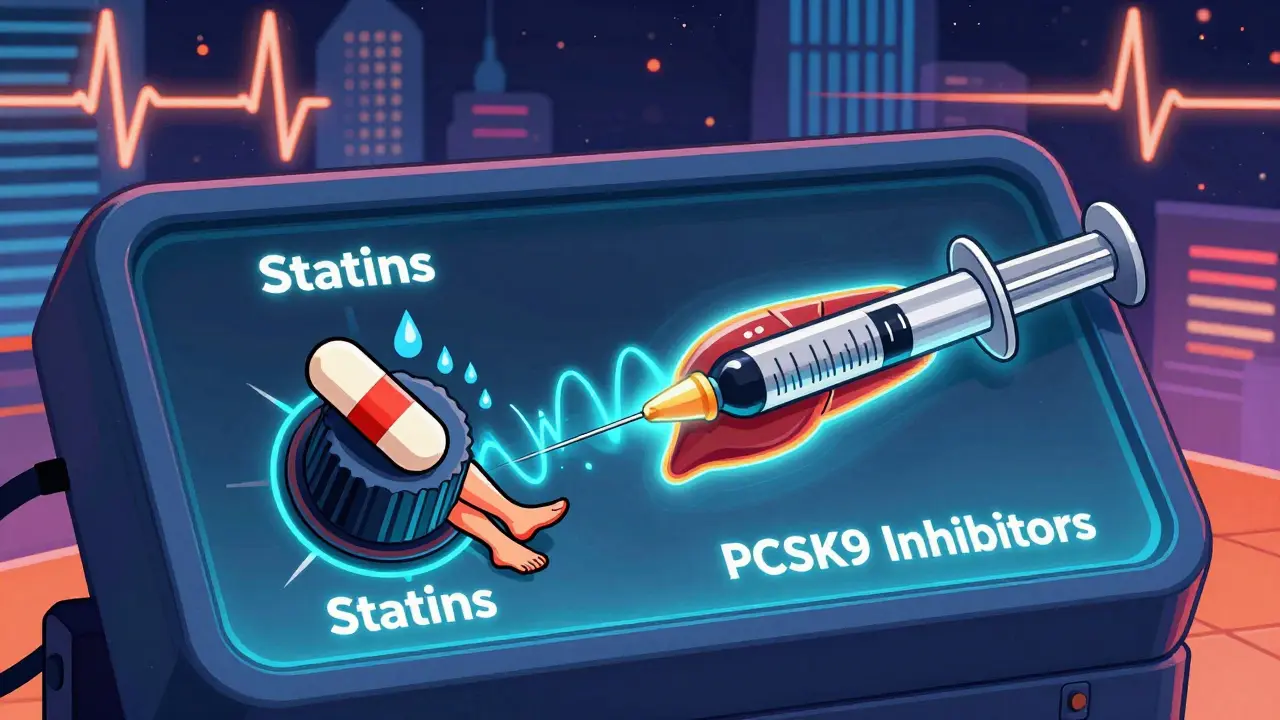
When it comes to lowering bad cholesterol, two main players dominate the conversation: statins and PCSK9 inhibitors. Both work to reduce LDL - the kind that clogs arteries - but they’re as different as a daily pill and a monthly injection. If you’ve been told you need to lower your cholesterol, you’ve probably heard about statins. But if your LDL won’t budge, or you can’t tolerate statins, PCSK9 inhibitors might be your next step. So which one’s right for you? Let’s break down the real differences in side effects, how well they work, and who actually benefits.
How Statins Work - And Why So Many People Take Them
Statins have been the go-to for cholesterol control since the 1980s. They block an enzyme in your liver called HMG-CoA reductase, which your body uses to make cholesterol. Less production means less LDL circulating in your blood. The result? A 30% to 50% drop in LDL, depending on the dose and type.
What makes statins so popular isn’t just how well they work - it’s how long we’ve known they work. Decades of data show they cut heart attacks, strokes, and deaths in people with heart disease. They’re also dirt cheap. Generic versions like atorvastatin and simvastatin cost as little as $4 to $10 a month. That’s why over 40 million Americans take them.
But they’re not perfect. About 5% to 10% of people can’t handle them because of muscle pain - sometimes so bad they have to stop. Others report brain fog, fatigue, or digestive issues. A 2023 study in Mayo Clinic Proceedings found that muscle-related side effects are the #1 reason people quit statins. And while rare, statins can slightly raise the risk of hemorrhagic stroke in certain people, especially those with high blood pressure or a history of bleeding in the brain.
PCSK9 Inhibitors: The New Kid on the Block
PCSK9 inhibitors - like alirocumab (Praluent) and evolocumab (Repatha) - came onto the scene in 2015. They don’t touch cholesterol production. Instead, they block a protein called PCSK9 that normally destroys LDL receptors on liver cells. More receptors mean your liver can pull more LDL out of your blood. The result? A 50% to 61% drop in LDL - often better than even the strongest statin.
These drugs are injected under the skin, either every two weeks or once a month. No pills. No daily routine. That’s a plus for people who hate taking meds every day. And unlike statins, they don’t interact with liver enzymes or affect muscle tissue. That’s why they’re often the answer for people who can’t take statins.
Studies like the FOURIER and ODYSSEY trials showed that adding a PCSK9 inhibitor to a statin cut heart attacks and strokes by nearly 30% in high-risk patients. Even more impressive? These drugs don’t seem to raise the risk of hemorrhagic stroke - a known concern with statins.
Side Effects: What You Actually Feel
Let’s talk about what matters most: how you feel on these drugs.
With statins, the big complaint is muscle pain. It’s not always dramatic - sometimes it’s just a dull ache in the shoulders or legs. But if it’s persistent, it’s enough to make people quit. Some also report memory issues or trouble sleeping, though studies haven’t proven a direct link. Liver enzyme changes happen sometimes, but serious liver damage is extremely rare.
PCSK9 inhibitors? Their side effect profile is cleaner. The most common issue is mild redness or itching at the injection site - usually goes away in a day or two. In rare cases, people develop allergic reactions or feel dizzy after injecting. But muscle pain? Almost never. That’s why users on Drugs.com give PCSK9 inhibitors a 7.9/10 rating compared to statins’ 6.8/10. One Reddit user wrote: “Switched from atorvastatin to evolocumab after 10 years of muscle pain. Life-changing.”
But there’s a catch: you have to inject them. For some, that’s a dealbreaker. Anxiety about needles, fear of messing up the injection, or just not wanting to carry syringes around can make people avoid them - even if they’re the better option medically.
Who Gets Which Drug?
Doctors don’t just pick one over the other randomly. There are clear guidelines.
If you have heart disease, diabetes, or a history of stroke - and your LDL is above 70 mg/dL - statins come first. That’s the standard. If you’re at very high risk - say, you’ve had a heart attack and your LDL is still above 100 - you might get both a statin and a PCSK9 inhibitor.
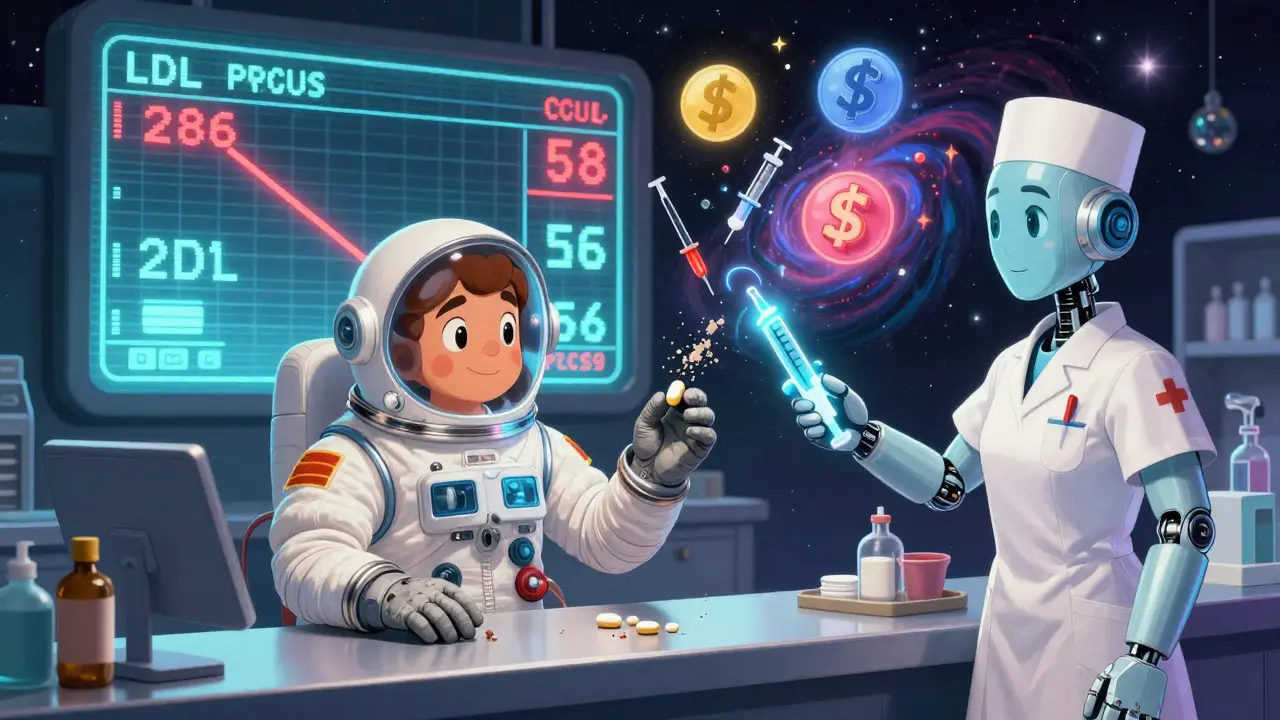
But if you’ve tried two or three statins and still have muscle pain, or your LDL won’t drop below 100 despite maximum doses, PCSK9 inhibitors become your next move. They’re also the top choice for people with familial hypercholesterolemia - a genetic condition that causes LDL levels to soar past 200 mg/dL from birth. One patient in the FH Foundation registry dropped from 286 mg/dL on high-dose rosuvastatin to 58 mg/dL after adding alirocumab.
And if you’re at higher risk for brain bleeding? PCSK9 inhibitors might be safer. UCLA research found statins slightly raise hemorrhagic stroke risk in certain groups - a risk that doesn’t appear with PCSK9 inhibitors.
Cost: The Hidden Barrier
Here’s the hard truth: PCSK9 inhibitors cost a lot. Each year, you’re looking at $5,000 to $14,000. Statins? Under $100 a year. That’s why only about 1.2 million Americans use PCSK9 inhibitors, compared to 40 million on statins.
Insurance won’t cover them unless you’ve tried and failed statins. Most insurers require proof you’ve been on the highest tolerated dose for at least 6 months. They also want lab results showing your LDL is still too high. The prior authorization process can take weeks. Some patients give up after getting denied three times.
But things are changing. Manufacturers now offer copay cards that drop monthly costs to under $50 for many. Some Medicare Advantage plans and large employers are covering them more widely. Still, if you’re uninsured or underinsured, the price tag is a major roadblock.
What About Other Options?
Statins and PCSK9 inhibitors aren’t the only tools. Ezetimibe (Zetia) lowers LDL by about 15-20% and can be added to statins for a modest boost. Bempedoic acid (Nexletol) works in the liver like a statin but doesn’t enter muscles - so fewer muscle side effects. Then there’s inclisiran (Leqvio), a newer injection that silences the PCSK9 gene. You only need two shots a year. It’s not as potent as the monthly PCSK9 inhibitors, but it’s easier to stick with.
And there’s more on the horizon. Merck’s oral PCSK9 inhibitor, MK-0616, showed 60% LDL reduction in early trials. If approved, it could change everything - no needles, no injections, just a pill. Phase III results are expected in 2026.

Long-Term Safety: What We Know So Far
Statins have 40 years of safety data. We know they’re safe for decades. PCSK9 inhibitors? The longest studies go to about 5 years. And they look good. No increase in cancer, diabetes, or cognitive decline. The FDA and European regulators have both confirmed their safety profile. But we’re still waiting for 10- or 20-year data.
One thing’s clear: PCSK9 inhibitors don’t cause the same muscle or liver issues as statins. And because they’re not metabolized by the liver, they’re safer for people with liver disease or those taking multiple medications.
Real-World Decisions: What Patients Actually Do
Here’s what you won’t hear in a doctor’s office: many people switch to PCSK9 inhibitors not because of science - but because they’re tired of pain.
One 58-year-old man with a history of heart attack had been on rosuvastatin for 8 years. He had constant leg cramps. His LDL was 92 mg/dL - too high. He switched to evolocumab. Muscle pain vanished. His LDL dropped to 41 mg/dL. He now says, “I didn’t realize how much pain I was living with until it was gone.”
On the flip side, a 65-year-old woman with high cholesterol couldn’t afford the $1,200 monthly copay after her insurance changed. She went back to a low-dose statin and accepted a higher LDL. “I’d rather have a little more risk than no meds at all,” she said.
It’s not just about numbers. It’s about quality of life. Can you take the drug? Can you afford it? Will you stick with it? Those questions matter as much as the lab results.
Final Take: Statins First - But PCSK9 Inhibitors Are a Game-Changer
Statins are still the foundation. They’re proven, cheap, and effective for most people. But if you’ve hit a wall - muscle pain, stubborn LDL, or high stroke risk - PCSK9 inhibitors offer something statins can’t: powerful LDL reduction without the muscle side effects.
They’re not for everyone. But for the right person - someone with familial hypercholesterolemia, a history of heart disease, or statin intolerance - they can be life-changing. And with oral versions and cheaper options coming, they’ll likely become more common in the next five years.
The bottom line? Don’t assume one size fits all. Talk to your doctor about your goals, your side effects, and your budget. Your cholesterol numbers matter - but so does how you feel every single day.
Can PCSK9 inhibitors replace statins completely?
For most people, no. Statins are still the first-line treatment because they’re proven to reduce heart attacks and deaths over decades, and they’re affordable. PCSK9 inhibitors are usually added to statins or used only if statins aren’t tolerated. But in rare cases - like severe familial hypercholesterolemia or true statin intolerance - they may be used alone.
Do PCSK9 inhibitors cause weight gain or diabetes?
No. Large clinical trials have shown no link between PCSK9 inhibitors and weight gain, new-onset diabetes, or increased blood sugar. This is different from statins, which can slightly raise blood sugar in some people - though the cardiovascular benefits still outweigh that risk for most.
How long does it take for PCSK9 inhibitors to work?
You’ll usually see your LDL drop within 2 to 4 weeks after the first injection. The full effect - often a 50%+ reduction - is typically reached by 8 to 12 weeks. Your doctor will check your levels after 12 weeks to see how you’re responding.
Are there any long-term risks with PCSK9 inhibitors?
So far, no major long-term risks have been found in 5-year studies. There’s no evidence of increased cancer, cognitive decline, or liver damage. The biggest concern remains cost and access - not safety. Ongoing studies are tracking patients beyond 10 years, but current data is reassuring.
Can I switch from a statin to a PCSK9 inhibitor without tapering?
Yes. You don’t need to gradually reduce your statin before starting a PCSK9 inhibitor. Many patients start the injection while continuing their statin, especially if they’re at high risk. If you’re switching because of side effects, your doctor may stop the statin right away. Always follow your provider’s guidance - don’t stop or change meds on your own.
Uju Megafu
January 21, 2026 AT 11:05Statins are a joke. I’ve seen so many people on them who are just dragging themselves through life-fatigued, brain-dead, achy-and still their LDL is 110. Meanwhile, PCSK9 inhibitors? Clean. Clean. Clean. Why are we still pretending statins are the gold standard when they’re just a cheap band-aid for lazy doctors? This isn’t medicine, it’s corporate convenience.
MAHENDRA MEGHWAL
January 21, 2026 AT 23:07While I appreciate the comprehensive overview, I must respectfully emphasize that the comparative efficacy and safety profiles of both therapeutic modalities require rigorous contextualization within individual patient phenotypes. The economic burden of PCSK9 inhibitors, though substantial, must be weighed against long-term cardiovascular event reduction and quality-of-life metrics, particularly in high-risk populations.
Kevin Narvaes
January 23, 2026 AT 19:13bro statins made me feel like my muscles were made of wet cement and my brain was a dial-up connection… then i tried the shot and suddenly i could run up stairs without crying. also my doc said my ldl dropped like i just won the lottery. why is this even a debate? 🤡
Dee Monroe
January 23, 2026 AT 22:19It’s not just about the numbers on the lab report, you know? It’s about waking up without that dull ache in your thighs, it’s about not having to choose between taking your pill and being able to hold your grandchild, it’s about the quiet dignity of living without the constant low-grade suffering that statins inflict on so many people-especially those who aren’t even in the highest risk category. PCSK9 inhibitors don’t just lower cholesterol-they restore agency. And that’s something no algorithm or cost-benefit spreadsheet can ever quantify.
Philip Williams
January 25, 2026 AT 21:02Given the data presented, it is imperative to consider adherence rates in addition to clinical outcomes. While PCSK9 inhibitors demonstrate superior LDL reduction, their suboptimal adherence due to injection burden and cost may negate their theoretical advantages. A comparative analysis of real-world persistence rates would provide greater clinical insight.
Ben McKibbin
January 26, 2026 AT 02:11Let’s be real-statins are the pharmaceutical equivalent of duct tape on a leaking boat. They work, sure, but they’re messy, crude, and leave you feeling like you’ve been dragged through a gravel pit. PCSK9 inhibitors? Precision engineering. They don’t just fix the problem-they redesign the whole damn system. And yes, they’re expensive. But so was the first iPhone. The market will adapt. The science is undeniable. Stop clinging to the past because it’s cheap.
Melanie Pearson
January 26, 2026 AT 08:38It is unconscionable that American healthcare prioritizes profit over patient well-being. These drugs are proven, safe, and life-saving-yet access is restricted by insurance gatekeepers and corporate greed. The fact that a 58-year-old man must suffer chronic muscle pain because he cannot afford a $50 monthly copay is a moral failure of the highest order. This is not medicine. This is exploitation dressed in white coats.
Rod Wheatley
January 28, 2026 AT 01:11For anyone still on the fence: I’ve been prescribing PCSK9 inhibitors for 4 years now. The patients who switch from statins? They come back with tears in their eyes, saying, ‘I didn’t know I was this tired.’ Their energy returns. Their sleep improves. Their mood lifts. And yes, the injection site might sting for a second-but that’s nothing compared to the daily torture of statin myopathy. If you’re intolerant? Don’t suffer. Don’t wait. Advocate. Push. Your life is worth more than a $10 pill.