MS Relapse vs. Pseudorelapse: How to Tell Them Apart and When Steroids Really Help
 Dec, 1 2025
When your MS symptoms suddenly get worse, it’s natural to panic. Is this a real relapse - a sign your disease is actively attacking your nervous system? Or is it just a pseudorelapse, a temporary flare-up caused by something simple like a fever or a hot shower? The difference matters a lot. Getting it wrong can mean unnecessary steroids, avoidable side effects, and even hospitalization - all for a problem that doesn’t need them.
What’s a True MS Relapse?
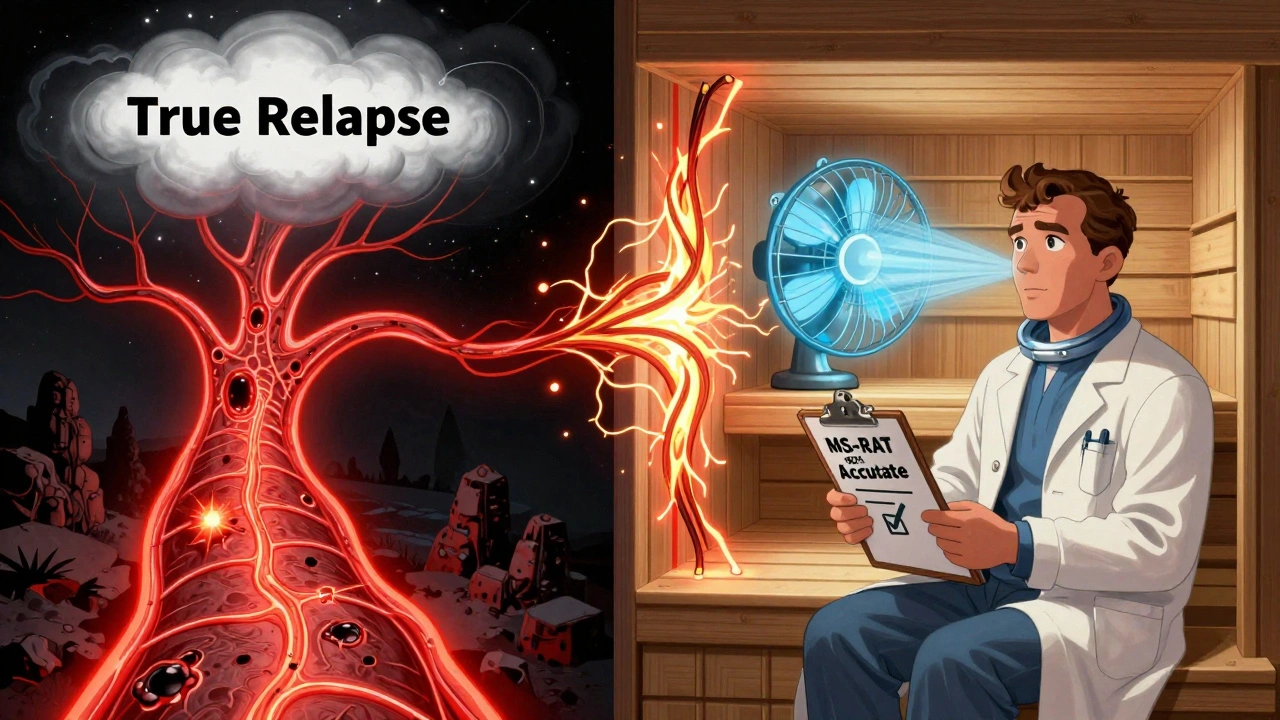
A true MS relapse happens when your immune system launches a new attack on the myelin sheath around your nerves. This causes fresh inflammation and damage. It’s not just your old symptoms getting worse - it’s something new, or a major jump in severity that lasts at least 24 to 48 hours, with no other obvious cause.Think of it like a fire breaking out in a part of your nervous system that was previously quiet. You might suddenly lose feeling in your leg, develop double vision, or have trouble walking that wasn’t there before. These symptoms don’t come and go with the weather or a bad night’s sleep. They stick around.
Doctors use MRI scans to confirm a true relapse. If you have new or active lesions - bright spots on the scan that show inflammation - that’s a strong sign. These lesions mean your immune system is actively causing damage. Without treatment, symptoms can linger for weeks or months. Even after they improve, some damage often remains, adding up over time.
What’s a Pseudorelapse?
A pseudorelapse looks just like a relapse. Your legs feel heavy. Your vision blurs. Your balance is off. But here’s the catch: there’s no new damage. No new inflammation. No new lesions on your MRI.Your nerves are already scarred from past MS attacks. Now, something is temporarily messing with how well those damaged nerves can send signals. It’s like a frayed wire that works fine until it gets too hot - then it shorts out. Take away the heat, and it works again.
Common triggers include:
- Heat - hot showers, summer weather, saunas, even a fever
- Urinary tract infections (UTIs) - the #1 trigger, affecting nearly 7 out of 10 people who experience pseudorelapses
- Other infections - colds, flu, sinus infections
- Stress - emotional or physical
- Physical exhaustion
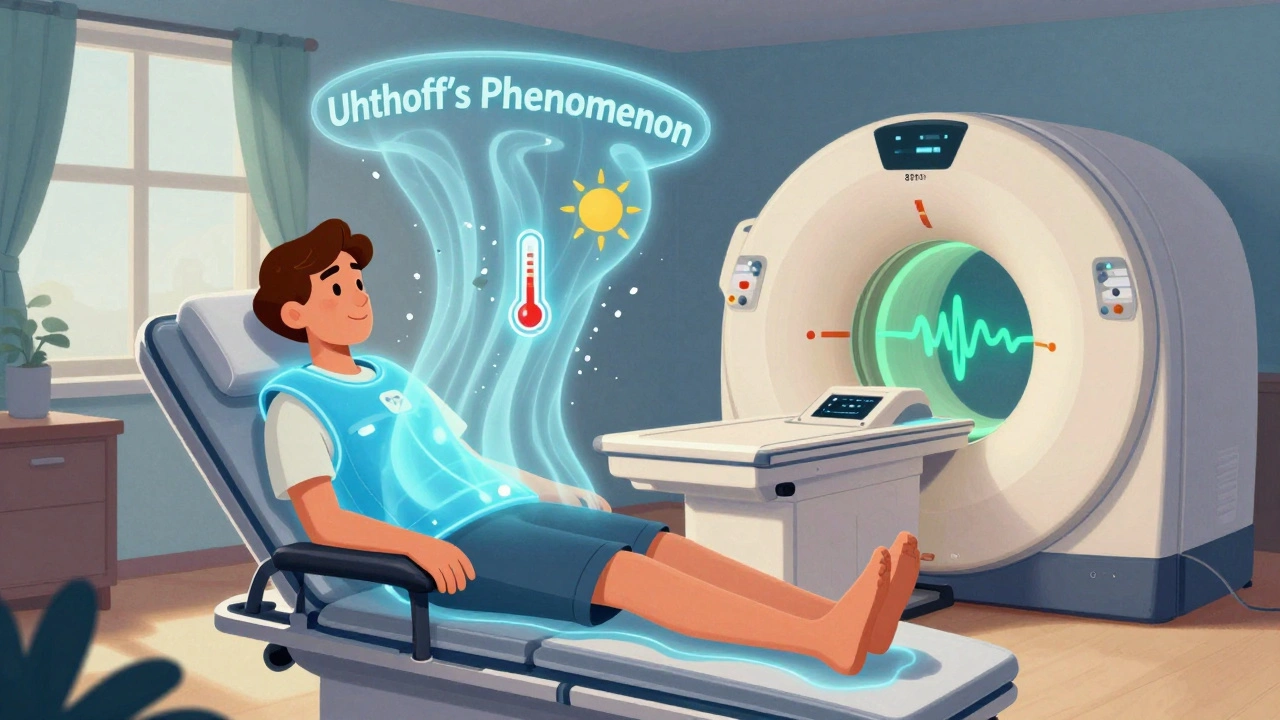
Uhthoff’s phenomenon is a classic example. If you’ve had optic neuritis before, your vision might get blurry or dark when your body temperature rises - even from a brisk walk on a warm day. It’s not new damage. It’s your optic nerve, already scarred, struggling to work under heat stress. Cool down, and your vision returns - often within minutes.
Why Steroids Don’t Help with Pseudorelapses
High-dose IV steroids like methylprednisolone are the go-to treatment for true MS relapses. They work by calming down the immune system’s attack, reducing inflammation, and speeding up recovery. About 70-80% of people see faster improvement with steroids.But if you’re having a pseudorelapse? Steroids do nothing. There’s no inflammation to stop. Your nerves aren’t being attacked - they’re just overheated, tired, or fighting off an infection.
And here’s the problem: giving steroids when they’re not needed causes real harm. About 25% of patients develop high blood sugar. 40% get terrible insomnia. 30% experience mood swings, anxiety, or even hallucinations. One nurse on Reddit reported a patient who ended up in the hospital with steroid-induced psychosis after being misdiagnosed with a relapse.
Studies show that 30-40% of pseudorelapses are mistakenly treated with steroids. That’s not just wasted money - it’s dangerous. The National MS Society estimates this mismanagement costs the U.S. healthcare system over $12 million a year.
How to Tell the Difference
There’s no single test, but there’s a clear process. If your symptoms flare up, ask yourself:- How long have they lasted? If they’re gone in under 24 hours, it’s likely a pseudorelapse. True relapses stick around.
- What changed right before it started? Did you get sick? Run a fever? Spend hours in the sun? Take a hot bath? These are huge red flags for pseudorelapse.
- Did your symptoms improve after cooling down or treating the infection? If yes - that’s your answer.
Doctors will usually check for:
- Temperature (fever above 100.4°F is a major clue)
- Urinalysis (to catch UTIs)
- Blood tests (to rule out electrolyte imbalances or infection markers)
If it’s still unclear, an MRI can help. New lesions = true relapse. No new lesions = pseudorelapse. Many neurologists now use tools like the MS-Relapse Assessment Tool (MS-RAT), which combines symptom duration, temperature, and functional impact to give a probability score - 92% accurate in recent studies.
Who’s Most at Risk for Pseudorelapses?
Pseudorelapses become more common the longer you’ve had MS. Why? Because your nervous system has more damaged pathways. Even a small stressor - like a mild cold or a warm day - can overload those weakened signals.Older patients, especially those over 55 with significant disability, are more likely to have trouble bouncing back after a pseudorelapse. It’s not because the pseudorelapse caused damage - it’s because their bodies are less able to recover from the strain. About 15% of these patients don’t return to their normal function, even after the trigger is gone.
Women with MS are more likely to get UTIs - the top trigger - so they may experience pseudorelapses more often. But men with progressive MS are more likely to have severe relapses, especially involving the cerebellum or motor control.
What to Do Instead of Reaching for Steroids
If you suspect a pseudorelapse, don’t rush to the ER for IV steroids. Do this:- Cool down. Use cooling vests, cold packs, air conditioning, or a cool shower. For Uhthoff’s phenomenon, this alone can fix symptoms in minutes.
- Treat the infection. If you have a UTI, get antibiotics. If you have a cold, rest and hydrate.
- Reduce stress. Try deep breathing, light stretching, or meditation. Stress can raise your body’s inflammatory markers, making symptoms worse.
- Track your triggers. Keep a simple journal: date, symptoms, temperature, sleep, stress level, any illness. You’ll start seeing patterns.
One patient, MSWarrior2020, shared how her neurologist taught her to use a cooling vest during summer heatwaves. Her leg weakness vanished within two hours - no drugs, no hospital visit.

When to Call Your Neurologist
You don’t need to guess alone. Call your neurologist if:- Symptoms last more than 48 hours without improvement
- You have a fever or signs of infection that won’t go away
- Your symptoms are severe - trouble walking, bladder/bowel control, or vision loss
- You’re unsure whether it’s a relapse or pseudorelapse
Don’t wait. Even if it turns out to be a pseudorelapse, your doctor needs to know. It helps them adjust your care plan and avoid future mistakes.
The Bigger Picture
Pseudorelapses aren’t just annoying - they’re a sign your nervous system is hanging by a thread. Every time your nerves get overloaded, it’s a reminder that your MS is still there, even if it’s not actively attacking.Managing triggers isn’t about avoiding life - it’s about protecting your function. Stay cool in summer. Treat infections fast. Rest when you’re tired. Track what makes your symptoms worse. These aren’t small details. They’re part of your long-term strategy to stay as independent as possible.
And remember: you’re not imagining it. Your symptoms are real - even if the cause isn’t new damage. Too many people are told they’re just "stressed" or "overreacting." That’s wrong. You need to be heard. You need to be tested. You need to be treated correctly.
Can a pseudorelapse turn into a true relapse?
No, a pseudorelapse itself doesn’t turn into a true relapse. But the same trigger - like a UTI or fever - can also spark a real immune attack. That’s why it’s important to treat infections quickly. A pseudorelapse doesn’t mean your MS is worsening, but it can be a warning sign that your body is vulnerable.
Do I need an MRI every time my symptoms get worse?
Not always. If your symptoms clearly match a known trigger - like a fever or heat exposure - and they improve quickly, an MRI isn’t needed. But if symptoms last longer than 48 hours, are severe, or happen without a clear cause, your neurologist will likely order one to rule out a true relapse.
Why do some doctors still give steroids for pseudorelapses?
Many doctors - especially outside MS specialty centers - aren’t trained to recognize the difference. A patient walks in with leg weakness, and the default is steroids. It’s faster than ruling out infections or checking temperature. But studies show neurologists who specialize in MS get it right 85% of the time, while general neurologists and primary care doctors are only right 45-60% of the time. Better education and tools like the MS-RAT are helping close this gap.
Can stress really trigger a pseudorelapse?
Yes. Stress doesn’t cause MS damage, but it can raise your body’s stress hormones, which temporarily interfere with nerve signal transmission. This is especially true if your nerves are already damaged. Many patients report symptom flares during high-pressure work periods, family crises, or sleep deprivation. Managing stress isn’t just good mental health - it’s part of MS management.
Are there any new tests to tell relapses from pseudorelapses?
Yes. The MS-Relapse Assessment Tool (MS-RAT), validated in 2023, uses symptom duration, temperature, and functional impact to give a probability score with 92% accuracy. Researchers are also studying blood tests for neurofilament light chain - a protein released when nerves are damaged. If levels are high, it suggests a true relapse. These tools aren’t everywhere yet, but they’re coming fast.
John Biesecker
December 3, 2025 AT 05:03man i thought i was the only one who got that weird leg weakness after a hot shower 😅 turns out it’s uhthoff’s phenomenon?? like… my neuro said "just rest" but now i know it’s not laziness, it’s my nerves being drama queens 🥲
Genesis Rubi
December 3, 2025 AT 07:26why do we even need a fancy tool for this? in america we got doctors who know their shit. if you're getting steroids for no reason, you're probably just a hypochondriac. stop overthinking and go work out.
Doug Hawk
December 4, 2025 AT 01:06the key insight here is that pseudorelapses are essentially neurometabolic interference-not demyelination. the axons are intact but conduction is compromised by thermal or metabolic stressors. so steroids are irrelevant because they target cytokine cascades, not ion channel dysfunction. the ms-rat tool is a step forward, but we need biomarkers like nfl to differentiate at the molecular level. also, utis are the silent villains here-always rule those out first.
Michael Campbell
December 4, 2025 AT 08:39they're lying about steroids. big pharma makes billions off this. they want you dependent. i got misdiagnosed twice. now i use ice packs and never trust a doctor again. 🤡
Saravanan Sathyanandha
December 5, 2025 AT 17:29in india, we call this "nervous system fatigue"-and our elders say, "rest, hydrate, and eat turmeric." it’s fascinating how modern neurology confirms what traditional wisdom knew all along. the body speaks; we just stopped listening. thank you for this clear guide-it’s a lifeline.
alaa ismail
December 7, 2025 AT 01:36i’ve had 3 of these and each time i thought i was dying. turns out i just needed a cold drink and a nap. wow.
ruiqing Jane
December 8, 2025 AT 22:39This is exactly the kind of information that should be in every neurology office, on every MS pamphlet, and taught in med school. Thank you for writing this with such clarity. You’ve just saved someone from unnecessary steroids-and possibly a psychiatric hospital stay. This is advocacy in action.
Fern Marder
December 10, 2025 AT 03:51heat = bad. stress = bad. infections = worse. 🤦♀️ why do we still treat this like it’s a mystery? it’s not. it’s basic neurology. if your leg feels like jelly after a hot tub, take a cold shower. duh.
Carolyn Woodard
December 10, 2025 AT 04:56the absence of new lesions doesn’t equate to absence of suffering. pseudorelapses are real in their impact-even if they’re not real in their pathology. we need more validation for patients who are told "it’s all in your head" when their body is screaming otherwise. the ms-rat is promising, but we still lack systemic empathy in clinical practice.
Allan maniero
December 12, 2025 AT 04:52it’s worth noting that in the uk nhs, access to mri is often delayed, so clinicians rely heavily on clinical history and trigger identification-making the ms-rat even more valuable in resource-limited settings. i’ve seen patients wait six weeks for a scan, only to find no new lesions. they were told it was a pseudorelapse all along, but without the tool, it took far too long to confirm. education and tools like this can reduce diagnostic inertia across the board.
Anthony Breakspear
December 12, 2025 AT 12:17cooling vest? genius. i just got one last summer and it’s like my legs finally remembered how to work. no drugs, no drama. just chill vibes and a good vest. if you’re struggling with heat, just try it. it’s not magic, it’s science. 🤘
Zoe Bray
December 12, 2025 AT 23:37the differential diagnosis between true relapse and pseudorelapse constitutes a critical clinical paradigm in the management of multiple sclerosis. the integration of objective biomarkers such as neurofilament light chain with validated clinical assessment tools like the ms-rat represents a paradigm shift toward precision neurology. it is imperative that healthcare systems prioritize training and implementation to mitigate iatrogenic harm from inappropriate steroid administration.
Girish Padia
December 13, 2025 AT 17:08you people are too soft. if your legs don’t work, you should walk through pain. no excuses. america is weak. we used to just deal with it.
Saket Modi
December 15, 2025 AT 06:04lol why even write all this? just take the steroids. who cares if you get insomnia? at least your legs work for a week. 😴