Liver Disease and Drug Metabolism: How Reduced Clearance Affects Medication Safety
 Jun, 8 2026
Liver Disease Dose Adjustment Calculator
Estimate recommended dose reductions for medications in patients with hepatic impairment based on Child-Pugh classification and drug extraction ratio.
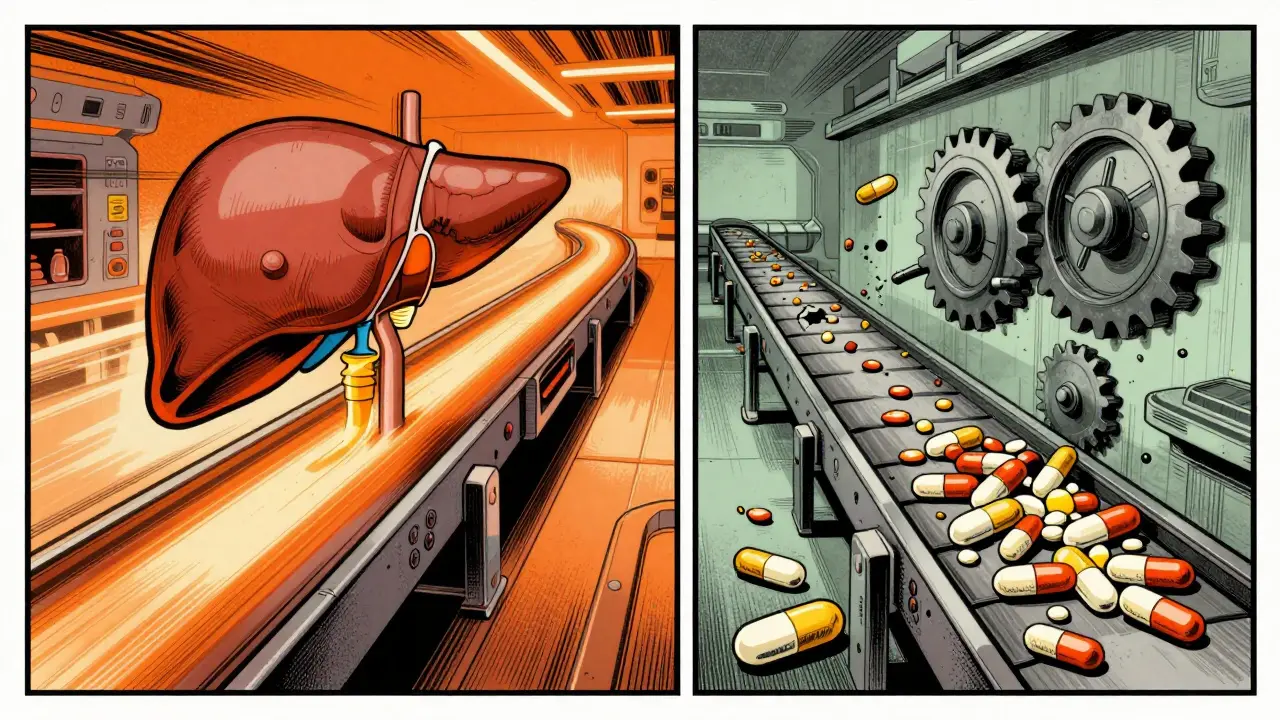
Imagine taking a standard dose of painkiller or anxiety medication, only to find it lingering in your system for days instead of hours. For the millions of people living with chronic liver disease, this isn't a hypothetical scenario-it's a daily clinical reality. The liver acts as the body's primary chemical processing plant, breaking down medications so they can be safely eliminated. When that organ is damaged, its ability to clear drugs drops significantly, leading to dangerous accumulation and unpredictable side effects.
In 2024, the CDC reported that 22.5 million Americans live with chronic liver conditions. This massive patient population faces a complex pharmacological challenge: standard drug doses often become toxic. Understanding how hepatic clearance fails in these patients is not just academic; it is a matter of life and death. Whether you are a healthcare provider adjusting prescriptions or a patient managing multiple conditions, grasping the mechanics of reduced drug metabolism is essential for safety.
The Mechanics of Hepatic Impairment
To understand why drugs accumulate, we need to look at what happens inside a diseased liver. According to the 2025 Merck Manual, reviewed by experts like Dr. Danielle Tholey, liver disease alters drug handling through several specific pathways. It’s not just about one thing slowing down; it’s a systemic breakdown involving blood flow, enzyme activity, and protein binding.
First, consider blood flow. In healthy individuals, the liver receives about 1.5 liters of blood per minute. In advanced cirrhosis, this flow can drop to 0.8-1.0 L/min due to structural changes and scarring. More critically, up to 40% of blood may bypass the liver entirely through portosystemic shunts. This means orally administered drugs skip their first pass through the liver, entering the bloodstream directly and increasing their bioavailability unexpectedly.
Second, the cellular machinery slows down. The liver relies on enzymes, particularly the cytochrome P450 family, to break down chemicals. Research published in the British Journal of Clinical Pharmacology (2024) shows that in advanced cirrhosis:
- CYP2E1 activity drops by 40-60%.
- CYP3A4 activity decreases by 30-50%.
- Transport proteins like OATP1B1 lose 50-70% of their function.
These reductions mean that drugs relying on these pathways stay in the body much longer. For example, if a drug normally has a half-life of 4 hours, it might linger for 8 to 10 hours in a patient with moderate impairment. This prolongation leads to higher peak concentrations and a greater risk of toxicity.
High-Extraction vs. Low-Extraction Drugs
Not all medications behave the same way in a compromised liver. Pharmacologists categorize drugs based on their "extraction ratio"-the percentage of drug removed from the blood during a single pass through the liver. This distinction dictates how dosage adjustments should be made.
| Drug Type | Extraction Ratio | Clearance Depends On | Effect of Liver Disease | Examples |
|---|---|---|---|---|
| High-Extraction | > 0.7 | Liver Blood Flow | Significant increase in bioavailability; clearance drops sharply. | Fentanyl, Morphine, Propranolol |
| Low-Extraction | < 0.3 | Enzyme Capacity & Protein Binding | Clearance reduces moderately; half-life extends significantly. | Lorazepam, Diazepam, Methadone, Warfarin |
Approximately 70% of commonly prescribed drugs fall into the low-extraction category. While high-extraction drugs like fentanyl are heavily impacted by reduced blood flow, low-extraction drugs like diazepam are more sensitive to the loss of enzymatic capacity. This nuance matters because a blanket "reduce all doses" approach doesn't work. You must know which lever is pulling the clearance rate for each specific medication.
Assessing Severity: Child-Pugh and MELD Scores
You cannot adjust doses effectively without quantifying the severity of the liver damage. Clinicians rely on two primary scoring systems: the Child-Pugh-Turcotte classification and the Model for End-Stage Liver Disease (MELD) score.
The Child-Pugh classification evaluates five parameters: bilirubin levels, albumin levels, INR (clotting time), ascites (fluid buildup), and hepatic encephalopathy. Patients are categorized into Class A (mild), B (moderate), or C (severe). For instance, Class C is defined by bilirubin >3.0 mg/dL, albumin <2.8 g/dL, and INR >2.3. The FDA guidance (2023) recommends using this system rather than isolated lab values because liver function is multifactorial.
Alternatively, the MELD score focuses on objective lab data to predict short-term mortality. Dr. William M. Lee notes that for every 5-point increase in the MELD score above 10, drug clearance decreases by approximately 15%. This linear relationship provides a practical heuristic for clinicians: higher MELD scores demand more aggressive dose reductions.
Clinical Guidelines for Dose Adjustments
So, how much should you reduce the dose? The answer depends on the drug class and the severity of the impairment. The American Association for the Study of Liver Diseases (AASLD) 2024 guidelines provide clear recommendations:
- Child-Pugh Class B (Moderate): Reduce doses of high-hepatic-extraction drugs by 25-50%.
- Child-Pugh Class C (Severe): Reduce doses by 50-75%.
Specific drug classes require special attention. Benzodiazepines, for example, are notorious for causing sedation and confusion in liver patients. The European Association for the Study of the Liver (EASL) 2023 consensus states that benzodiazepines with active metabolites, such as diazepam, require a 50-70% dose reduction in cirrhosis. In contrast, those without active metabolites, like lorazepam, need only a 25-40% reduction. Choosing lorazepam over diazepam is a strategic move to minimize accumulation risks.
Warfarin presents another critical case. Its clearance drops by 30-50% in cirrhosis, necessitating 25-40% dose reductions to maintain therapeutic INR levels. Without adjustment, patients face a heightened risk of bleeding. Conversely, some drugs require no change. Sugammadex, which is 96% renally excreted, needs no dose reduction in mild-to-moderate liver dysfunction, though recovery times may still be slightly prolonged.

Real-World Risks and Adverse Events
The consequences of ignoring these pharmacokinetic shifts are severe. A study in the New England Journal of Medicine (2023) highlighted that inappropriate dosing of direct-acting antivirals in patients with advanced liver disease resulted in a 22.7% treatment failure rate, compared to just 5.3% with proper adjustments. This isn't just about efficacy; it's about safety.
Cerebral sensitivity also plays a role. Patients with chronic liver disease have a 30-50% enhanced sensitivity to opioids and sedatives. Standard doses can precipitate hepatic encephalopathy-a state of altered consciousness caused by toxin buildup. Furthermore, antibiotic dosing poses frequent challenges. Ceftriaxone, for instance, can reach 40-60% higher peak concentrations in cirrhotic patients due to reduced clearance, increasing the risk of neurotoxicity.
Interestingly, while adverse drug reactions aren't statistically more likely in advanced liver disease (odds ratio 1.15), patients tolerate them far worse due to reduced functional reserve. A minor side effect in a healthy person could be catastrophic in someone with end-stage liver disease.
Future Directions: Precision Dosing
The landscape of pharmacotherapy in liver disease is evolving. The FDA approved 18 new medications in 2023 with specific dosing recommendations for hepatic impairment, a 25% increase from the previous year. Regulatory bodies now mandate hepatic impairment studies for new drugs, ensuring better data for clinicians.
Advanced modeling techniques, such as Physiologically Based Pharmacokinetic (PBPK) modeling, are gaining traction. These models predict drug exposure with 85-90% accuracy by incorporating variables like hepatic blood flow and hepatocellularity. Experts predict that within five years, 70% of new drug labels will include model-based dosing recommendations. Additionally, personalized approaches combining genetic polymorphisms (like CYP2C9*3 alleles) with liver function tests are expected to replace broad population-based guidelines, offering safer, more tailored care for this vulnerable population.
Which drugs do not require dose adjustment in liver disease?
Drugs that are excreted entirely via renal routes with no hepatic involvement generally do not require dose adjustment. Additionally, drugs metabolized minimally by the liver (<20%) with a wide therapeutic range may not need changes. Examples include certain antibiotics like ceftriaxone (though monitoring is advised) and sugammadex, which is primarily renally cleared.
How does cirrhosis affect opioid metabolism?
Cirrhosis significantly reduces the clearance of opioids, especially high-extraction drugs like morphine and fentanyl. Blood flow reduction and decreased enzyme activity cause these drugs to accumulate. Moreover, cerebral sensitivity to opioids increases by 30-50%, meaning standard doses can lead to excessive sedation or respiratory depression. Dose reductions of 50-75% are often necessary in severe cases.
What is the difference between Child-Pugh Class B and C dosing?
Child-Pugh Class B indicates moderate liver impairment, while Class C indicates severe impairment. For high-hepatic-extraction drugs, Class B typically requires a 25-50% dose reduction, whereas Class C requires a more aggressive 50-75% reduction. Class C patients have lower albumin, higher bilirubin, and worse clotting profiles, necessitating stricter caution to avoid toxicity.
Why are benzodiazepines risky for patients with liver disease?
Benzodiazepines are risky because they are metabolized by the liver and can cause profound sedation. Those with active metabolites (e.g., diazepam) accumulate significantly, requiring 50-70% dose reductions. Even those without active metabolites (e.g., lorazepam) need 25-40% reductions. The enhanced cerebral sensitivity in liver disease patients makes them prone to hepatic encephalopathy and falls.
How does PBPK modeling improve drug dosing in liver disease?
Physiologically Based Pharmacokinetic (PBPK) modeling uses computer simulations to predict how drugs behave in the body based on physiological parameters like liver blood flow and enzyme levels. It offers 85-90% accuracy in predicting drug exposure in liver disease, allowing for more precise, individualized dosing recommendations compared to traditional population-based averages.