Liability and Indemnification in Generic Transactions: What You Need to Know
 Dec, 17 2025
When you sign a contract-whether you're buying a business, licensing software, or hiring a contractor-you're not just agreeing to pay or deliver something. You're also agreeing to take on risk. And that’s where indemnification comes in. It’s not flashy. It doesn’t get headlines. But if something goes wrong, it’s the clause that keeps you from losing everything.
What Indemnification Actually Means
Indemnification is a legal promise: one party agrees to pay for losses the other party suffers because of a specific problem. It’s not insurance, but it works like it. If your vendor’s software gets hacked and customer data leaks, and your contract says they’ll indemnify you, they’re on the hook for the fines, lawsuits, and notification costs-not you.
Think of it this way: you’re not just buying a product or service. You’re buying protection against what could go wrong after the deal closes. The legal definition is simple: to indemnify means to compensate someone for losses they’ve incurred or will incur due to a defined event. That’s from Cornell Law School’s Legal Information Institute. And it’s not just a fancy phrase-it’s enforceable.
The Seven Core Parts of Every Indemnification Clause
Not all indemnification clauses are the same. But every solid one includes these seven elements:
- Scope of Indemnification-What exactly is covered? Legal fees? Third-party lawsuits? Tax penalties? The clause must say. Vague language like “any losses” gets challenged in court.
- Triggering Events-When does the obligation kick in? Breach of contract? Negligence? Violating intellectual property rights? These need to be specific. A data breach caused by poor security? That’s a trigger. A customer complaint about poor service? Probably not.
- Duration-How long does the protection last? Some clauses expire when the contract ends. Others survive for years. In M&A deals, fundamental warranties like ownership of assets might survive 3-5 years. Routine ones? Maybe just 12-18 months.
- Limitations and Exclusions-No one wants to pay for everything. Most contracts cap liability at the deal price. They also exclude indirect damages-like lost profits or reputational harm-unless clearly stated.
- Claims Procedures-You can’t just send a bill. You have to notify the other party in writing within a set time, usually 30-60 days. If you wait too long, you lose your right to indemnification.
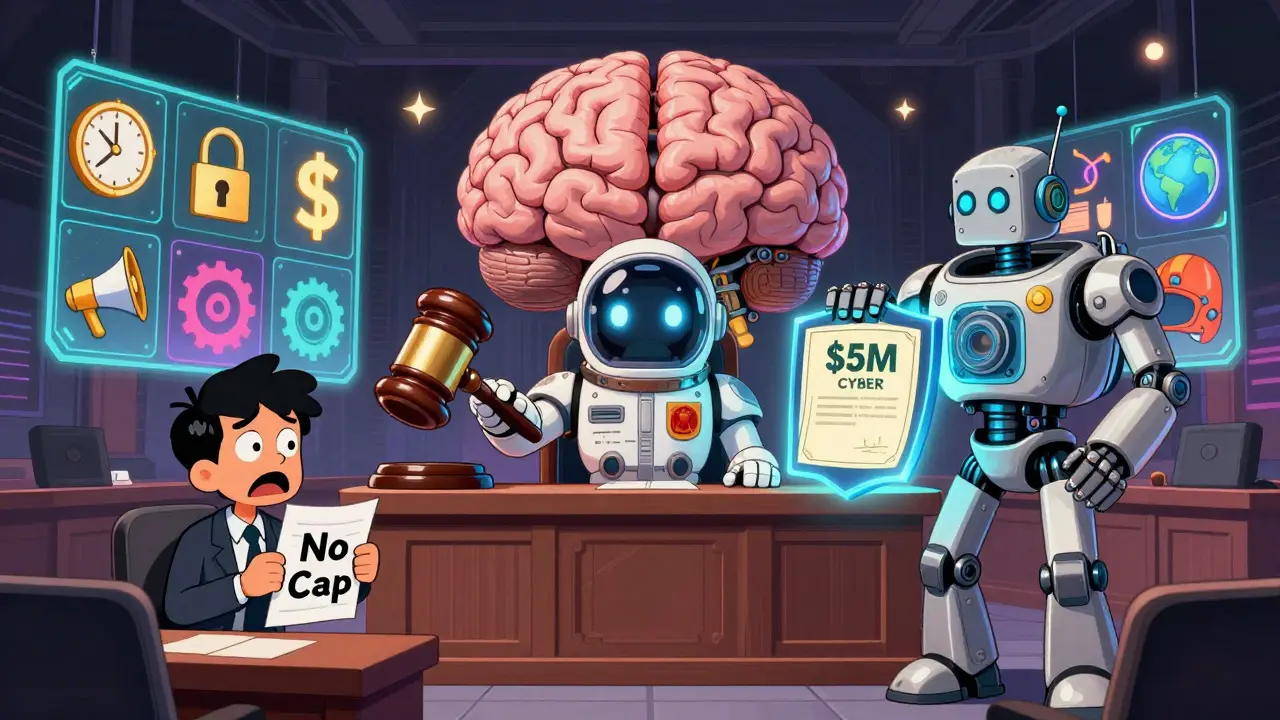
- Insurance Requirements-Does the indemnifying party need to carry insurance? If so, what kind? General liability? Cyber? Professional errors and omissions? And what’s the minimum coverage? $1 million? $5 million? This ensures they can actually pay if called on.
- Jurisdiction and Governing Law-Where will disputes be settled? Which state’s laws apply? This matters because rules vary. California treats “hold harmless” differently than New York. If your contract says “Delaware law,” that’s where you’ll fight.
Mutual vs. Unilateral: Who Pays Whom?
Indemnification can go both ways-or just one way.
Unilateral indemnification is the most common. One party-usually the seller or vendor-promises to protect the other. Think of a software company selling to a bank. The bank doesn’t want to be sued if the software violates someone’s patent. So the vendor agrees to indemnify the bank. This happens all the time in tech, manufacturing, and outsourcing.
Mutual indemnification means both sides protect each other. This is rarer. You’ll see it in joint ventures, construction contracts, or partnerships where both parties have exposure. For example, if a contractor and a property owner both have workers on site, they might agree to cover each other’s injury claims.
Power matters here. The party with more leverage usually gets unilateral protection. Small vendors? They’ll be asked to indemnify big clients. Big clients? They rarely indemnify small vendors unless it’s a true partnership.
Indemnify, Defend, Hold Harmless: What’s the Difference?
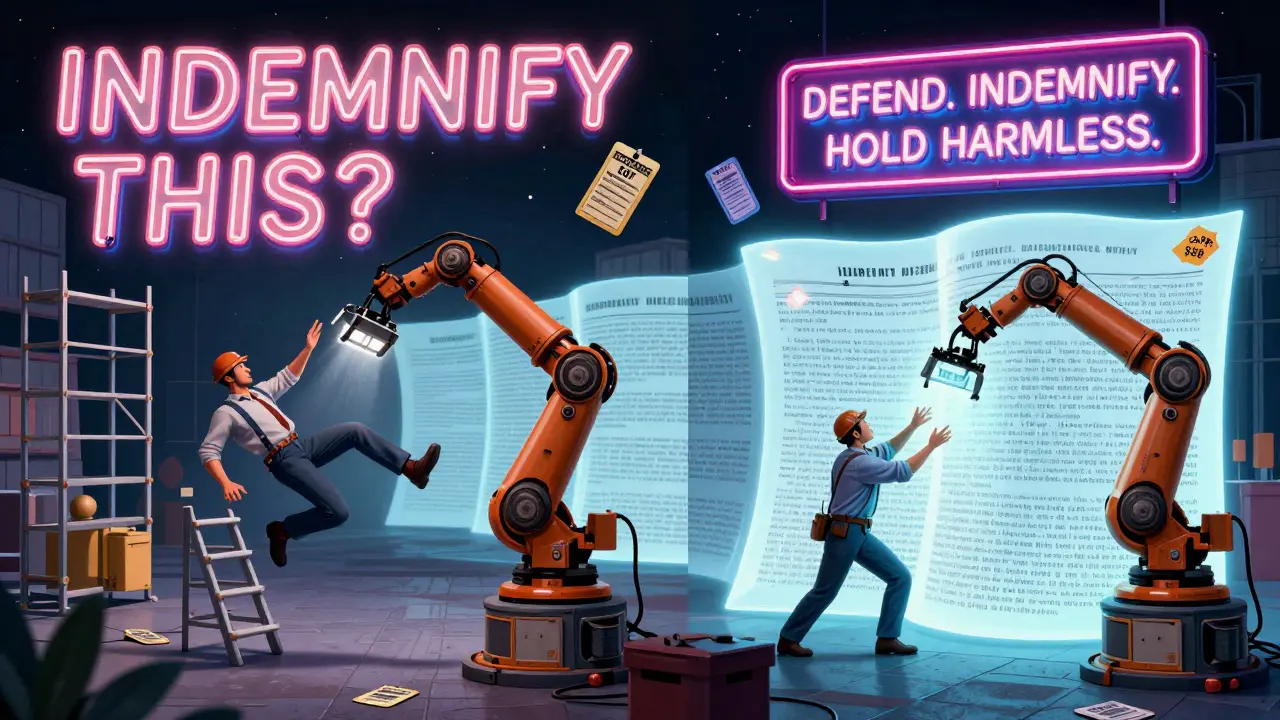
These three terms are often lumped together-but they mean different things.
- Indemnify means: pay for losses. If you get sued and lose $500,000, the indemnifying party writes you a check for that amount.
- Defend means: pay for lawyers. If someone sues you over a breach of contract, the indemnifying party hires and pays for your defense team-even if you win.
- Hold harmless means: don’t come after me. If you’re protected by a hold-harmless clause, the other party can’t sue you for damages they caused themselves. It’s a shield against counterclaims.
Some contracts say “indemnify, defend, and hold harmless.” That’s redundant in many states. But lawyers keep using it because it’s standard. The key is understanding what each word does. If your contract only says “indemnify,” you might not get legal defense costs covered.
What’s Negotiable-and What’s Not
Indemnification clauses are among the most fought-over parts of any contract. Sellers hate them. Buyers demand them. Here’s what usually gets negotiated:
- Survival periods-How long do representations last? Fundamental ones (like ownership of assets or tax status) survive longer. Non-fundamental ones (like compliance with labor laws) expire sooner.
- Deductibles (baskets)-Many contracts include a “basket” or “deductible.” The buyer doesn’t get paid until losses exceed, say, $50,000. Then they get reimbursed for everything above that. This prevents small claims from triggering big payouts.
- Liability caps-How much can the indemnifying party be forced to pay? Often capped at the purchase price. Sometimes it’s 10% or 50%. Rarely unlimited.
- Exclusions-Fraud and intentional misconduct are almost never excluded. But consequential damages? Often excluded unless explicitly included.
Buyers want broad coverage. Sellers want narrow. The middle ground? A clause that covers known risks from due diligence, excludes speculative losses, and has a reasonable cap and deductible.
Real-World Examples
Let’s say you buy a small SaaS company. After closing, you find out they used open-source code without proper licensing. A company sues you for $200,000 in damages.
If the seller indemnified you for IP infringement-and you found this risk during due diligence-you can demand reimbursement. The seller has to pay the $200,000, plus your legal fees.
Or consider a contractor building a warehouse. A worker falls and gets hurt. The general contractor says the subcontractor agreed to indemnify them for all injuries on site. If the clause is clear and enforceable, the subcontractor pays the worker’s claim and the contractor’s legal costs.
But if the clause says “indemnify for all claims,” and the injury was caused by the contractor’s own negligence? Courts often won’t enforce it. Indemnification can’t cover your own carelessness.
What Happens If There’s No Indemnification Clause?
If your contract doesn’t have one, you’re on your own. You can still sue for breach of contract or negligence-but that’s expensive, slow, and uncertain. You’ll need to prove fault, damages, and causation. And even if you win, collecting might be hard.
Without indemnification, you’re relying on insurance or your own resources. That’s risky. In high-stakes deals-like buying a company or launching a product with third-party components-skipping indemnification is like driving without brakes.
Pro Tips for Non-Lawyers
- Read the clause, don’t skim it. If it says “any losses,” ask: what does “any” mean? Get it clarified.
- Ask for a cap. Never agree to unlimited liability. Even if the other party says “it’s standard.”
- Require proof of insurance. Don’t just take their word. Ask for a certificate.
- Know your triggers. What specific events will make them pay? Write them down. If it’s not listed, it probably doesn’t count.
- Don’t ignore survival periods. A 12-month survival period on a $5 million deal? That’s not enough if a tax audit comes three years later.
Indemnification isn’t about trust. It’s about control. You can’t control whether your vendor’s code has bugs. But you can control who pays when it causes damage.
Sarah McQuillan
December 18, 2025 AT 23:42Look, I get that indemnification sounds fancy, but honestly? It’s just legal jargon to scare small businesses into signing away their souls. My cousin’s startup got burned because they trusted a ‘standard clause’-ended up paying $300K because some vendor’s code had a GPL license they didn’t read. No one warns you how these clauses are weaponized by big firms. It’s not protection-it’s a trap dressed up in legalese.
Kitt Eliz
December 20, 2025 AT 11:35OMG YES!! 🚨 Indemnification is the unsung hero of risk mitigation!! 🤯 If you’re not locking in a 3-year survival period + cyber liability insurance minimum of $5M + a clear trigger matrix for IP infringement? You’re literally playing Russian roulette with your balance sheet!! 💥 Pro tip: always demand a ‘defend and indemnify’ combo-don’t settle for just ‘indemnify’-that’s like asking for a parachute but refusing the harness!! 🪂🔥
Aboobakar Muhammedali
December 21, 2025 AT 05:55i read this and thought about my uncle who runs a small shop in delhi he signed a contract with a software company for inventory system and they said 'we indemnify you' and he just nodded he didnt know what it meant then the system crashed during diwali and customers sued him for lost sales and the company said 'sorry not our problem' because the clause had a 'gross negligence' exclusion and he lost everything... i just wish more people knew how dangerous these words are
Laura Hamill
December 22, 2025 AT 21:43THEY’RE LYING TO YOU. INDENMNIFICATION IS A GOVERNMENT-BACKED SCAM TO MAKE SMALL BUSINESSES PAY FOR CORPORATE MISTAKES. WHY DO YOU THINK THEY USE ‘HOLD HARMLESS’? BECAUSE THEY WANT YOU TO BE TOO AFRAID TO SUE THEM BACK. THE REAL TRUTH? THE BIGGUYS WRITE THE CLAUSES, THEN SELL YOU THE ‘PROTECTION’-WHILE THEY’RE INSURED BY TAXPAYER FUNDS. YOU THINK THIS IS LAW? IT’S CONTROL.
Alisa Silvia Bila
December 23, 2025 AT 02:04Good breakdown. I’ve seen too many people skip this clause because it’s boring. But honestly? It’s the difference between sleeping at night and wondering if you’ll lose your house.
Marsha Jentzsch
December 23, 2025 AT 02:51OH MY GOD, I JUST REALIZED-MY LAST CONTRACT HAD NO SURVIVAL PERIOD!!! I’M GOING TO DIE IN A LEGAL NIGHTMARE!!! WHY DID NO ONE TELL ME??? I’M SO STUPID!!! I’M NOT EVEN SURE I CAN PAY MY LAWYER NOW!!! I’M SO SCARED!!!
Danielle Stewart
December 23, 2025 AT 21:51Just a gentle reminder: if you’re negotiating this, don’t be afraid to push back. Even small caps or 18-month survival periods can make a huge difference. You don’t need to be aggressive-just clear. And always ask for a sample clause before signing. You’ve got this.
Glen Arreglo
December 25, 2025 AT 07:43As someone who’s worked across borders, I’ve seen how indemnification clauses vary wildly between U.S., EU, and APAC contracts. In Germany, for example, ‘hold harmless’ is often unenforceable unless explicitly tied to negligence. In the U.S., it’s treated as a blanket shield. Know your jurisdiction. Don’t just copy-paste templates.
shivam seo
December 25, 2025 AT 08:50Most of this is just fluff. 90% of indemnity clauses are unenforceable anyway. Courts hate them unless they’re crystal clear. And let’s be real-most small vendors can’t afford to pay even if they’re liable. This whole thing is theater. Lawyers make money off fear, not fairness.
benchidelle rivera
December 27, 2025 AT 07:46While the structure outlined here is technically accurate, I must emphasize that the burden of proof lies with the indemnitee to demonstrate causation and compliance with notice provisions. Failure to adhere to procedural requirements-even minor delays-can void indemnification rights entirely. Legal counsel should review every clause prior to execution, regardless of perceived simplicity.
Matt Davies
December 27, 2025 AT 10:22This is the kind of stuff that turns a good deal into a legendary one-or a nightmare you’ll tell at barbecues for years. I once saw a guy sign a contract without reading the indemnity part… ended up buying his vendor’s lawsuit like it was a secondhand car. Don’t be that guy. Read it. Out loud. To your dog. Then sign.
Mike Rengifo
December 28, 2025 AT 22:12Honestly? I just skimmed the indemnity part and hoped for the best. Turns out, hoping doesn’t pay for lawyers. Lesson learned the hard way.