Ketamine and Esketamine: Fast-Acting Depression Treatments Compared
 Jan, 3 2026
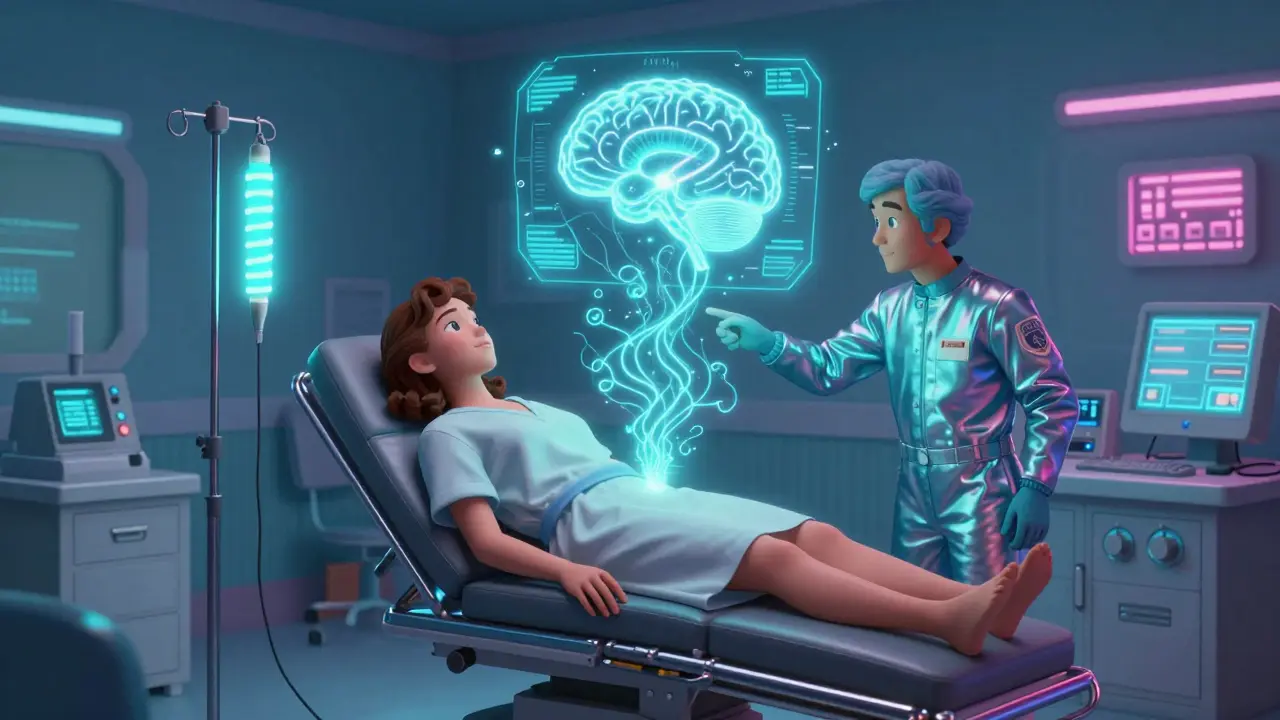
When standard antidepressants fail, people with treatment-resistant depression don’t have time to wait weeks for relief. For many, the answer lies in two powerful but very different options: ketamine and esketamine. Both work fast-sometimes within hours-but they’re not the same. Understanding the differences can mean the difference between getting better and staying stuck.
How Ketamine and Esketamine Work
Ketamine was first approved in 1970 as an anesthetic. Decades later, doctors noticed patients who received it for surgery often reported feeling better emotionally-even before the anesthesia wore off. That led to research into its antidepressant effects. Esketamine is a purified version: just the (S)-enantiomer of ketamine. It’s not a new drug, just a more targeted piece of it.
Both work by targeting glutamate, a brain chemical involved in mood, memory, and learning. Unlike SSRIs that take weeks to boost serotonin, ketamine and esketamine quickly rebuild connections between brain cells. In some patients, the shift happens after the first dose. Brain scans show increased activity in areas tied to emotional regulation within hours. This isn’t just placebo-it’s measurable neuroplasticity.
Administration: IV vs Nasal Spray
How you get the drug matters as much as what you get. IV ketamine is delivered through a vein over 40 minutes in a clinic. You’re monitored the whole time. Esketamine comes as a nasal spray-Spravato®-and you self-administer it under supervision.
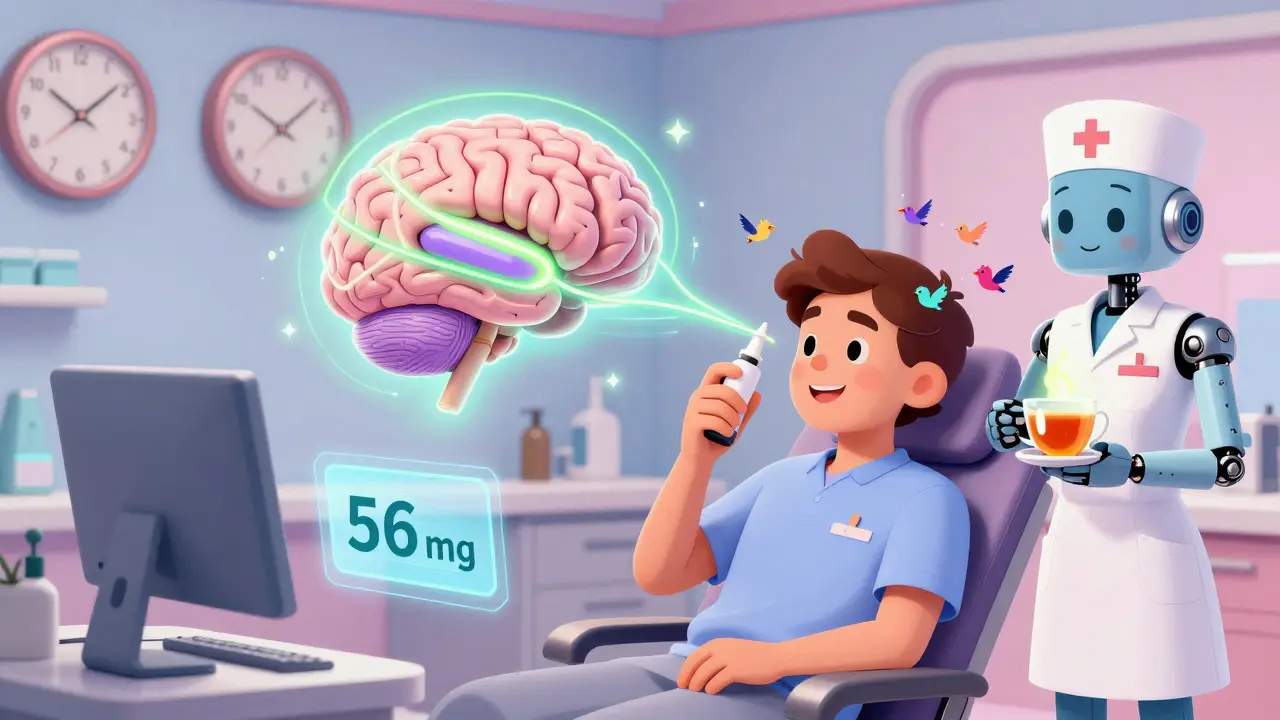
IV ketamine gives you full control over the dose. The standard is 0.5 mg per kilogram of body weight. Esketamine comes in fixed doses: 56 mg or 84 mg, sprayed into each nostril. That means less flexibility but also less variability. One big advantage of the nasal spray? No needles. For people terrified of needles or with difficult veins, that’s huge.
But there’s a catch. The body absorbs IV ketamine faster and more completely. With the nasal spray, only about 50% of the dose actually enters your bloodstream. That’s why esketamine often needs more frequent doses to catch up.
Efficacy: Which Works Better?
A 2025 study from Mass General Brigham tracked 153 adults with treatment-resistant depression. 111 got IV ketamine. 42 got esketamine. After a full course, ketamine users saw a 49.22% drop in depression scores. Esketamine users saw 39.55%. That’s not a small gap-it’s clinically meaningful.
Ketamine also acted faster. Many patients felt better after the first IV session. With esketamine, most needed at least two treatments before noticing real change. This matches earlier studies: ketamine consistently shows stronger and quicker effects across multiple time points-from 24 hours to eight weeks out.
But efficacy isn’t just about numbers. One patient told me: “I felt like myself again after ketamine, but I spent the whole hour in a fog.” Another said: “Spravato didn’t knock me out. I could drive home. I felt like I had my life back without losing my mind.”
Safety and Side Effects
Both drugs cause dissociation-feeling detached from your body or surroundings. But IV ketamine triggers it more often: 42.3% of patients reported it versus 28.7% with esketamine. Hallucinations, dizziness, and nausea are more common with IV too.
Esketamine’s side effects are milder on average, but it still carries risks. The FDA requires all patients to stay in the clinic for two hours after each dose. Why? Because blood pressure can spike, and dissociation can be scary-even dangerous-if you’re alone.
Abuse potential is real. Ketamine is a Schedule III controlled substance. So is esketamine. That means you can’t just pick it up at your local pharmacy. Both require strict oversight. But because esketamine is FDA-approved for depression, it’s easier to track and regulate in clinical settings.
Cost and Insurance
Money talks. A full course of eight IV ketamine infusions costs between $4,200 and $5,600. A comparable course of Spravato® runs $5,800 to $6,900. So why is esketamine more expensive? Because it’s branded. Ketamine is generic. No patent. No marketing. Just a drug in a bag.
Insurance coverage is the real kicker. About 67% of commercial plans cover Spravato®. Only 38% cover IV ketamine. That’s because Spravato® has FDA approval for depression. Ketamine doesn’t. Even though doctors use it legally off-label, insurers treat it like an experimental treatment.
Here’s the twist: IV ketamine is actually more cost-effective. A 2025 JAMA Psychiatry analysis found it delivers better value per quality-adjusted life year (QALY)-$14,327 versus $18,764 for esketamine. That means for every dollar spent, IV ketamine gives you more long-term health benefit.
Who Gets Which Treatment?
There’s no one-size-fits-all. Here’s how experts break it down:
- If you’re in crisis-suicidal, unable to function, losing hope-IV ketamine is often preferred. It works faster and stronger. Dr. John Krystal at Yale says it’s the best option for life-threatening depression.
- If you’re stable enough to manage outpatient care and want less intense side effects, esketamine makes sense. Dr. Christine Denny at Columbia says it’s better for long-term maintenance.
- If you hate needles, have poor veins, or anxiety around medical settings, the nasal spray is easier to tolerate.
- If you’re paying out-of-pocket, IV ketamine saves money. But if insurance covers Spravato®, the difference shrinks.
Real-world data backs this up. On PatientsLikeMe, 63% of IV ketamine users felt major relief within 24 hours. But 78% of esketamine users rated their overall experience as “good” or “excellent”-mostly because they didn’t feel like they’d been hit by a truck.
Access and Availability
Here’s the harsh truth: even if you qualify, you might not be able to get either treatment. Only 12.4% of U.S. counties have certified Spravato® centers. IV ketamine clinics are more common-1,087 as of 2025-but still concentrated in big cities.
Most rural areas have zero options. And even in cities, waitlists can be months long. Insurance approvals take time. Some clinics require you to try five or six other meds before they’ll even consider you.
There’s hope on the horizon. Janssen is testing a higher-dose Spravato® (112 mg). Phase 3 trials are underway for intramuscular ketamine-potentially a middle ground between IV and nasal. That could mean faster delivery without a needle.
Long-Term Outlook
Neither drug is a cure. Both require maintenance. After the initial six to eight sessions, most patients need booster treatments every few weeks. The 2024 follow-up study found 56% of IV ketamine responders stayed in remission at six months with maintenance. For esketamine, it was 49%.
Scientists are now looking for biomarkers to predict who will respond. Early EEG studies show that patients whose brain gamma waves increase in the frontoparietal region after treatment are more likely to improve. That could one day mean a simple brain scan tells your doctor whether ketamine is right for you.
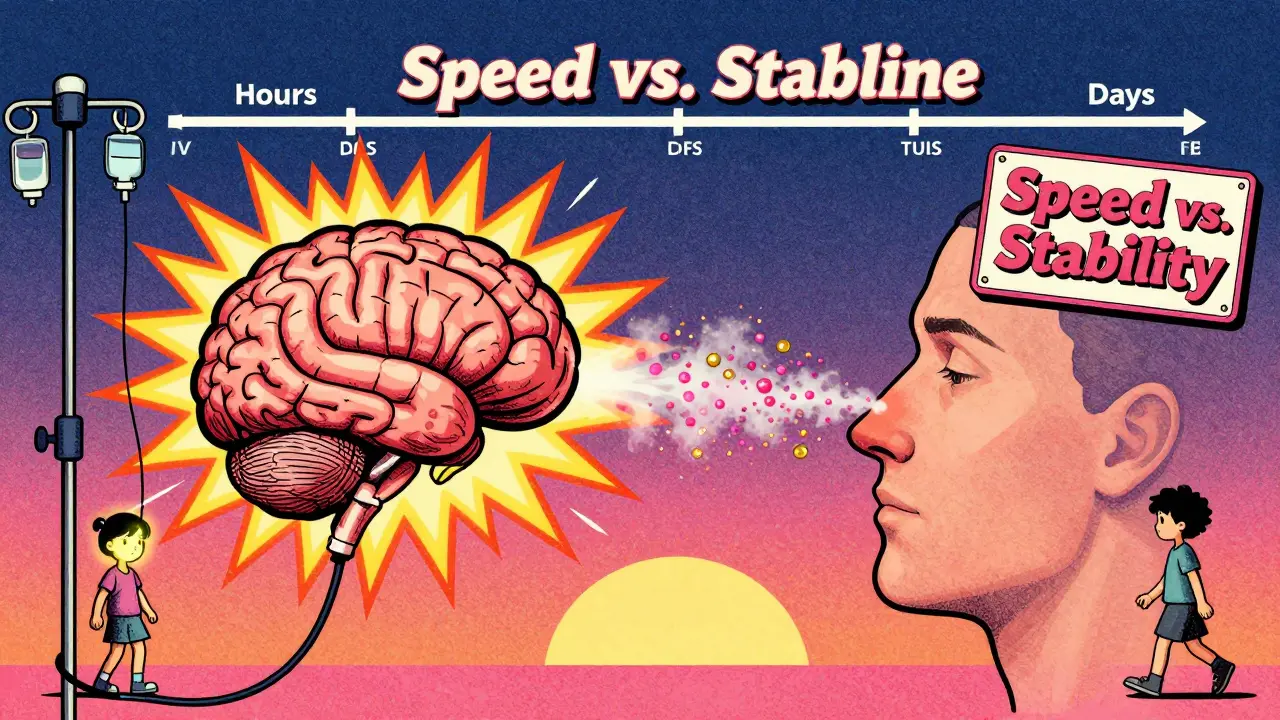
For now, the choice comes down to this: speed and strength versus safety and convenience. Ketamine hits harder and faster. Esketamine is gentler and easier to fit into life. Neither is perfect. But for people who’ve lost years to depression, even one option that works is a lifeline.
Is ketamine approved by the FDA for depression?
Ketamine itself is not FDA-approved for depression. It was approved in 1970 as an anesthetic. Its use for depression is off-label, meaning doctors can prescribe it legally, but it’s not officially labeled for that purpose. Esketamine (Spravato®), however, is FDA-approved specifically for treatment-resistant depression and major depressive disorder with acute suicidal ideation.
How soon do ketamine and esketamine start working?
Many patients feel improvements within hours after the first IV ketamine dose. With esketamine, it usually takes two treatments before noticeable changes occur. Studies show IV ketamine produces faster symptom reduction than the nasal spray, especially in the first 24 to 72 hours.
Can I take ketamine or esketamine at home?
No. Both require medical supervision. Esketamine is self-administered in a clinic under observation, followed by a mandatory two-hour monitoring period. IV ketamine is given in a clinical setting with continuous monitoring due to risks like high blood pressure and dissociation. Neither is approved for home use.
Are there long-term risks with ketamine or esketamine?
Long-term data is still limited, but chronic use may affect bladder health, memory, or liver function. Regular monitoring is required. Neither drug is meant to be used indefinitely without breaks. Most treatment plans include scheduled maintenance doses rather than daily use. The risk of dependence exists but is low when used under clinical supervision.
Do I still need to take my regular antidepressant?
Yes. Esketamine is only approved for use alongside an oral antidepressant. For IV ketamine, it’s not required by law-but most clinicians recommend continuing antidepressants because the combination improves long-term outcomes. Stopping your regular medication abruptly can increase relapse risk.
What if I can’t afford either treatment?
Some clinics offer sliding-scale fees or payment plans. Clinical trials are another option-many universities and hospitals run studies that provide free treatment. Check with NAMI or local mental health nonprofits for resources. IV ketamine is often cheaper than Spravato®, and if your insurance covers it, it may be the most affordable path forward.
Uzoamaka Nwankpa
January 3, 2026 AT 12:40After my third IV ketamine session, I cried for three hours-not because I was sad, but because I remembered what joy felt like. No drug has ever done that for me. I don’t care if it’s off-label. If it brings you back from the dead, it’s a miracle.
Chris Cantey
January 4, 2026 AT 15:32It’s ironic that we’re treating depression with a dissociative-anesthetic, no less-while ignoring the root causes: isolation, economic despair, the collapse of community. We’re patching the soul with chemicals because we refuse to fix the system that broke it in the first place.
Abhishek Mondal
January 5, 2026 AT 14:51Let’s be precise: ketamine is a racemic mixture of (R)- and (S)-enantiomers; esketamine is the (S)-enantiomer alone-yet the literature suggests the (R)-enantiomer may possess superior antidepressant properties with fewer dissociative effects. The FDA’s approval of esketamine appears less a triumph of pharmacology and more a corporate maneuver to patent a derivative of a 50-year-old compound. The real innovation? Monetizing dissociation.
Oluwapelumi Yakubu
January 6, 2026 AT 17:54Man, I’ve seen folks roll up to ketamine clinics like they’re getting a latte at Starbucks-‘Oh yeah, I’m doing the IV thing this week.’ But here’s the real tea: it ain’t about the drug, it’s about the space. The quiet room. The nurse who doesn’t look at you like you’re broken. That’s the medicine, not the infusion. The ketamine? Just the spark. The human connection? That’s the flame.
I had a cousin who went through it in Lagos-no fancy clinic, just a doctor with a IV bag and a folding chair. She came back smiling. Not because of the dose. Because someone sat with her while she cried.
And don’t get me started on insurance. You think they care if you live? They care if it’s coded as ‘off-label.’ That’s the real tragedy.
Also, Spravato®? Sounds like a skincare line. ‘Gentle on the soul, gentle on the nose.’
Real talk: if you’re still debating between the two, you’re not depressed-you’re just rich.
Terri Gladden
January 7, 2026 AT 04:11Okay but what if the dissociation isn’t just a side effect-what if it’s the POINT? Like, maybe your brain needs to break to rebuild? I mean, think about it-when you’re depressed, you’re already dissociating from reality. So why not lean in? I did ketamine and I saw my childhood self crying in the corner of the room. She was wearing that yellow dress from 1998. I hugged her. I cried. I came back. That’s not a side effect. That’s therapy.
Also I think the FDA is scared of ketamine because it’s too real. Like, what if people start realizing you don’t need 12 years of therapy and 7 different SSRIs to feel okay? What if you just need one night with a stranger in a white coat holding your hand?
Also I think they’re hiding something about the bladder thing. Like, why do all the studies say ‘long-term risks are unknown’? Because they don’t want you to know you might start peeing your pants in 2030.
Jennifer Glass
January 8, 2026 AT 07:51I’ve been on 14 different antidepressants over 11 years. I’ve done TMS, ECT, CBT, mindfulness, journaling, acupuncture, and even a 10-day silent retreat. Nothing worked. Then I got IV ketamine. I didn’t feel ‘happy.’ I felt… neutral. Like the static noise in my head finally turned off. That’s the difference. It didn’t make me euphoric. It just stopped the screaming.
My therapist said it’s like turning down the volume on a radio that’s been blasting at 11 for a decade. You don’t suddenly hear Beethoven-you just hear silence. And silence, after all that noise? That’s peace.
I’m on maintenance now. Every 3 weeks. I drive myself. I don’t need to be ‘cured.’ I just need to be able to get out of bed without crying first.
And yes, I still take my SSRI. I’m not an idiot. This isn’t magic. It’s medicine. And I’m grateful.
Joseph Snow
January 10, 2026 AT 06:58Let’s not ignore the elephant in the room: ketamine is a party drug. Esketamine is just corporate ketamine with a label. The FDA approved it because Janssen paid for the trials-not because it’s fundamentally better. The ‘clinical significance’ of a 10% difference in scores is statistically meaningful but clinically negligible for most patients. And the cost? $7,000 for a nasal spray that delivers half the active ingredient? That’s not healthcare. That’s a Ponzi scheme disguised as psychiatry.
Meanwhile, the real solution-community, housing, food security, trauma-informed care-is ignored because it doesn’t have a patent. We’ve turned mental illness into a pharmaceutical product line. And we’re all complicit.
melissa cucic
January 11, 2026 AT 02:54It’s fascinating how the medical community treats ketamine as a ‘last resort’-as if it’s a desperate gamble-when, in reality, it’s one of the most evidence-backed interventions for treatment-resistant depression we’ve ever had. The fact that insurance companies resist coverage isn’t a reflection of efficacy-it’s a reflection of institutional inertia and profit-driven gatekeeping.
And yet, despite the data, the stigma persists: ‘It’s just a club drug.’ But so was morphine, once. So was lithium. Science doesn’t care about your prejudices. It cares about outcomes. And the outcomes here are undeniable.
Perhaps the real question isn’t ‘Which drug works better?’ but ‘Why are we still debating this in 2025?’
Akshaya Gandra _ Student - EastCaryMS
January 11, 2026 AT 16:03i just reed this and i think ketamine is so cool but also scary like what if u get addicted? like i dont know if i would want to go to a clinic every 3 weeks for life
en Max
January 13, 2026 AT 10:12Based on the available evidence, the differential efficacy profile between IV ketamine and intranasal esketamine is statistically significant and clinically meaningful, particularly in acute-phase response metrics. The pharmacokinetic advantages of intravenous administration-namely, 100% bioavailability versus approximately 50% for the intranasal formulation-correlate directly with the observed magnitude and speed of symptom reduction. Furthermore, the higher incidence of dissociative phenomena with IV administration is not merely a side effect, but a pharmacodynamic biomarker of NMDA receptor antagonism, which may be directly proportional to therapeutic effect. Long-term safety profiles remain under investigation; however, the risk-benefit ratio, particularly for life-threatening depression, favors IV ketamine in the majority of clinical contexts.
Angie Rehe
January 13, 2026 AT 20:49They’re lying about the bladder thing. I know a guy who did 40 IV sessions over two years. He’s on dialysis now. And no one talks about it because the clinics don’t want you to know. They’ll tell you ‘it’s rare’-but they never tell you what ‘rare’ means. Is it 1 in 100? 1 in 10? They don’t say. And then they charge you $600 a session and tell you it’s ‘medically necessary.’
And don’t get me started on the ‘supervised setting.’ They watch you for two hours, then kick you out. What happens when you’re dissociated at 3 a.m. and your blood pressure spikes? Who’s there then? No one. They don’t care. They just want your money.
This isn’t treatment. It’s a luxury service for the rich who can afford to pay $7,000 to feel something for a day. Meanwhile, the rest of us are still on Prozac and praying.