How to Verify Recall Notices and Affected Medication Lots: A Step-by-Step Guide
 Jul, 9 2026
Imagine it’s 2 AM. Your phone buzzes with an alert about a Class I drug recall. The stakes are high-patients could be at serious risk. You need to know immediately if you have the affected medication in your stock and, more importantly, who has already taken it. This isn't just administrative busywork; it's a critical patient safety protocol that requires speed, accuracy, and strict adherence to regulations.
Verifying recall notices and identifying affected medication lots is the backbone of drug safety monitoring. Whether you run a large hospital pharmacy or manage a small community clinic, the process remains the same: identify, isolate, notify, and document. Getting this wrong can lead to severe health consequences for patients and significant legal penalties for your facility. In this guide, we’ll break down exactly how to verify these notices efficiently, using current standards from the FDA and leading healthcare organizations.
Understanding the Urgency: Recall Classes and Timelines
Not all recalls are created equal. The Food and Drug Administration (FDA) categorizes recalls based on the potential health hazard. Understanding these classes dictates your response speed and verification depth.
- Class I: These involve situations where there is a reasonable probability that the use of or exposure to the product will cause serious adverse health consequences or death. For these, the FDA mandates that facilities contact 100% of direct customers and achieve 80% compliance with removal instructions. Recent updates to 21 CFR 7.50 require verification of 100% of affected lots within 48 hours.
- Class II: These involve products that might cause temporary or medically reversible adverse health consequences, or where the probability of serious harm is remote.
- Class III: These involve products that are unlikely to cause adverse health reactions but violate labeling or manufacturing guidelines.
The timeline is tight. According to California State Board of Pharmacy requirements, healthcare facilities must confirm receipt of a recall notice within 24 hours and complete the verification of affected lots within 72 hours. Delays here aren’t just inefficient; they’re dangerous. Dr. Jane Axelrad, former FDA Deputy Director of Drug Policy, emphasized that verification must include physical location checks, not just electronic matches, because nearly a quarter of recalls involve products misfiled in wrong storage locations.
The Seven-Step Verification Process
So, how do you actually verify a recall? The California State Board of Pharmacy outlines seven mandatory steps that serve as the gold standard for medication lot verification.
- Pre-positioning: Never rely on just one source. Set up alerts from multiple channels, including the FDA’s MedWatch portal, manufacturer emails, and third-party services like First Databank. The American Society of Health-System Pharmacists (ASHP) warns against relying solely on postal mail, which can delay critical notifications.
- Inventory Cross-Reference: Identify if you possess the product by matching the National Drug Code (NDC), lot number, expiration date, and packaging size against your inventory records. Exact matching is crucial-a slight variation in lot numbering formats is a common pitfall.
- Physical Removal: Remove the product from all patient care areas within 24 hours. This includes checking emergency kits, crash carts, and automated dispensing cabinets. The FDA found that 68% of hospitals had incomplete lot number verification, often missing unopened emergency kits.
- Patient Identification: Identify potentially affected patients. This step involves digging into your dispensing records to see who received the specific lot number during the relevant timeframe.
- Alternative Sourcing: Find alternative products to ensure continuity of care for patients who need the medication.
- Return Quarantined Products: Follow manufacturer or FDA instructions for returning or destroying the recalled items.
- Documentation: Document every action. The Joint Commission Standard LDR.04.03.05 requires exact dates of notification, quantities removed by lot number, staff notified, and patient contacts.
Manual vs. Automated Verification Systems
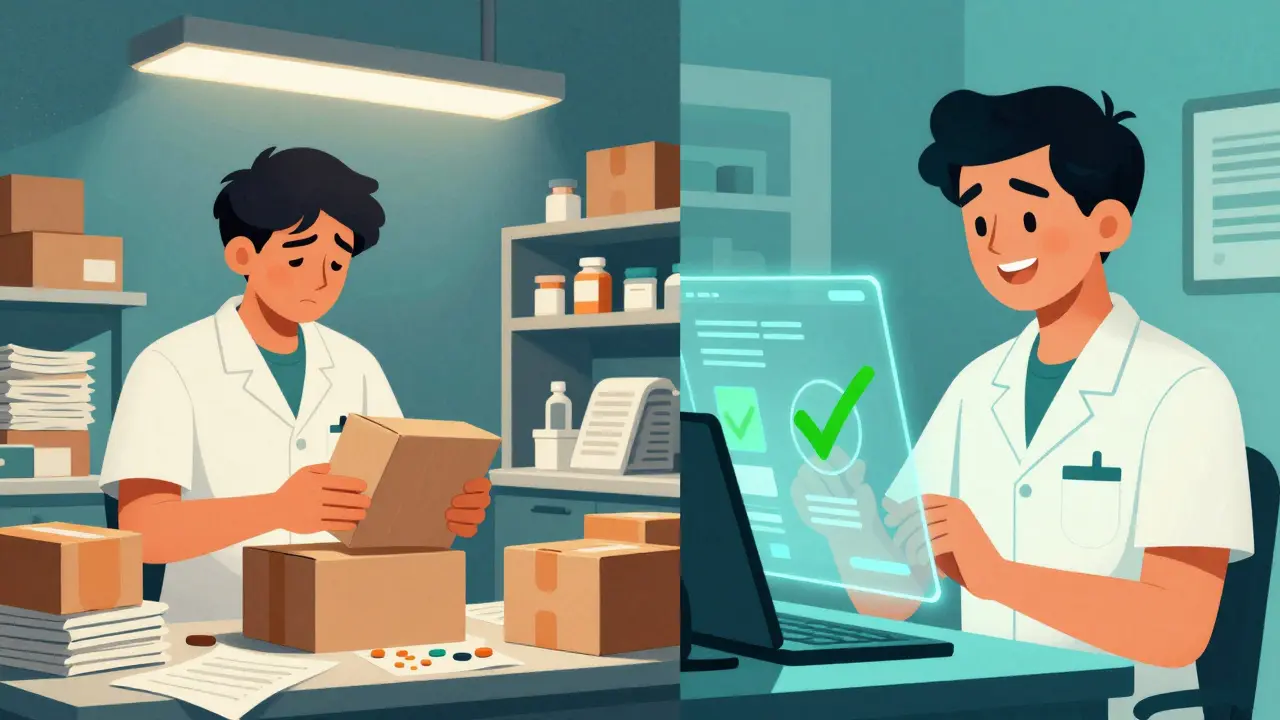
You can try to do this manually, but the data suggests it’s a risky gamble. ASHP’s 2022 Medication Safety Benchmarking study showed that manual verification takes an average of 4.7 hours per recall event with an 18.3% error rate. In contrast, automated systems reduce this time to 1.2 hours with only a 2.1% error rate.
| Feature | Manual Verification | Automated Systems (e.g., TruMed, Navitus) |
|---|---|---|
| Average Time per Recall | 4.7 hours | 1.2 hours |
| Error Rate | 18.3% | 2.1% |
| Lot Number Matching | Prone to human error | 99.8% accuracy |
| Cost | High labor cost | Subscription fee ($2,995 - $4,800/year) |
| Best For | Rural clinics with limited IT | Hospitals and large pharmacies |
Automated platforms like TruMed’s AccuSite or Navitus’ Recall Management Platform integrate directly with your pharmacy management system. They flag recalled medications during dispensing and automatically cross-reference incoming recalls with your inventory database. However, these tools aren’t magic bullets. They require integration with existing systems running Windows Server 2016 or later and work best in settings with robust IT infrastructure. Rural pharmacies with limited resources may still find manual processes necessary, though they should aim for hybrid solutions.
Common Pitfalls and How to Avoid Them
Even experienced pharmacists make mistakes. Here are the most frequent issues reported by professionals and how to sidestep them.
False Positives: A December 2022 survey by Pharmacy Times found that 63% of hospital pharmacists encountered "false positive" recalls where their system flagged products not actually affected. This wastes valuable time. To avoid this, always double-check the NDC and lot number against the physical package. Don’t trust the digital record blindly.
Fragmented Notifications: Sarah Chen, a pharmacist at Johns Hopkins Hospital, noted that receiving notices via seven different channels with conflicting lot numbers causes dangerous confusion. Consolidate your information sources. Use a dedicated recall management platform or assign a single team member to aggregate all notices into one central dashboard.
Misfiled Inventory: As mentioned earlier, 23% of recalls involve products in the wrong storage location. Regularly audit your physical inventory. Ensure that emergency kits and backup stocks are included in your electronic inventory system so they aren’t overlooked during a verification sweep.

Building a Robust Recall Response Team
Verification isn’t a solo job. ASHP’s guidance emphasizes establishing a dedicated Recall Team with defined roles. Facilities with formal teams completed verification 3.2 times faster than those without. Your team should include:
- Pharmacy Manager: Oversees the entire process and ensures regulatory compliance.
- Inventory Specialist: Handles the physical search and removal of products.
- Clinical Pharmacist: Identifies affected patients and recommends therapeutic alternatives.
- IT Support: Manages software alerts and database queries.
Training is essential. The Joint Commission requires a minimum of 2 hours of annual training for staff involved in medication safety. Consider creating a "recall playbook" with pre-identified staff responsibilities and verification workflows. According to AHRQ’s 2023 Medication Safety Report, 86% of top-performing facilities use such playbooks.
Future Trends in Drug Safety Monitoring
The landscape of drug recall verification is evolving rapidly. By 2027, the Drug Supply Chain Security Act amendments will require electronic verification for all prescription drugs. We’re also seeing the rise of blockchain-enabled verification systems. Pfizer and Walgreens tested a distributed ledger solution that reduced verification time to just 17 minutes per recall in a 2023 trial.
Artificial intelligence is also entering the mix. The FDA’s 2024 strategic plan targets a 95% reduction in verification errors by 2028 through AI-assisted lot matching technology. While these technologies are promising, they don’t replace the need for human oversight. Always maintain a manual check protocol as a backup.
Staying ahead of these changes means keeping your systems updated and your staff trained. The goal is not just compliance, but ensuring that every patient leaving your care is safe from defective medications.
What is the first step when receiving a drug recall notice?
The first step is to immediately acknowledge receipt of the notice and determine the recall class (I, II, or III). Then, cross-reference the National Drug Code (NDC) and lot number against your current inventory to see if you possess the affected product. Do not delay; Class I recalls require action within 24-48 hours.
How do I match lot numbers accurately?
Exact matching is critical. Compare the lot number on the recall notice with the lot number printed on the physical packaging of the medication in your stock. Pay attention to format differences, as some manufacturers use alphanumeric codes while others use purely numeric ones. If your system uses barcodes, scan the package to ensure the digital record matches the physical item.
Is manual verification still acceptable?
While manual verification is still used, especially in smaller facilities, it carries a high error rate (18.3%) and is time-consuming. It is recommended only if automated systems are not feasible. If you must verify manually, use a checklist and have a second person review the findings to minimize errors.
What documentation is required after a recall?
You must document the date of notification, the actions taken, the quantity of product removed by lot number, the staff members notified, and any patient contacts made. This documentation is vital for Joint Commission audits and FDA inspections. Keep records for at least three years or as required by local regulations.
How can I prevent false positives in my system?
To prevent false positives, ensure your inventory database is meticulously maintained. Regularly update product details, including packaging sizes and lot number formats. When a recall alert triggers, physically verify the product before removing it or notifying patients. Double-check the NDC and lot number against the recall notice to confirm a match.