How to Store and Label Breast Milk When Taking Temporary Medications
 Dec, 1 2025
When you’re breastfeeding and need to take a short-term medication-whether it’s an antibiotic, pain reliever, or something for a cold-it’s natural to worry about your milk. Should you stop nursing? Should you throw out your pumped milk? The short answer: you almost never need to stop. Most medications are safe to take while breastfeeding, and with the right storage and labeling, you can keep feeding your baby without wasting a single drop of milk.
Why Most Medications Don’t Require Pump and Dump
The idea that you must "pump and dump" every time you take medicine is a myth. In fact, fewer than 2% of all medications require you to stop breastfeeding, even temporarily. This comes from Dr. Thomas Hale’s Medications and Mothers’ Milk, the most trusted reference in lactation pharmacology. Many common drugs-like ibuprofen, amoxicillin, or loratadine-pass into breast milk in tiny amounts, far below what would affect your baby. Even medications labeled "caution" or "moderate risk" often don’t need you to interrupt feeding. What matters isn’t just the drug itself, but when you take it and how your body processes it. Some medications peak in your bloodstream within an hour. Others take several hours. Your goal isn’t to avoid breastfeeding entirely-it’s to time your feeds so your baby gets milk with the lowest possible medication level.How to Store Milk Before, During, and After Medication
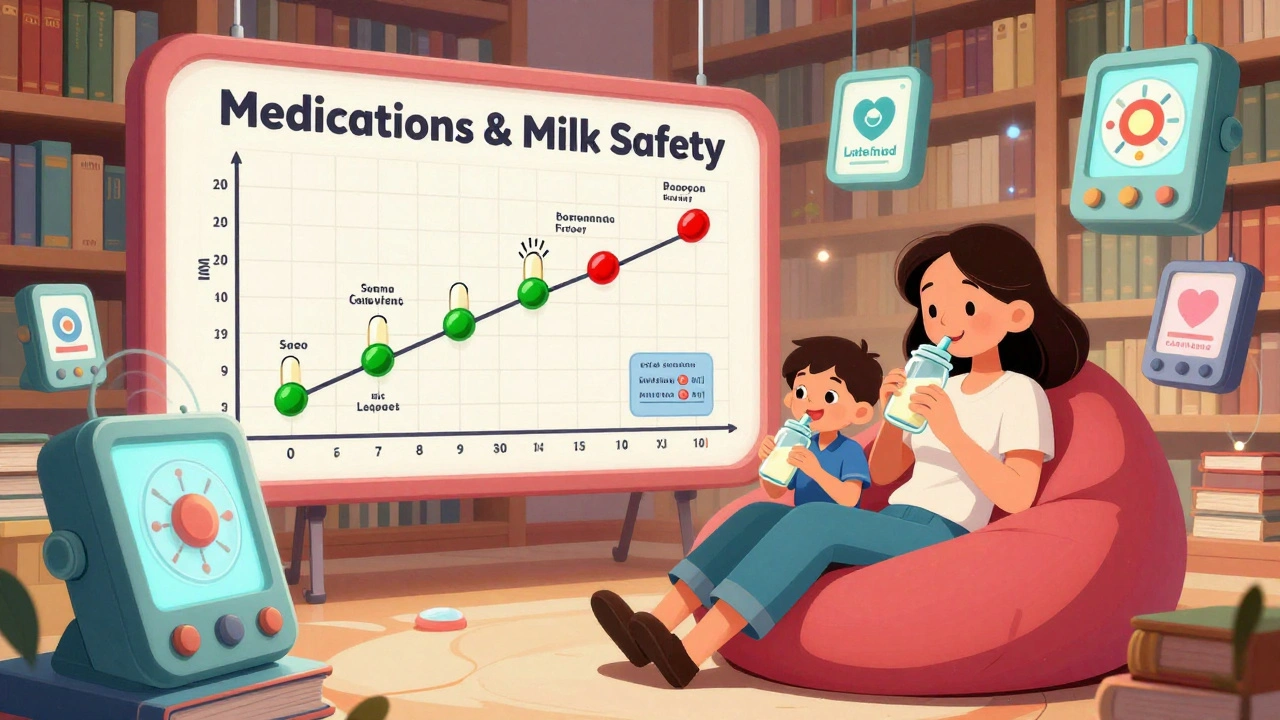
The key to safe milk storage during medication use is separation. Don’t mix milk pumped before you took the medicine with milk pumped after. Here’s how to do it right:- Before taking the medication: Pump and store milk as usual. This milk is completely safe and should be labeled with the date and time.
- During peak medication time: After you take the pill, wait until the drug reaches its highest concentration in your blood. For most drugs, this is 1-3 hours after taking it. Pump during this window and store separately.
- After the peak: Once the medication has cleared from your system (usually 4-12 hours later, depending on the drug), you can resume pumping milk for feeding. This milk is safe again.
Labeling Your Milk: What to Write
A simple date and time aren’t enough when you’re managing medication. Your label needs to tell you exactly what’s in that bag. Here’s what to include:- Date and time of expression (required for all stored milk)
- Baby’s name (especially important if milk goes to daycare or is stored in a shared fridge)
- Medication name (e.g., "Amoxicillin 500mg")
- Time you took the dose (e.g., "Taken at 8 AM")
- Batch type (e.g., "Pre-med", "Peak", "Post-med")
Storage Times: Still Follow the Rule of 4s-But With Exceptions
Standard breast milk storage rules still apply, but with one big change: medication-affected milk shouldn’t sit around longer than necessary.- Room temperature (up to 77°F / 25°C): 4 hours max-even for pre-med milk. Medication-affected milk should be refrigerated or frozen within 2 hours.
- Refrigerator (39°F / 4°C): Up to 4 days for pre-med milk. For milk pumped during or right after taking medicine, use within 24-48 hours. After 4 days, antimicrobial properties drop, and the risk of bacterial growth increases.
- Freezer (0°F / -18°C): 6-12 months for pre-med milk. For medication-affected milk, use within 3-6 months. Don’t freeze milk you’re unsure about-better to use it fresh after the medication clears.

What to Do When You’re Away From Home
If you’re traveling, at work, or at a doctor’s appointment, you still need to store milk safely. Use an insulated cooler bag with frozen ice packs. The CDC says this keeps milk cold for up to 24 hours. But here’s the trick: if you’re taking medication, keep your milk in a separate cooler or use a labeled bag inside the main one. Some moms carry a small cooler with just one or two bags of pre-med milk for emergencies. Others use a milk storage box with separate compartments. The goal is to avoid mixing batches.When to Discard Milk (And When Not To)
You don’t need to throw out milk just because you took medicine. Here’s when to keep it:- Keep: Pre-med milk, post-med milk, and milk pumped after the medication has fully cleared.
- Discard: Only if your doctor specifically says to (rare), or if the milk smells sour, tastes off, or was left at room temperature too long.
Tools That Help
There are now tools designed just for this:- Specialized milk storage bags: Some brands now come with built-in spaces to write medication name and time.
- Apps like MotherToBaby: Updated in early 2024, this app lets you enter your medication, dose, and time. It generates a custom label and tells you when your milk is safe again.
- Medication trackers: Simple paper logs or digital notes in your phone can help you remember when you took your last dose and when to pump.
What Your Doctor Should Tell You
Too often, doctors prescribe medication without explaining breastfeeding implications. You have the right to ask:- "Is this safe for breastfeeding?"
- "When does it peak in my milk?"
- "How long until it’s safe to nurse again?"
- "Should I save any milk before I start?"
Real-Life Example: Taking Antibiotics
Sarah, a mom of two, was prescribed amoxicillin for a sinus infection. She took 500mg every 8 hours. Here’s what she did:- Before her first dose: pumped 8 oz and labeled it "Pre-med - 8 AM"
- At 8 AM: took pill
- At 10 AM: pumped 4 oz and labeled it "Peak - Amoxicillin 500mg"
- At 4 PM: pumped 6 oz and labeled it "Post-med - Amoxicillin"
- At 8 PM: took next dose, repeated the cycle
Common Mistakes to Avoid
Based on thousands of mother reports:- Mistake: Mixing all milk in one bag. Fix: Use separate containers with clear labels.
- Mistake: Throwing out milk just because you took medicine. Fix: Check the drug’s half-life. Most are safe within hours.
- Mistake: Not labeling the time you took the pill. Fix: Write it down immediately after dosing.
- Mistake: Assuming "pump and dump" is always needed. Fix: Only do it if your provider says so.
What’s Changing in 2025
The FDA plans to require all new prescription labels to include breastfeeding storage instructions by late 2025. That means you’ll soon see notes like: "Store milk expressed 2 hours after dose separately. Safe to use after 8 hours." Until then, you’re your own best advocate.Final Rule: When in Doubt, Save It
If you’re unsure whether milk is safe, freeze it. Frozen milk lasts months. You can always toss it later if you find out the drug wasn’t safe-but you can’t get it back if you threw it out too soon. Your baby deserves your milk. And with the right system, you can give it to them-even while you’re taking medicine.Do I need to pump and dump if I take a cold medicine?
No, you usually don’t. Most over-the-counter cold medicines like pseudoephedrine, dextromethorphan, or guaifenesin are considered safe for breastfeeding. You can pump and store milk as normal. If you’re unsure, check the drug’s half-life or use an app like MotherToBaby. Only avoid breastfeeding if your doctor specifically tells you to.
Can I freeze milk that was pumped while on medication?
Yes, but only if it’s milk pumped after the medication has cleared from your system. Milk pumped during the peak concentration window (1-3 hours after taking the drug) should be stored separately and used only after the drug has fully cleared-usually 6-12 hours later. Once cleared, you can freeze it safely. Don’t freeze milk you’re unsure about; use it fresh within 48 hours instead.
How do I know if a medication is safe while breastfeeding?
Check the LactMed database (from the NIH) or ask your doctor to consult a lactation specialist. Medications are ranked from L1 (safest) to L5 (dangerous). Most common drugs are L1 or L2. If your prescription doesn’t mention breastfeeding, ask for a safety rating. You can also call MotherToBaby for free expert advice.
What if I accidentally mix medicated and non-medicated milk?
If you mixed a small amount of medicated milk with a large batch of pre-med milk, it’s usually fine. The concentration becomes very low. But if you mixed equal parts or aren’t sure, it’s safer to discard it. Going forward, use separate containers and labels to avoid repeat mistakes. Most mothers who make this mistake once don’t repeat it after learning proper labeling.
How long does it take for medicine to leave my breast milk?
It depends on the drug. For most common medications, it takes 4-12 hours to clear from breast milk. Drugs with a short half-life (like ibuprofen or amoxicillin) clear in 4-6 hours. Longer-acting drugs (like some antidepressants or pain meds) may take 24-48 hours. Check the drug’s half-life or use an app to get a personalized timeline. When in doubt, wait 12 hours after your last dose.
Should I pump more often when taking medication?
Yes, if you’re worried about supply. Pumping on your regular schedule helps maintain your milk production. Even if you’re not feeding the milk you pump during the medication window, pumping regularly prevents engorgement and keeps your supply steady. You can freeze or donate excess milk later if it’s safe.
Alicia Marks
December 2, 2025 AT 01:19Just saved this for my next round of antibiotics. So many moms panic and dump milk unnecessarily-this is the clear, calm guide we all need. Thank you.
Shannara Jenkins
December 3, 2025 AT 14:10I used colored stickers like you said-green for pre, yellow for peak, red for post. Game changer. My partner even started helping me label without me saying a word. 🙌
Elizabeth Grace
December 4, 2025 AT 09:38Why does it feel like the medical system wants us to feel guilty for needing meds? I took Zyrtec for allergies and my OB said to pump and dump for 24 hours. I called MotherToBaby and they laughed. Literally laughed. Said it’s L1. I cried. Not from sadness-from relief.
Steve Enck
December 5, 2025 AT 23:44While your methodology is statistically sound, it fails to account for the pharmacokinetic variability introduced by maternal metabolic polymorphisms, particularly CYP2D6 and CYP3A4 isoforms, which can extend half-life by up to 300% in certain genotypes. Your 4–12 hour window is a population average and constitutes a dangerous oversimplification for clinical decision-making. I urge you to consult the 2023 meta-analysis by Chen et al. on interindividual clearance variation in lactating women.
मनोज कुमार
December 7, 2025 AT 18:40Roger Leiton
December 9, 2025 AT 18:16This is the most helpful thing I’ve read all year. I just took amoxicillin last night and was about to toss 12 oz of milk. Now I’m freezing the peak batch and using pre-med for tomorrow’s feed. Thank you so much 😊🍼
Ella van Rij
December 11, 2025 AT 18:03Oh good, another 2000-word essay on how to label milk like you’re running a NASA mission. Next you’ll be telling us to color-code our nipple shields. At least the author didn’t mention essential oils. I’m impressed.
dave nevogt
December 12, 2025 AT 08:55It’s fascinating how we’ve turned a biological process-nourishing a child-with such profound simplicity into a bureaucratic labyrinth of labels, timers, and color-coded systems. We’re not storing chemicals; we’re storing love. And yet, society insists we treat it like a hazardous material. I wonder if this level of control is really about safety… or about our collective anxiety over motherhood being deemed insufficient unless it’s meticulously documented. The fact that we need apps to tell us our own bodies are safe says more about our culture than it does about pharmacology.
Paul Keller
December 13, 2025 AT 04:43While I appreciate the comprehensive nature of this guide, I must emphasize that the assumption that all mothers have access to insulated coolers, waterproof labels, or smartphones capable of running MotherToBaby is a privileged one. In rural or low-income settings, many women rely on reusable plastic bags, handwritten notes in pencil, and shared refrigerators in communal spaces. The recommendations here, while scientifically impeccable, lack cultural and socioeconomic contextualization. A truly equitable approach would include low-tech alternatives-like using a single color-coded rubber band around the bottle to denote batch type, or even verbal communication with caregivers. Science must serve all mothers, not just those with the means to optimize.
Laura Baur
December 13, 2025 AT 23:44Let’s be honest-this entire system is a symptom of a medical-industrial complex that profits from maternal fear. Why do we assume every medication is dangerous unless proven otherwise? Why isn’t the default assumption safety? Why are mothers forced to become pharmacologists, data analysts, and logistical coordinators just to feed their babies? This isn’t empowerment-it’s exploitation dressed up as education. And don’t get me started on the fact that this guide doesn’t mention that formula companies pay hospitals to push "pump and dump" narratives. You’re being manipulated. Wake up.
Joel Deang
December 15, 2025 AT 16:54OMG I JUST DID THIS LAST WEEK AND THOUGHT I WAS A BAD MOM 😭 I DUMPED 6 OZ BECAUSE I TOOK IBUPROFEN AND NOW I FEEL SO STUPID. THANK U FOR THIS I’M GOING TO FREEZE THE REST NOW 🥹🍼
Lynn Steiner
December 15, 2025 AT 18:42My husband said "just throw it out, we can buy formula" and I screamed into a pillow for 20 minutes. This post? Saved my sanity. I’m not dumping anything anymore. My milk is my power. And if some pill wants to ride in it? Fine. Let it. I’m still feeding my baby. 💪