Hand Hygiene: Evidence-Based Infection Prevention at Home
 Dec, 22 2025
Every time you walk in the door, touch a doorknob, or pick up your toddler after they’ve played with the dog, you’re handling germs. Most of them are harmless. But a few - like norovirus, influenza, or even the common cold - can turn a quiet evening into a week of fever, vomiting, and missed work or school. The good news? You don’t need fancy gadgets or expensive products to stop them. You just need to wash your hands the right way.
Why Hand Hygiene Matters More Than You Think
Hand hygiene isn’t just about being clean. It’s one of the most powerful tools we have to stop infections from spreading in your home. The CDC found that proper handwashing can reduce respiratory illnesses by up to 21% and gastrointestinal illnesses by 31%. That’s not a guess - it’s from a national survey of over 30,000 U.S. households. And the cost? About $1.27 per person per year for soap and water. That’s less than the price of a coffee.
Think about this: if you have a child in daycare or someone in the house who works in a hospital, you’re already exposed to more germs than you realize. Norovirus, the bug that causes violent stomach bugs, spreads easily in homes - with a 16% to 28% chance of infecting another family member if someone gets sick. Influenza has a 3.2% household transmission rate. SARS-CoV-2? Around 10%. All of these can be cut down dramatically with simple handwashing.
Soap and Water vs. Hand Sanitizer: What Actually Works
Not all hand cleaning is the same. Many people think hand sanitizer is just as good as soap and water. It’s not. Here’s the real breakdown:
- Soap and water is the gold standard. It physically removes germs, dirt, and grease. It’s the only method that works against C. difficile spores and norovirus - both of which hand sanitizer can’t kill.
- Alcohol-based sanitizer (60-95% alcohol) kills germs quickly, especially enveloped viruses like flu and COVID-19. It’s great when you’re on the go, or when soap isn’t available. But if your hands are dirty, greasy, or sticky? Sanitizer drops to 12% effectiveness.
- Antibacterial soap? The FDA banned triclosan and 18 other antibacterial ingredients in consumer soaps back in 2016 because they offered no extra protection over plain soap - and might even be making bacteria stronger over time.
Bottom line: Use soap and water when you can. Especially after using the bathroom, before eating, after handling pets, or when your hands look dirty. Use sanitizer only when soap isn’t available - and make sure it’s at least 60% alcohol. Check the label. Many cheap brands don’t even meet that standard.
The 6-Step Handwashing Technique (And Why Most People Get It Wrong)
Washing your hands for 20 seconds isn’t enough if you’re not covering all the right spots. A 2023 NHS audit found that nearly half of households miss key areas. Here’s what you’re probably skipping:
- Palm to palm
- Right palm over left dorsum (back of hand) and vice versa
- Palm to palm with fingers interlaced
- Back of fingers to opposing palms with fingers interlocked
- Rotational rubbing of thumbs
- Rotational rubbing of fingertips in palms
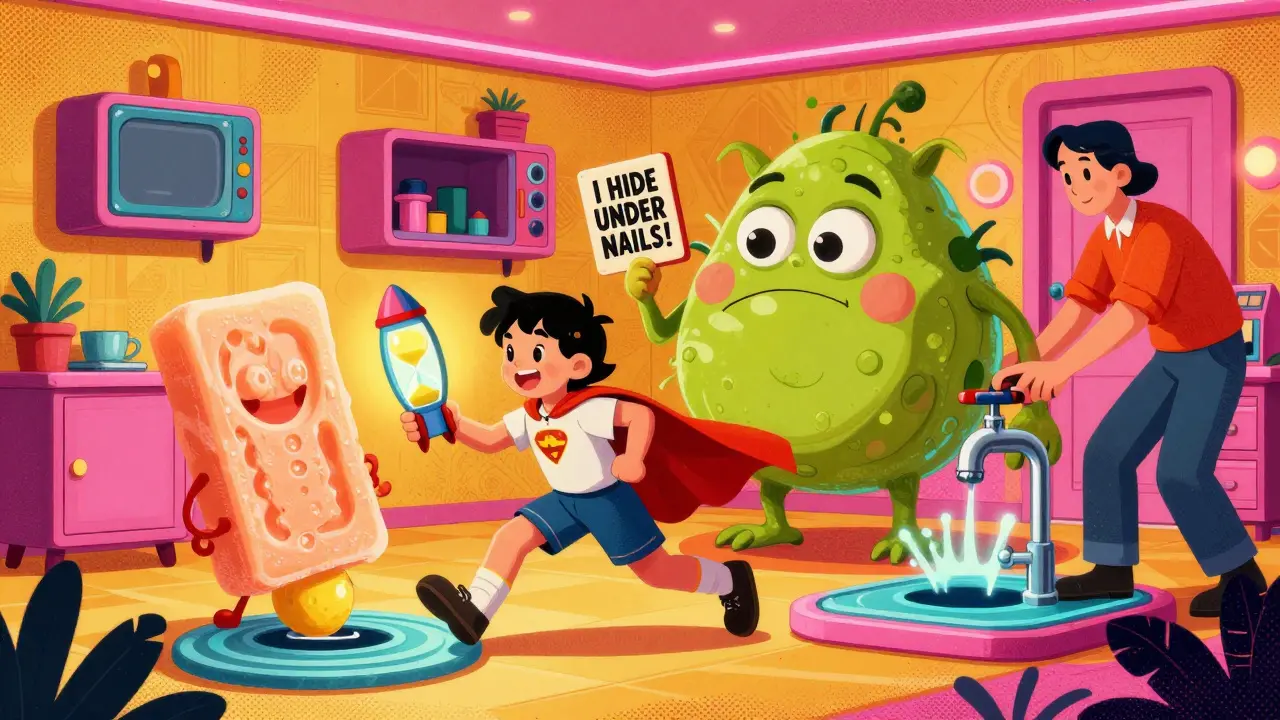
This is the WHO’s 6-step method. It’s not complicated. But most people do a quick rub and call it done. In one study, 68% of people didn’t clean their fingertips. 57% missed their thumbs. 43% didn’t get between fingers. Those are the exact spots where germs hide - under nails, around cuticles, in the creases.
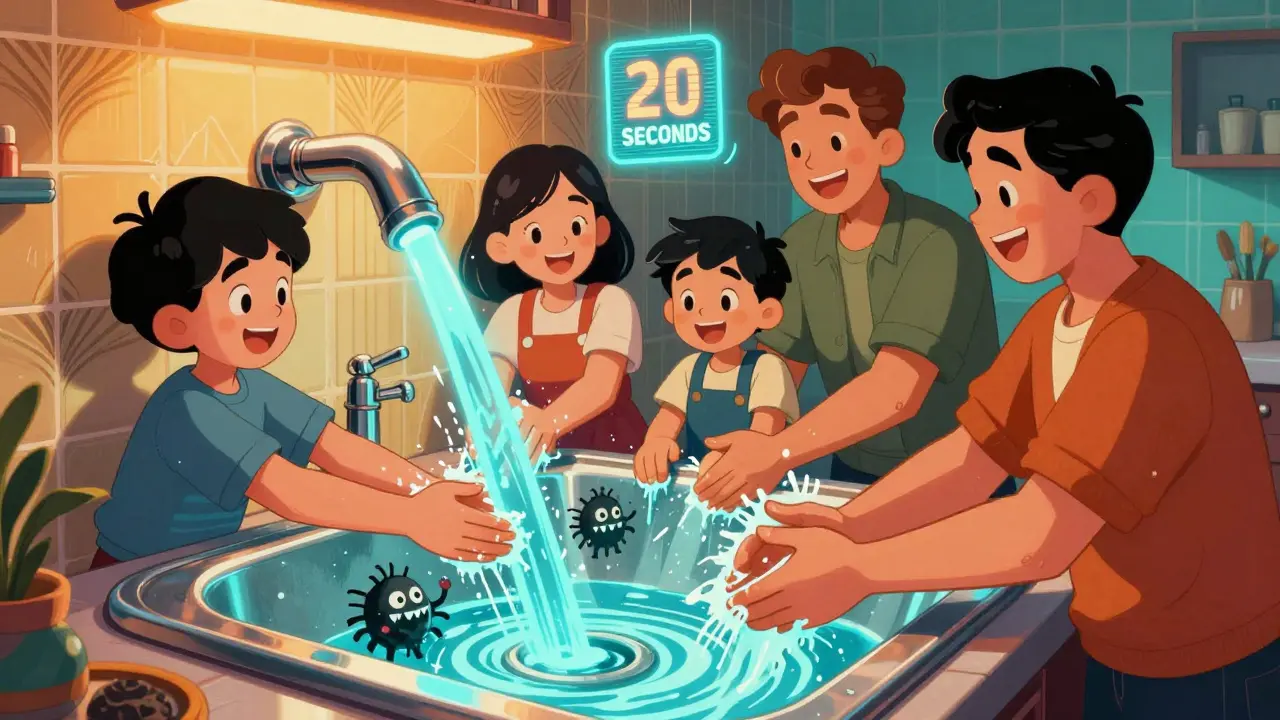
How long should you wash? 20 to 30 seconds. That’s about the time it takes to sing “Happy Birthday” twice. Not once. Twice. If your kids are bored after five seconds, try a timer. Amazon sells simple sand timers for under $5. One parent on Reddit said using one cut her family’s colds from six per year to two.
Water Temperature: Hot or Cold? The Science Says This
You’ve probably been told to use hot water. But here’s the truth: it doesn’t matter much. A 2017 study in mSphere showed that water between 100-108°F (38-42°C) helps loosen dirt and grease - but cold water at 60°F (15°C) removes germs just as effectively. The real benefit of warm water is comfort. If you’re washing your hands for 20 seconds, you’re more likely to stick with it if the water isn’t freezing.
And here’s a bonus: using cold water saves energy. One Yale study estimated you could cut household energy use by 40% just by switching to cold-water handwashing. That’s better for your wallet and the planet.
The Hidden Danger: Recontaminating Your Hands After Washing
Here’s the cruel twist: you can wash your hands perfectly - and then immediately touch the faucet, the towel dispenser, or the door handle and pick up the same germs you just washed off.
CDC testing found that 89% of households recontaminate their hands this way. The fix? Use a paper towel to turn off the faucet and open the door. If you’re using a hand dryer, don’t touch the buttons or the sides. Paper towels are better - they reduce bacteria on hands by 76% compared to air dryers, according to a Mayo Clinic study.
For households with kids or older adults, consider installing foot-pedal faucets. They cost between $45 and $120 to retrofit, but they eliminate the need to touch anything after washing. One family in Minnesota installed them after their toddler kept getting sick - and saw a 40% drop in illness over six months.
Hand Hygiene for Kids and Seniors: Making It Stick
Kids don’t care about germs. They care about getting back to their toys. A 2021 study in Pediatrics found that the average child washes for only 8.2 seconds. That’s not enough. So how do you get them to do it right?
- Use posters with pictures of the 6-step method. The Minnesota Health Department offers free ones in 24 languages.
- Make it fun. Play a 20-second song. Try “Baby Shark” or “Don’t Stop Believin’.”
- Turn it into a ritual. “We wash hands before snacks,” “We wash hands after dog cuddles.” Consistency builds habit.
For older adults, especially those with arthritis or dry skin, washing can be painful. Use moisturizing soap. Apply lotion right after drying. A 2020 study showed that doing this cuts dermatitis by 62%. Also, consider automatic soap dispensers - they reduce the need to squeeze bottles and can be mounted at a comfortable height.
When and How Often to Wash: The Daily Routine That Works
You don’t need to wash your hands 20 times a day. But there are five key moments when it’s non-negotiable:
- After coming home - This is the #1 moment to stop community germs from entering your home.
- Before preparing or eating food - Cuts foodborne illness risk by 78%, per USDA data.
- After using the bathroom - Prevents fecal-oral spread of germs. Reduces risk by 47%.
- After touching pets - Prevents 3.2 million zoonotic infections in the U.S. each year.
- After coughing, sneezing, or blowing your nose - Stops the spread of respiratory viruses.
That’s it. Five moments. If you nail these, you’re already ahead of 70% of households.
Common Mistakes and How to Fix Them
- Mistake: Using too little soap. Fix: Use a nickel- to quarter-sized amount. That’s 3-5 mL. Too little = incomplete coverage.
- Mistake: Stopping before 20 seconds. Fix: Use a timer. Digital apps like ‘Clean Hands Timer’ have 4.7 stars on the App Store from over 12,000 reviews.
- Mistake: Using expired sanitizer. Fix: Alcohol evaporates. Check the expiration date. If it’s been sitting for over two years, toss it.
- Mistake: Skipping moisturizer. Fix: Apply lotion within 3 minutes of drying. Prevents cracks and dryness that let germs in.
It takes 21 days of consistent practice to turn hand hygiene into a habit, according to a 2022 behavioral study. Start small. Pick one moment - say, after using the bathroom - and make it perfect. Then add another. Slowly, it becomes automatic.
The Bigger Picture: Why This Isn’t Just About You
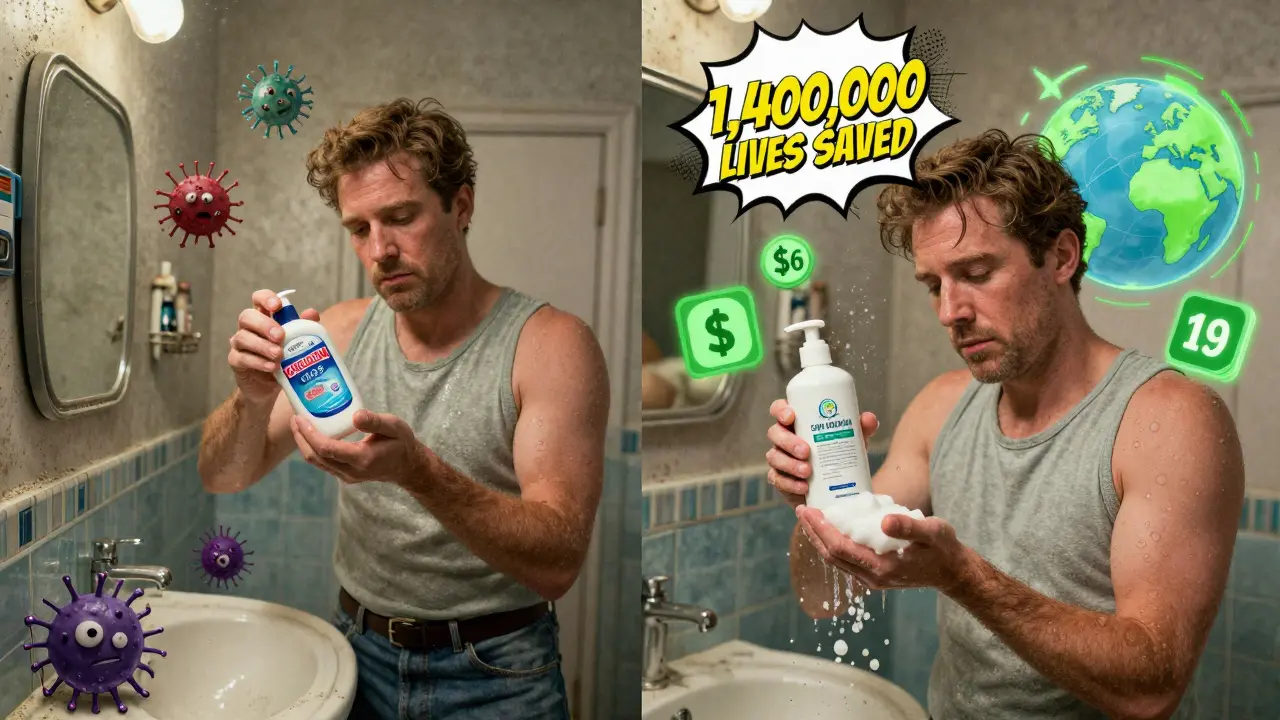
Hand hygiene isn’t just personal. It’s public health. Dr. William Schaffner from Vanderbilt says proper handwashing prevents 1.8 million child deaths globally each year from diarrheal diseases. The WHO estimates that if everyone in the world washed their hands properly at key moments, we could prevent 1.4 million deaths annually by 2030.
And the ROI? It’s insane. For every $1.27 you spend on soap and water, you save $16 in healthcare costs - according to Dr. Philip Tierno’s testimony to Congress. That’s a 1,200% return. No vaccine, no drug, no treatment comes close.
Even small changes matter. The ‘Germ Buster’ campaign in Minnesota schools reduced absenteeism by 22% using hand hygiene education. That’s not magic - it’s science.
Right now, only 35% of households maintain proper hand hygiene during peak illness seasons. That’s the weakest link in community infection control. But it’s also the easiest to fix.
You don’t need to be a doctor. You don’t need to buy anything expensive. You just need to wash your hands - the right way, at the right times, long enough to make a difference.
Is hand sanitizer as good as soap and water?
No. Hand sanitizer kills germs quickly but doesn’t remove dirt, grease, or certain viruses like norovirus or C. difficile. Soap and water physically washes them away. Use sanitizer only when soap isn’t available - and make sure it’s at least 60% alcohol.
Do I need antibacterial soap?
No. The FDA banned antibacterial soaps with triclosan in 2016 because they offer no extra benefit over plain soap - and may contribute to antibiotic resistance. Plain soap and water work just as well.
How long should I wash my hands?
At least 20 seconds. That’s the time it takes to sing "Happy Birthday" twice. Washing for less than that reduces germ removal by over 50%. Use a timer or play a short song to keep track.
Does water temperature matter?
Not for killing germs. Cold water at 60°F (15°C) removes pathogens just as effectively as hot water. Warm water (100-108°F) feels better and helps with grease, but it’s not necessary for hygiene. Cold water also saves energy.
What if I don’t have running water?
Use alcohol-based hand sanitizer with at least 60% alcohol. If that’s not available, the WHO recommends a "tippy tap" - a simple, low-water device made from a bottle hung above a basin. It’s used in over 1.2 million homes worldwide and reduces water use by 90% while still being effective.
Can handwashing cause dry skin?
Yes, especially with frequent washing. Use a moisturizing soap and apply lotion within 3 minutes after drying. Studies show this reduces skin irritation and dermatitis by 62%. Don’t skip moisturizer - cracked skin lets germs in.
Aurora Daisy
December 22, 2025 AT 12:24Oh wow, another ‘wash your hands like a surgeon’ lecture. Because clearly, the only reason people get sick is because they didn’t scrub their pinkies long enough. Meanwhile, my grandma washed hands in a bucket with lye soap and lived to 98. Coincidence? Maybe. But I’ll take lye over CDC brochures any day.
Isaac Bonillo Alcaina
December 23, 2025 AT 22:29You cite CDC data like it’s gospel, but you ignore the fact that handwashing compliance in real households hovers around 5%. Your entire argument rests on the assumption that people are rational actors who care about statistical reductions in illness. They’re not. They’re tired, distracted, and emotionally overloaded. This isn’t a hygiene issue - it’s a behavioral economics failure disguised as public health advice.
Also, ‘sing Happy Birthday twice’? That’s not a technique - it’s a toddler distraction tactic. And you wonder why kids don’t wash properly? Because you’re treating them like pets, not people.
Joe Jeter
December 25, 2025 AT 19:56Hand sanitizer doesn’t work against norovirus? Tell that to the 87% of people who’ve never had norovirus and still use sanitizer religiously. Also, why are we assuming everyone has access to running water? What about the 2.2 billion people without safe water? Your ‘gold standard’ is a luxury most of the world can’t afford.
And ‘foot-pedal faucets’? That’s not hygiene - that’s Elon Musk-level overengineering. My sink has a lever. I pull it. Done. Stop selling solutions to problems people don’t have.
Jeffrey Frye
December 26, 2025 AT 12:36lol so if i wash my hands for 20 sec but forget to rub my thumbs i might as well not have washed at all? and who the hell has time for that? my kid spits up on my shirt 5x a day and i’m lucky if i get to wipe my hands on my jeans. this article is written by someone who’s never changed a diaper.
also ‘toss expired sanitizer’? bro i’ve had that bottle since 2020. it’s still got 30% alcohol left. that’s enough to kill a virus… or at least make me feel better about myself.
Sidra Khan
December 27, 2025 AT 09:50Can we talk about how this entire post is just a 2000-word ad for soap companies and hand dryer manufacturers? 🤡
Also, ‘use a timer’? I’ve got a 3-year-old who thinks ‘Happy Birthday’ is a 45-second epic. I’m not singing it twice. I’m just wiping my hands on my pants and moving on. 🙃
Lu Jelonek
December 27, 2025 AT 19:12I work in a nursing home. I’ve seen people wash their hands perfectly - then touch the door handle with their clean hands, then grab their insulin pen. The system is broken. It’s not about technique. It’s about design.
Automatic dispensers, touchless faucets, and foot pedals aren’t luxuries - they’re necessities for vulnerable populations. I wish this article had spent more time on systemic barriers, not just individual habits.
Ademola Madehin
December 28, 2025 AT 01:43Y’all be acting like handwashing is the only thing keeping your family alive 😭
My cousin in Lagos washes his hands with river water and a rock and he’s never had a cold. Meanwhile my aunt in Atlanta uses $12 hand soap and still got COVID three times. What’s the real story here? 🤔
Stop making us feel guilty for not being scientists.
suhani mathur
December 28, 2025 AT 15:50Let’s be real - the only reason handwashing ‘works’ is because it’s the one thing we can control when everything else feels like chaos. You don’t need a 6-step method to feel less powerless.
Also, the ‘soap and water is gold standard’ line? Cute. I’ve seen people wash their hands with dish soap, shampoo, and once, even toothpaste. It’s not about perfection - it’s about intention. And that’s enough.
Pankaj Chaudhary IPS
December 30, 2025 AT 08:14As someone who has served in public health across rural India, I can confirm that hand hygiene saves lives - but not through perfection. It saves lives through consistency, community, and cultural adaptation.
In villages where running water is scarce, we trained women to use tippy taps with bamboo and plastic bottles. Within six months, child diarrhea rates dropped by 41%. The technique wasn’t WHO-certified - but the results were real.
Stop framing hygiene as a Western checklist. It’s a human right - and it thrives when it’s rooted in local wisdom, not imported manuals.
bharath vinay
December 30, 2025 AT 20:11Who funded this article? The CDC? The soap industry? The hand dryer lobby? Look - if handwashing was so effective, why are we still in a global pandemic? Why do hospitals still have infection rates? Why do kids still get sick?
Handwashing is a placebo. A distraction. A way to make people feel like they’re doing something while the real problems - air quality, food systems, corporate greed - go unaddressed.
Don’t wash your hands. Wash your mind. Question everything.
Andrea Di Candia
December 31, 2025 AT 03:45I think what’s beautiful here is how something so simple - washing hands - becomes this quiet act of care. For your kids. For your aging parents. For the barista who handles your coffee cup. It’s not about stats or science - it’s about showing up, even in the smallest ways.
Maybe we don’t need more instructions. Maybe we just need to remember: we’re not just protecting ourselves. We’re protecting each other.
Wilton Holliday
January 2, 2026 AT 03:18One thing I’ve learned from working with families: the key isn’t the technique - it’s the rhythm. Make it part of the flow. ‘We wash hands before snacks.’ ‘We wash hands after the dog.’
My daughter used to hate washing. Now she sings ‘Baby Shark’ and does the full 6-step like a pro. No lectures. No timers. Just consistency and a little fun.
And yes - I still use the $5 sand timer. It’s the best $5 I’ve ever spent. 🙌