Grapefruit and Immunosuppressants: A Dangerous Drug-Food Interaction Guide
 Apr, 1 2026
You might think breakfast juice is harmless, but for thousands of patients on specific medications, one glass of Grapefruit Juicea citrus beverage containing compounds that interact with drug metabolism enzymes can turn life-saving medicine into a toxic threat. This isn’t just an old wives' tale; it is a documented pharmacological crisis that kills the body's ability to regulate critical drug levels. If you have received an organ transplant or take strong immunosuppressants, the relationship between your diet and your dosage is far more complex than most people realize.
The Hidden Mechanism: Why Your Body Can’t Process Meds
To understand the danger, we need to look at what happens inside your gut. Your small intestine contains a workforce of enzymes responsible for breaking down the food and medicines you consume. One specific team of these workers, known as the CYP3A4 Enzyme Systema family of enzymes in the liver and intestines that metabolizes approximately 50% of all prescribed drugs, handles a massive workload. About half of all oral medications go through this system before entering your bloodstream.
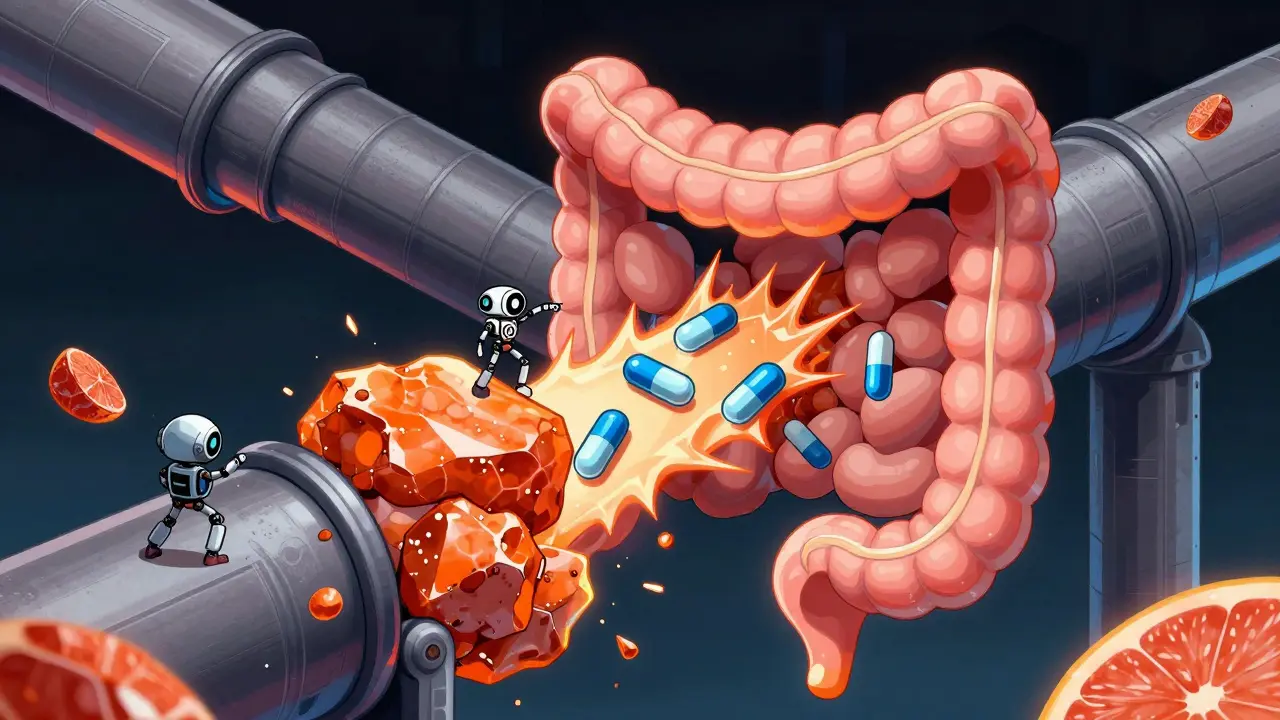
Grapefruit contains unique chemical compounds called furanocoumarins, specifically 6′,7′-dihydroxybergamottin. These compounds act like a permanent roadblock. When you drink the juice, these chemicals bind to the CYP3A4 enzyme. Unlike temporary interactions where the effect wears off quickly, this binding is irreversible. Once the enzyme is blocked, your body cannot produce fresh ones to replace them immediately. It can take up to three days for your system to recover full function.
This means the drug you took doesn’t get broken down. Instead, it floods directly into your blood. Research indicates that a single serving of grapefruit juice can increase the concentration of certain immunosuppressants in your blood by anywhere from 50% to over 300%. That difference turns a carefully calibrated dose into an overdose. For patients with a narrow therapeutic index-where the gap between a helpful dose and a toxic dose is thin-this spike is incredibly dangerous.
Medications Most at Risk
Not every pill reacts to citrus fruit. However, several cornerstone drugs used to prevent organ rejection are highly sensitive to this blockage. These medications share a common pathway: they rely almost entirely on the intestinal CYP3A4 for metabolism. If you are taking any of the drugs listed below, you must treat grapefruit with extreme caution.
| Drug Name (Brand) | Common Uses | Risk Level | Impact on Blood Levels |
|---|---|---|---|
| Cyclosporine (Neoral, Gengraf) | Kidney, Heart, Liver Transplants | High | Increases by 50-100% |
| Tacrolimus (Prograf, Astagraf XL) | Organ Transplantation, Eczema | Very High | Increases by 30-50% |
| Sirolimus (Rapamune) | Kidney Transplants | Critical | Increases by 200-300% |
| Everolimus (Zortress) | Renal Transplants | Critical | Serious Interaction |
Patients often ask if newer formulations change this rule. While companies like Astellas Pharma have developed extended-release versions, such as Envarsus XR for tacrolimus, the risk does not disappear. Modified-release properties may alter absorption slightly, but the underlying metabolic pathway remains vulnerable to the same inhibition. Do not assume a "new" version of your med allows you to relax your diet.

Recognizing the Signs of Toxicity
When you accidentally consume grapefruit while on these drugs, the consequences aren’t immediate. You won’t feel sick in five minutes. The buildup happens silently over hours. By the time you notice symptoms, your drug levels are already spiking. Knowing what to look for can save your life.
The most common sign is neurological tremors. Patients frequently report shaking hands, dizziness, or confusion that feels similar to intoxication. Nausea and severe vomiting are also typical responses as the body tries to reject the excess chemical load. More critically, because these drugs stress the kidneys, sudden fatigue, reduced urination, or swelling in the ankles can indicate acute kidney injury.
In community support forums, transplant recipients have shared alarming anecdotes. A kidney recipient reported a hospitalization after a casual lunch where he had orange and grapefruit segments mixed together. His tacrolimus levels shot from a stable 8 ng/mL to a toxic 24 ng/mL within 36 hours. This isn't a theoretical risk; real people end up in the ER for exactly this reason. Another user noted experiencing hyperkalemia (high potassium) alongside drug toxicity, causing heart palpitations.
The 72-Hour Safety Window
If you have decided to stop eating grapefruit permanently, there is still a question of timing. Many people think, "I’ll just stop drinking the juice when I start my new meds." That approach fails because the enzyme damage takes days to heal. Medical consensus requires a strict avoidance period.
Research demonstrates that CYP3A4 activity remains inhibited for up to 72 hours after consumption. This means if you drink a glass of juice on Monday morning, your enzymes won’t fully recover until Thursday evening. To be safe, you must stop consuming the fruit at least three days before starting your medication regimen. Conversely, if you slip up, do not panic. Monitor your levels closely and wait for the clearance window to pass before normalizing your routine.

Navigating Fruit Choices Safely
Avoiding grapefruit doesn’t mean you have to give up all citrus. Nutritionists emphasize that regular oranges, lemons, limes, and tangerines are generally safe for most patients because they lack the high concentration of furanocoumarins found in grapefruit. You can make a simple swap: trade your morning grapefruit wedge for orange slices.
However, there is one major trap: pomelo and Seville oranges. Pomelo looks similar to grapefruit and shares its chemical makeup. Seville oranges are bitter varieties typically used in marmalades, but they contain the same inhibitory compounds. Avoid anything labeled as marmalade made from bitter oranges. If you are unsure about a specific fruit variety, assume it poses a risk and check with your pharmacist.
What to Do If You Made a Mistake
We aren’t perfect. Sometimes you order a smoothie that contains hidden grapefruit juice, or you snack on a piece of fruit at a friend’s house without checking. If this happens, contact your transplant coordinator immediately. They will likely order a stat blood draw to check your trough levels.
Transplant centers like the University of Pittsburgh Medical Center have specific protocols for this scenario. They usually recommend checking levels within 3 to 5 days of exposure. In some cases, doctors will reduce the dose temporarily until levels stabilize again. Never try to adjust your dose yourself based on symptoms alone. Always follow your medical team’s instructions for monitoring.
Sam Hayes
April 2, 2026 AT 12:42really important read for anyone on transplant meds the grapefruit thing isnt just a rumor. ive seen people get confused because they think oranges are okay but pomelos are risky too. the seven day wait rule saves so much trouble in the long run. just wanted to share that staying consistent with checking labels helps avoid hospital visits. glad this info is getting shared widely
HARSH GUSANI
April 3, 2026 AT 13:02😡 yes this is true people need to listen 🤦♂️ health comes first. don't be stupid with your meds or you pay the price. if you hurt yourself it's your fault 🚫🥭 follow the rules 👴. thank god for science 🙏 stay safe 🛑 never take shortcuts with your liver
Joseph Rutakangwa
April 4, 2026 AT 21:54Stay vigilant with dietary choices to prevent toxicity
Beth LeCours
April 6, 2026 AT 08:59It is kind of scary how easy it is to mess up. Just drink orange juice instead. Don't take any chances with your health today.
Joey Petelle
April 8, 2026 AT 03:15One would assume the average human possesses enough intellect to read a warning label yet we require constant hand holding regarding citrus fruits. Truly a testament to modern dependency on biological oversight rather than personal responsibility. Another trip to the ER for free medicine is never a bad idea.
Vicki Marinker
April 8, 2026 AT 06:43While the information provided is generally accurate, it fails to acknowledge individual metabolic variances which may mitigate certain risks. The absolute prohibition suggested feels somewhat excessive for patients with robust enzymatic function. Nuance is often lost in favor of alarmism within public health discourse.
Lawrence Rimmer
April 8, 2026 AT 08:47We live in a world where natural biology battles synthetic intervention constantly. To ignore the fundamental truths of our gut chemistry is to invite chaos into one's own organism. Discipline in diet reflects discipline in life philosophy overall. We must respect the ancient wisdom of the body's design.
angel sharma
April 10, 2026 AT 06:44This guide highlights exactly why consistency matters every single day.
Every choice we make regarding nutrition impacts how our body processes necessary treatments.
It might seem small to skip a glass of juice but the cumulative effect on kidney function is massive.
Transplant recipients deserve the best care possible and that starts with understanding interactions deeply.
There is power in knowledge that keeps us safe from avoidable complications.
We should all support each other in making these informed decisions consistently.
Small changes lead to significant improvements in long term outcomes for everyone involved.
The medical community works hard to find these cures and protects lives daily.
Ignoring warnings undermines all that hard work put into research and development.
It takes courage to change habits that you enjoy for your own well being.
We can all be heroes by simply educating ourselves and those around us properly.
Remember that patience is key when waiting for enzyme recovery times.
Trust your doctors and always verify ingredients before consuming anything new.
Your future self will thank you for taking these precautions seriously now.
Living a longer healthier life is the ultimate goal we should strive for together.
Sakshi Mahant
April 11, 2026 AT 19:14Thank you for sharing this valuable resource with the community. It is comforting to see detailed explanations about the specific drugs affected. We all learn something new and it builds trust between patients and their medical teams. Please continue to spread awareness gently without causing panic. Everyone appreciates clarity when navigating complex health challenges.
HARSH GUSANI
April 12, 2026 AT 16:03😡 yes this is true people need to listen 🤦♂️ health comes first. don't be stupid with your meds or you pay the price. if you hurt yourself it's your fault 🚫🥭 follow the rules 👴. thank god for science 🙏 stay safe 🛑 never take shortcuts with your liver