Geriatric Polypharmacy Interventions: How to Reduce Adverse Drug Events in Older Adults
 Mar, 18 2026
Polypharmacy Risk Calculator
How This Tool Works
This calculator estimates your risk of adverse drug events based on the medications you take. It uses evidence-based guidelines to identify potentially inappropriate medications and calculates risk levels based on your specific regimen.
Select medications you're currently taking. Each additional medication increases risk by 8%. High-risk medications add extra risk.
Your Current Medications
Next Steps
More than 41% of adults over 65 in the U.S. take five or more medications daily. For many, this isn’t a choice-it’s the result of managing diabetes, heart disease, arthritis, and depression all at once. But each extra pill adds risk. Studies show that every additional medication increases the chance of a dangerous fall by about 8%. And with hospitalizations from drug reactions costing the U.S. healthcare system over $30 billion a year, it’s clear: we need better ways to manage what’s called geriatric polypharmacy.
What Exactly Is Geriatric Polypharmacy?
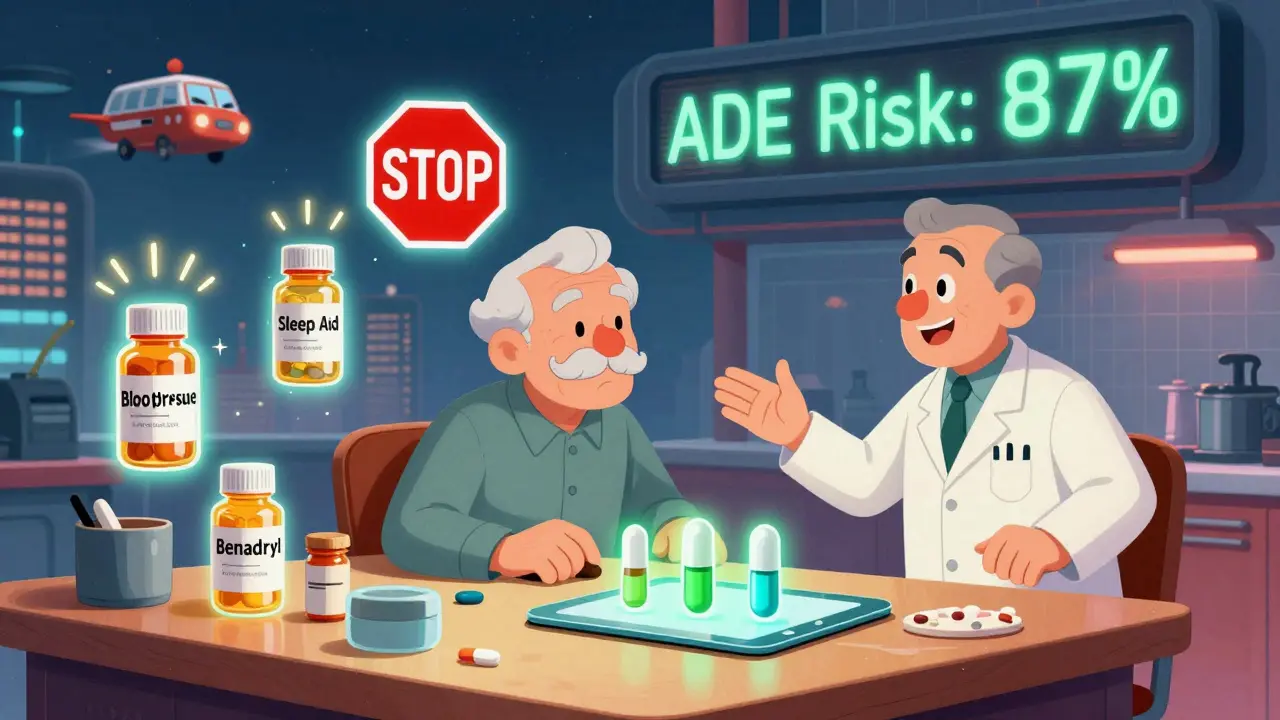
Polypharmacy isn’t just about taking a lot of pills. It’s when someone regularly uses five or more medications, especially when some of them don’t add real benefit-or even cause harm. The American Geriatrics Society and the American Academy of Family Physicians both use this five-pill threshold because research shows risks climb sharply after this point. It’s not the number alone, though. It’s the mix. A blood pressure drug, a sleep aid, an anticholinergic for overactive bladder, a painkiller, and a statin might seem fine on paper. But together, they can blur a patient’s thinking, weaken their balance, or drop their blood pressure too low.Older adults are especially vulnerable. Their bodies process drugs differently. Kidneys slow down. Liver function declines. And many take meds prescribed by different doctors-each focused on one condition, not the whole picture. A 2023 study found that nearly 80% of seniors see five or more providers each year. No one is looking at the full list.
The Real Danger: Adverse Drug Events
Adverse drug events (ADEs) aren’t just side effects. They’re preventable harms: falls, confusion, kidney damage, internal bleeding, or sudden hospital trips. One landmark study in the Journal of the American Geriatrics Society found that seniors on four or more medications had a 30-50% higher risk of injurious falls. Each extra pill? Add another 8% risk.And it’s not just falls. A 2022 report from the Institute for Safe Medication Practices showed that nearly 28% of all hospital admissions for older adults were linked to medication problems. That’s one in four. Many of these could be avoided.
Some medications are especially risky for seniors. The 2023 update to the Beers Criteria-a widely used guide for unsafe prescribing in older adults-added new red flags. Anticholinergics like diphenhydramine (Benadryl) can cause memory loss. Benzodiazepines like lorazepam increase fall risk. Even long-term proton pump inhibitors (PPIs) for heartburn can lead to bone fractures and infections. These aren’t rare cases. They’re common.
Three Levels of Intervention-Only One Works
Not all medication reviews are equal. Researchers have broken them down into three types:- Type I: Just reviewing the medication list-no patient contact.
- Type II: Review plus checking if the patient is actually taking the pills.
- Type III: Full face-to-face (or video) consultation with a clinician who evaluates both the drugs and the patient’s health status.
Here’s the hard truth: only Type III works. A 2023 study in JAMA Network Open found that Type III interventions reduced unplanned hospital readmissions by 18.3%. Types I and II? No meaningful difference.
Why? Because you can’t fix polypharmacy from a chart. You need to talk to the person. Ask: Are you still taking this? Why? What are you worried about if you stop? One 82-year-old man was on seven medications, including a sleeping pill he hadn’t taken in two years. He didn’t know it was still on his list. Another woman was on a blood thinner she didn’t need anymore-her atrial fibrillation had resolved, but no one checked.
Tools That Actually Help
There are several clinical tools to guide decisions, but not all are equally useful.- Beers Criteria (2023): Lists potentially inappropriate medications for older adults. Useful for flagging risks.
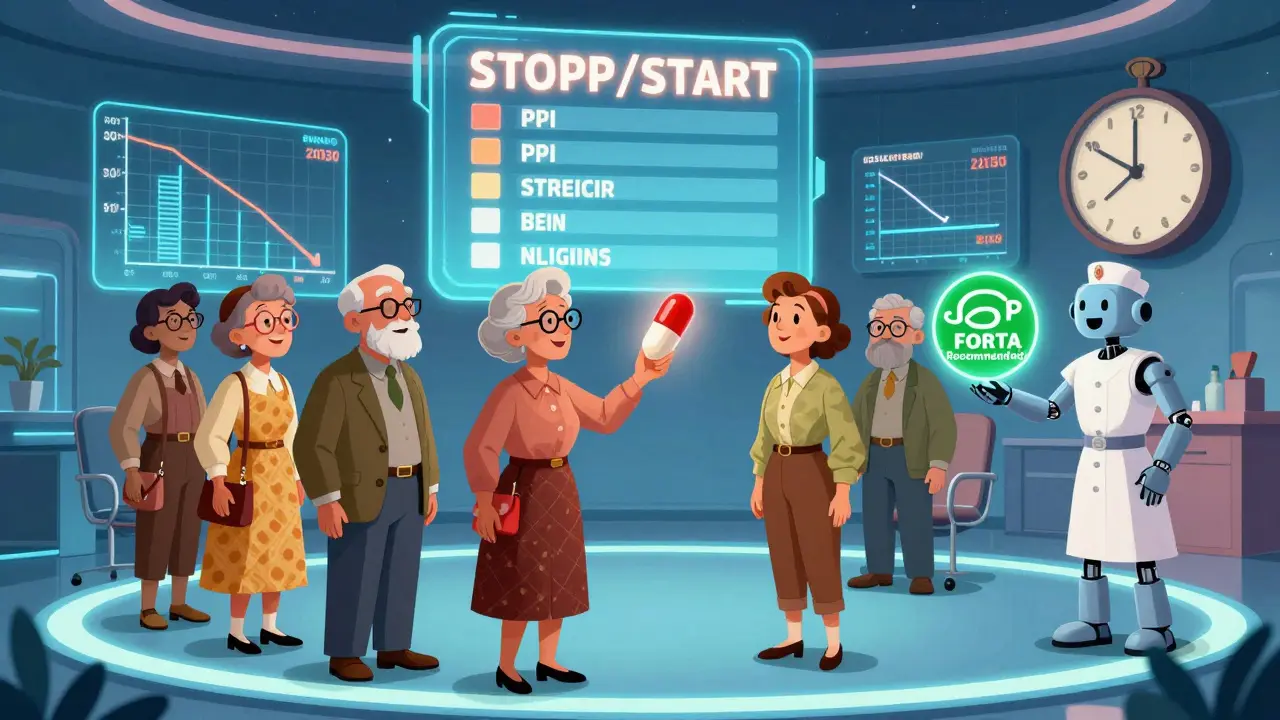
- STOPP/START v3 (2021): Identifies both inappropriate drugs (STOPP) and missed opportunities for needed drugs (START). This is the one that actually changes outcomes.
- FORTA List: Classifies drugs as Fit, Optimal, Recommended, or Avoided for older adults. Strong evidence for reducing harm.
Studies show that only STOPP/START and FORTA have proven to reduce hospitalizations and improve survival. Beers is helpful, but it doesn’t tell you when to start a needed drug-only what to avoid. That’s why many clinics now use both STOPP/START and FORTA together.
Who Should Lead These Interventions?
Pharmacists aren’t just pill counters. When they’re embedded in geriatric care teams under Collaborative Practice Agreements (CPAs), they cut inappropriate prescribing by over a third compared to doctors working alone. A 2025 study found pharmacist-led teams achieved 37.6% higher deprescribing rates.But here’s the catch: only 22 U.S. states allow CPAs for pharmacists. In the rest, they can’t adjust prescriptions without a doctor’s signature-delaying care, frustrating patients, and wasting time.
And it’s not just pharmacists. The best results come from teams: a geriatrician, a clinical pharmacist, a nurse, and sometimes a social worker. They check for social barriers too. Is the patient struggling to afford meds? Can they open bottles? Do they have someone to help them take pills correctly?
Where It Goes Wrong
Many programs fail because they focus only on cutting pills-without checking if the patient needs them.One study found that 12.8% of deprescribing attempts were inappropriate. Someone stopped a heart medication that was still needed. Another discontinued a thyroid pill, leading to fatigue and confusion. That’s why tools like STOPP/START and FORTA matter-they don’t just say “stop.” They say: Stop this, but consider starting that.
And then there’s the fear factor. A 2023 national poll found that 68.4% of older adults are scared to stop any medication-even ones they don’t take anymore. They worry about “going back” to how they felt before. That’s why communication is everything. You can’t just remove a pill. You have to explain why, how, and what to watch for.
Some patients even had bad experiences after rapid deprescribing. A 2022 JAMA Internal Medicine study found 12.4% of patients had withdrawal symptoms-seizures from stopping anticonvulsants too fast, or rebound anxiety from abruptly stopping benzodiazepines. Tapering matters. Monitoring matters.

What’s Working in Real Clinics
The Veterans Health Administration (VHA) has one of the most successful programs. Their Geriatric Research, Education and Clinical Centers (GRECCs) use embedded pharmacists who do full medication reviews every six months. They’ve reduced inappropriate prescribing by 26.8% in just three years.Duke University’s “Five Tips” approach is simple: get the real list, use STOPP/START, involve the patient, taper slowly, and document everything. Their error rate dropped by over 40%.
Even small clinics are seeing results. One community health center in Oregon started using the Medication Appropriateness Index (MAI). Within a year, inappropriate prescribing fell by 31.2%. But they had to fight for time. Most primary care doctors have less than five minutes per patient to review meds. And only 15% of Medicare Advantage plans pay for these reviews.
The Future: AI and Personalized Risk Scores
In April 2024, Epic Systems launched its “Polypharmacy Risk Score”-an AI tool built into electronic health records. It analyzes a patient’s age, conditions, medications, lab results, and history of falls. In validation studies, it predicted adverse events with 87.3% accuracy.The American Geriatrics Society is working on Beers Criteria v2026, which will include personalized deprescribing algorithms. And the National Institute on Aging is funding research into genomic risk scores-could your genes tell you if you’re more likely to have a bad reaction to a certain drug?
By 2030, experts predict comprehensive medication reviews will be standard for all older adults. Why? Because value-based care is here. Medicare is now penalizing providers whose patients have too many drugs. Starting in 2024, CMS includes polypharmacy metrics in its payment system. If more than 30% of your Medicare patients are on ten or more medications, your reimbursement drops.
What You Can Do
If you or a loved one is on five or more medications:- Get the full list-include supplements, OTCs, and creams.
- Ask: “Which of these are still needed? Which might be causing problems?”
- Request a full medication review with a pharmacist or geriatrician.
- Never stop a drug suddenly. Ask about tapering.
- Use STOPP/START or FORTA as a reference when talking to your provider.
It’s not about taking fewer pills. It’s about taking the right ones. For the right reasons. With the right support.
What is considered polypharmacy in older adults?
Polypharmacy in older adults is generally defined as the regular use of five or more medications. This threshold is used by major organizations like the American Geriatrics Society and the American Academy of Family Physicians because research shows the risk of adverse drug events rises sharply at this point. It’s not just the number, though-it’s whether the medications are still appropriate, effective, and safe for the individual’s current health status.
Can deprescribing really reduce hospitalizations?
Yes. Comprehensive medication reviews that include face-to-face patient consultations (Type III interventions) have been shown to reduce unplanned hospital readmissions by 18.3%. These reviews don’t just cut pills-they evaluate the whole picture: what’s working, what’s not, and what’s missing. When done right, they prevent dangerous drug interactions and withdrawal effects, leading to fewer ER visits and hospital stays.
Which tools are most effective for deprescribing?
The STOPP/START (v3, 2021) and FORTA lists are the most effective. STOPP identifies potentially inappropriate medications, while START identifies drugs that should be prescribed but are missing. Unlike the Beers Criteria, which only flags risks, these tools help clinicians make balanced decisions-reducing harm while ensuring essential therapies aren’t stopped. Studies show they improve clinical outcomes and reduce hospitalizations.
Why are pharmacists better at deprescribing than doctors?
Pharmacists have specialized training in drug interactions, dosing, and side effects. Under Collaborative Practice Agreements, they can directly adjust or discontinue medications without waiting for a physician’s approval. A 2025 study found pharmacist-led teams achieved 37.6% higher deprescribing rates than physician-only approaches. They also spend more time talking with patients, addressing fears, and creating safe tapering plans.
Is it safe to stop medications suddenly?
No. Abruptly stopping certain drugs-like benzodiazepines, antidepressants, or anticonvulsants-can cause serious withdrawal symptoms, including seizures, rebound anxiety, or heart rhythm problems. A 2022 study found 12.4% of patients had adverse events after rapid deprescribing. Always taper medications slowly under professional supervision. The goal is to remove harm, not create new risks.
How much time does a full medication review take?
A comprehensive medication review typically takes 45 to 60 minutes. This includes gathering the full medication list (which can take over 20 minutes), using tools like STOPP/START, discussing goals of care with the patient, and creating a deprescribing plan. Most primary care settings don’t have this time built in, which is why pharmacist-led models in geriatric clinics or VA systems are more successful.
Are there new technologies helping with polypharmacy?
Yes. In 2024, Epic Systems launched the “Polypharmacy Risk Score,” an AI tool integrated into electronic health records that predicts adverse drug events with 87.3% accuracy. It analyzes medications, age, lab results, and fall history. The American Geriatrics Society is also developing Beers Criteria v2026, which will include personalized deprescribing algorithms. These tools are helping shift care from reactive to preventive.
Shameer Ahammad
March 20, 2026 AT 09:59Let me be perfectly clear: polypharmacy is not a medical issue-it's a systemic failure of oversight. Five or more medications? That’s not ‘managing conditions’; it’s pharmaceutical roulette. Every doctor prescribes like they’re the only one in the room. No coordination. No accountability. And don’t get me started on how OTCs are ignored-Benadryl in the cabinet, ibuprofen in the drawer, melatonin ‘just because’-all unrecorded, all unchecked. The Beers Criteria exists for a reason. If you’re prescribing without consulting it, you’re not a clinician-you’re a liability.
STOPP/START isn’t ‘just a tool’-it’s the bare minimum. FORTA? Even better. But nobody uses them. Why? Because it’s easier to write a script than to have a conversation. And now, with Epic’s AI score? Finally. A system that can flag this chaos. But even that won’t fix the culture. We need mandatory interdisciplinary reviews. Not optional. Not ‘if time permits.’ Mandatory. And pharmacists must have prescriptive authority-full stop. Twenty-two states? That’s not policy. That’s negligence.
And the patients? They’re terrified to stop. Not because they’re irrational. Because they’ve been told for decades, ‘This pill keeps you alive.’ No one ever said, ‘Let’s see if you still need it.’ That’s malpractice by omission. The VHA model works because they have structure. The rest of us? We’re just hoping for the best. And that’s not healthcare. It’s gambling.
Michelle Jackson
March 22, 2026 AT 03:51So we’re blaming doctors now? Funny. My grandma’s on 12 meds. She’s 89. She’s fine. She eats, sleeps, watches her soaps. Who are you to say she needs less? If it ain’t broke don’t fix it. And stop pushing this deprescribing nonsense-next thing you know they’ll take away her blood pressure pills ‘cause some study says it’s ‘inappropriate.’
Suchi G.
March 24, 2026 AT 00:42I just want to say, as someone whose mom went through this-oh my god, the fear. She was on a benzodiazepine for 15 years. No one ever asked if she still needed it. Just kept renewing. Then, one day, her doctor said, ‘Let’s try weaning.’ We didn’t know how. We didn’t know what to watch for. She had panic attacks for weeks. She thought she was dying. I called the pharmacy three times. The pharmacist was the only one who had a plan. He printed out a taper schedule. He called her weekly. He didn’t just remove a pill-he held her hand through the whole thing.
And then, when they took away the PPI? She cried. Said she’d ‘never sleep again.’ Turns out, she hadn’t taken it in two years. Her daughter had been giving it to her ‘just in case.’ We didn’t even know. That’s the real tragedy. Not the number of pills. The silence. The lack of communication. The assumption that ‘if it’s on the list, it’s still doing something.’ It’s not. It’s just… there. Like a ghost. And we’re all too scared to ask if it’s still haunting us.
becca roberts
March 24, 2026 AT 21:22So let me get this straight. The solution to overprescribing is… more paperwork? More meetings? More ‘comprehensive reviews’ that take an hour? Meanwhile, my primary care doc spends 7 minutes with me and says, ‘Here’s a refill.’
Oh, and pharmacists are the heroes? Right. Because they’re the only ones who actually care enough to look at the list. Meanwhile, doctors are too busy billing for ‘annual wellness visits’ that are really just ‘let me write you 3 new scripts.’
And Epic’s AI tool? Cute. But it’s just a fancy version of ‘checklist.’ What we need is a law that says: no more than three new prescriptions per year unless reviewed by a pharmacist with full authority. And maybe, just maybe, stop letting cardiologists prescribe sleep meds. That’s not medicine. That’s a convenience.
Andrew Muchmore
March 25, 2026 AT 12:03Pharmacists should be able to adjust meds. Full stop. No more waiting for a signature. The system is broken. We know what works. Type III reviews reduce hospitalizations. Stop talking. Start acting.
Nicole Blain
March 26, 2026 AT 04:31My grandma’s on 8 meds. She says she’s ‘just trying to stay alive.’ I showed her the list. She didn’t even know half of them were still active. We went to the pharmacist. He took 45 minutes. We cut 3. She’s sleeping better. No more falls. I’m just glad we didn’t wait until she broke a hip.
PS: Pharmacists are underrated. 🙌
Kathy Underhill
March 26, 2026 AT 13:17The core issue isn’t the number of pills. It’s the absence of narrative. Medicine has become a catalog of interventions, not a story of a life. We treat diabetes, then hypertension, then arthritis, then insomnia-each as a separate problem, each with its own script. But the person? The person is just a collection of symptoms. We don’t ask: What do you want your days to look like? Are you still enjoying tea with your grandchildren? Can you walk to the mailbox? If the answer is yes, maybe we don’t need to keep all the pills. Maybe we need to stop treating disease and start protecting dignity.
Srividhya Srinivasan
March 27, 2026 AT 20:51Wake up. This isn’t about medicine-it’s about corporate greed. Big Pharma pushes pills. Doctors get paid per script. Pharmacies profit on refills. The VA? They’re the exception because they’re government-run. Private system? It’s a machine. They don’t want you to stop meds. They want you to keep buying them. The ‘Beers Criteria’? It’s a joke. They update it every few years like it’s a fashion trend. Meanwhile, the same companies are marketing anticholinergics to seniors like they’re miracle cures. And now they’re using AI? To make it look like science? It’s all a smokescreen. The real solution? Ban direct-to-consumer ads. End fee-for-service prescribing. Let pharmacists lead. Or better yet-make doctors work in teams. Not alone. Not with 10-minute visits. Not while being paid to prescribe. This system is rigged.
Prathamesh Ghodke
March 29, 2026 AT 10:15My uncle was on 9 meds. We got him to a geriatric pharmacist. Cut 4. He went from ‘I’m too tired to move’ to ‘I’m going to the lake this weekend.’
But here’s the thing-no one told him he could ask. He thought the pills were mandatory. Like oxygen. I wish I’d known this earlier. I wish more families did.
And yeah, pharmacists? They’re the real MVPs. Not the doctors. The ones who actually sit down, listen, and say, ‘Let’s see what we can take off.’
Lauren Volpi
March 31, 2026 AT 02:44Why are we even talking about this? In America, we fix things with more money, more pills, more tests. You want to reduce hospitalizations? Don’t cut meds. Cut the bureaucracy. Make doctors work faster. Let them prescribe without 10 layers of review. Stop making healthcare a game of compliance. We’re not Scandinavia. We don’t have time for ‘comprehensive reviews.’ We need results. And results come from action-not meetings.
Alexander Pitt
April 1, 2026 AT 13:02STOPP/START and FORTA are the only tools that work because they’re bidirectional. They don’t just say ‘stop.’ They say ‘start.’ That’s the difference between being cautious and being thoughtful. Most reviews are just deletion. These are optimization. And that’s why they reduce hospitalizations. It’s not about fewer pills. It’s about better care.
Manish Singh
April 2, 2026 AT 22:35I’ve seen this in India too. Elderly patients on 10+ meds. No one checks. No one asks. Family just keeps giving them what the last doctor said. OTCs? Supplements? Herbal stuff? All mixed in. And no one knows what’s real or what’s placebo.
But here’s the good part-when we do a full review with a pharmacist, the drop in confusion and falls is immediate. It’s not magic. It’s just attention.
Nilesh Khedekar
April 4, 2026 AT 04:21Who’s really behind this? The insurance companies. They don’t want you to stop meds because then you’d need less care. Less monitoring. Less ER visits. But if you stop the pills, you’re ‘healthier’-and they lose money. So they push for ‘annual reviews’ but don’t pay for them. And they make doctors rush. It’s all a trap. And now they’re using AI to make it look like science? Please. It’s just another way to track you. Next thing you know, your ‘polypharmacy score’ will affect your premiums. Or your life insurance. Watch out.
Robin Hall
April 4, 2026 AT 17:16The notion that Type III interventions are uniquely effective is not merely empirically supported-it is logically inescapable. The human condition cannot be adequately assessed through chart audits or pill counts. The complexity of physiological adaptation, psychological dependency, and social context necessitates direct, longitudinal, and empathetic engagement. The fact that this approach reduces hospitalizations by 18.3% is not a statistical anomaly-it is a moral imperative. To continue delegating this task to untrained personnel, or to constrain pharmacists within archaic legal frameworks, is not merely inefficient-it is ethically indefensible.