Generic Substitution for Respiratory Combination Inhalers: What You Need to Know
 Apr, 9 2026
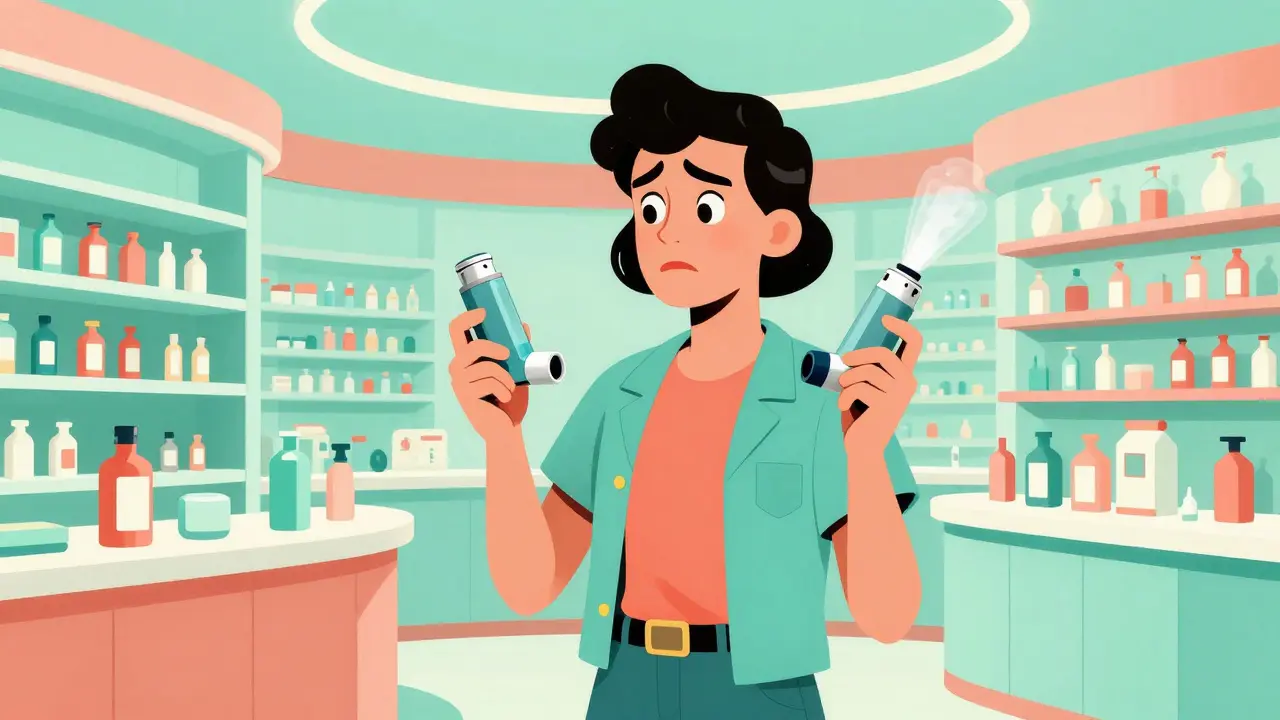
Swapping a brand-name pill for a generic one is usually a non-event. The chemical is the same, the dose is the same, and your body processes it the same way. But when it comes to respiratory combination inhalers, the story changes completely. In this case, you aren't just buying a drug; you're buying a delivery system. If the device changes, the way the medicine hits your lungs changes, and that can be the difference between breathing easy and an emergency room visit.
Many people are finding their prescriptions switched to generic versions of popular medications like Symbicort. While saving money is great, the risk lies in the mechanics. A Dry Powder Inhaler (DPI) requires a forceful, deep breath to pull the medication in, whereas a pressurized metered-dose inhaler (pMDI) requires a slow, coordinated breath. If you use a DPI technique on a pMDI, or vice versa, you simply aren't getting the dose you need.
| Device Type | Mechanism | Required Patient Action | Primary Risk if Incorrect |
|---|---|---|---|
| pMDI | Pressurized canister | Slow, deep inhalation + breath hold | Medicine hits throat, not lungs |
| DPI | Dry powder capsule/reservoir | Forceful, rapid inhalation | Insufficient powder deposition |
| Nebulizer | Liquid to mist | Passive breathing through mask/piece | Low efficiency/long duration |
The Trap of "Branded Generics"
There is a confusing middle ground in the market called the "branded generic." Take DuoResp Spiromax, for example. It contains the same active ingredients-budesonide and formoterol-as the Symbicort Turbohaler, but it is not a traditional generic because the device is different.
The Turbohaler requires a twisting motion to load the dose. The Spiromax uses a side slider. It sounds like a small detail, but it's a huge deal for patient safety. Research shows that 76% of patients switched from a Turbohaler to a Spiromax without specific training actually used the device incorrectly. When you don't know the new "rules" of the device, your asthma control can plummet. In fact, one study found a 22% increase in asthma exacerbations for patients switched to generic Spiromax without proper instruction.
Why Regulatory Approaches Clash
Depending on where you live, the rules for substitution vary wildly. In the United States, the FDA generally expects that a user can switch to a generic combination product without needing extra training from a doctor. This is a high-risk assumption.
Across the Atlantic, the European Medicines Agency (EMA) is much stricter. They require proof of therapeutic equivalence, which means the generic must show similar lung deposition patterns. This is critical because lung deposition can vary by 25% to 40% between different device types. Meanwhile, the UK's NICE guidelines explicitly advise against automatic substitution, warning that switching devices without a consultation often leads to worsened asthma control.

The Real-World Cost of "Saving Money"
From a financial perspective, generics are designed to lower costs. But if a patient ends up in the hospital because they couldn't trigger their new inhaler correctly, the "savings" vanish instantly. Industry data suggests that inappropriate substitution costs healthcare systems about $1.2 billion annually in avoidable emergency visits.
Patient stories reflect this struggle. On forums like Reddit, a vast majority of users reported worsening symptoms after being switched from Advair Diskus to a generic alternative without a demo. One patient reported that because they didn't realize they needed to breathe in harder with their new generic device, their condition deteriorated to the point of hospitalization. This isn't a failure of the drug's chemistry; it's a failure of the device transition.

How to Handle a Switch Safely
If your pharmacist tells you that your medication is now a generic, don't just take the box and leave. You need a formal transition. The most effective method is the "teach-back" approach. This is where you don't just listen to the pharmacist; you actually demonstrate the technique back to them. This simple step has been shown to increase proper technique retention from a dismal 35% to 82%.
Here is a checklist for anyone facing a substitution:
- Ask for the device name: Is it the exact same device as before, or a different one (e.g., Turbohaler vs. Spiromax)?
- Request a demo: Have the pharmacist or nurse show you exactly how to prime and trigger the device.
- Perform a teach-back: Use the device in front of the professional and have them correct your form.
- Check the inhalation speed: Ask specifically if you need a "slow and deep" breath or a "fast and forceful" one.
- Monitor symptoms: Keep a close eye on your breathing for the first 14 days after the switch.
The Future of Inhaler Safety
We are seeing a shift toward smarter technology to fix these gaps. Propeller Health and other smart sensor companies are creating devices that track adherence and technique. Early data suggests that providing real-time feedback on how a patient uses their inhaler can reduce exacerbations by 33%.
The Global Initiative for Asthma (GINA) has also updated its stance, prioritizing device familiarity and correct technique over the cost savings of generic substitution. As more combination products face generic competition-with projections suggesting 45% will be generic by 2027-the pressure on healthcare providers to provide better education is only going to increase.
Is a generic inhaler as effective as the brand-name version?
Chemically, yes. The active ingredients are usually identical. However, effectiveness depends on how the drug is delivered to the lungs. If the generic uses a different device mechanism and you aren't trained on it, the medication may never reach your lower airways, making it effectively useless regardless of the chemical purity.
Why can't I just use my old technique with a new generic device?
Different devices require different physics to move the drug. Some require you to create a vacuum with a fast breath to pull powder out, while others rely on a propellant that requires a slow, steady breath to ensure the mist doesn't just hit the back of your throat. Using the wrong technique can result in a significant loss of the delivered dose.
What should I do if I feel my generic inhaler isn't working?
First, do not stop your medication. Contact your healthcare provider immediately and ask for a technique check. It is very common for patients to unintentionally use a new device incorrectly. If your technique is perfect and symptoms persist, your doctor may need to switch you back to the original brand or a different combination entirely.
Do all generic substitutions require a new prescription?
This depends on the law in your region and the specific device. In some places, pharmacists can substitute an identical device. However, if the device mechanism changes (like switching from a Diskus to a Spiromax), most clinical guidelines recommend that the prescriber be involved to ensure the patient is properly transitioned and trained.
How can I tell if my inhaler is a generic combination product?
Check the packaging for the brand name. If it doesn't say the original name (like Symbicort or Advair) but lists the ingredients (like budesonide and formoterol), it's a generic. Always check if the physical shape and loading mechanism of the device match what you were using previously.
Doug DeMarco
April 10, 2026 AT 04:43Man, this is such a crucial heads-up for everyone! :) I've seen so many people just breeze through the pharmacy line without a second thought, but the delivery mechanism is everything here. Let's all make sure we're doing the teach-back method so nobody ends up in a bad spot! 🌟
Trey Kauffman
April 11, 2026 AT 13:57Oh, absolutely. Because clearly, the FDA believes that the average person possesses a PhD in respiratory fluid dynamics just by looking at a plastic tube. Truly a masterpiece of systemic efficiency.
Danny Wilks
April 11, 2026 AT 17:01It is quite fascinating to observe how these regulatory discrepancies manifest across different geopolitical borders, as the contrast between the EMA's stringent requirements for therapeutic equivalence and the more permissive American approach suggests a fundamental disagreement on the definition of patient safety in a commercialized healthcare landscape.
Camille Sebello
April 11, 2026 AT 18:11Wait... which pharmacy do you use?? My meds were swapped last week!!! Is yours generic too???
Peter Meyerssen
April 12, 2026 AT 09:46The bioavailability is basically a joke when the pulmonary deposition fails due to poor user interface. It's just basic pharmacokinetic failure 🙄. Most people just don't get the nuance of the device's ergonomics.
Rakesh Tiwari
April 12, 2026 AT 13:47How wonderful that we prioritize profit margins over actual lung function. I'm sure the pharmaceutical companies are just heartbroken that people are ending up in the ER because they couldn't figure out a slider.
Emily Wheeler
April 12, 2026 AT 19:16I really feel like we can approach this as a community by supporting one another in advocating for better education at the pharmacy level, because while the systemic failures are frustrating, the power of collective awareness and a proactive mindset can actually lead to better health outcomes for everyone involved in the long run.
Ben hogan
April 14, 2026 AT 01:36This whole post is just basic common sense dressed up as a warning. If you're too lazy to read the pamphlet, you deserve the dysfunction.
Kelly DeVries
April 15, 2026 AT 01:23honestly my doctor just gave me a generic and i felt like i was suffocating for a week lol it was so scary but then i found out i was just doing it wrong and now its fine
Ryan Hogg
April 15, 2026 AT 19:06I actually had a panic attack after my switch because I thought my asthma was just suddenly getting worse. It's terrifying when you feel like you can't breathe and you don't know why. I spent three days convinced I was dying before someone told me it was just the device. I still can't sleep thinking about it.
Suchita Jain
April 17, 2026 AT 02:49It is highly improper that you are discussing such medical intricacies on a public forum without providing your specific medical history for context. You must maintain a higher standard of discipline regarding your health.
Simon Stockdale
April 18, 2026 AT 23:28USA healthcare is just a total joke man we got the best docs but the system is just tryin to rob us blind by switchin meds and not tellin us how they work its just crazy how they think we're stupid enough to not notice the diffrence between a twist and a slide’n thing!!
kalpana Nepal
April 19, 2026 AT 08:04Medicine is for a few. In my country we believe in strength. These pills are just a way to make you weak and dependent on machines.
Lynn Bowen
April 20, 2026 AT 07:54This is a great reminder that medical standards aren't universal.