Generic Absorption Rates: How They Must Match Brand Drugs to Be Safe and Effective
 Dec, 25 2025
When you pick up a generic pill at the pharmacy, you expect it to work just like the brand-name version. But how do we know it really does? The answer lies in something called absorption rate - and the strict rules that make sure generics match brand drugs in how your body takes them in.
What Absorption Rate Really Means
Absorption rate isn’t about how strong the drug is. It’s about how fast and how much of the active ingredient gets into your bloodstream. Two key numbers measure this: AUC (Area Under the Curve) and Cmax (Maximum Concentration). AUC tells you the total amount of drug your body absorbs over time. Cmax tells you how high the drug spikes in your blood - that’s the speed part.
Think of it like pouring water into a glass. AUC is how much water ends up in the glass. Cmax is how fast the glass fills up. If the generic fills the glass slower or less full than the brand, it might not work the same. That’s why regulators don’t just check the ingredients - they check how your body actually uses them.
The FDA’s 80-125% Rule
In 1984, Congress passed the Hatch-Waxman Act, which created the modern path for generic drugs. Since then, the FDA has required that generics prove they’re bioequivalent to the brand-name version. The rule? The 90% confidence interval for both AUC and Cmax must fall entirely between 80% and 125% of the brand drug’s values.
This isn’t a range where generics can be 20% weaker or 25% stronger. It’s a statistical guarantee that the average absorption is extremely close. In fact, data from over 2,000 studies shows the real difference is usually just 3.5% - not even 5%. A 2016 review of nearly 2,100 studies found that 98% of generics differed from brand drugs by less than 10% in AUC. That’s not random variation. That’s precision.
The FDA doesn’t just rely on theory. They test this in real people. Bioequivalence studies involve 24 to 36 healthy volunteers who take both the generic and brand drug, in random order, with a clean break between doses. Blood samples are taken over hours to map out exactly how the drug moves through the body. Only if the numbers line up within that 80-125% window is the generic approved.
Dissolution Isn’t the Same as Absorption
You might hear that some generics dissolve differently in the lab. That’s true. A 2014 study found that over half of tested generics had different dissolution rates than their brand-name counterparts. One generic nifedipine took much longer to break down. Another amoxicillin dissolved faster. Some batches from the same manufacturer even varied between themselves.
But here’s the catch: dissolution is a lab test. Absorption is what happens in your body. Just because a pill breaks apart slower doesn’t mean your body absorbs less. The FDA knows this. That’s why they require in vivo testing - real human data - not just lab results. If the drug gets into your blood at the right speed and amount, the pill’s texture or coating doesn’t matter.

Narrow Therapeutic Index Drugs: The Exception
Not all drugs are created equal. Some, like warfarin, digoxin, and phenytoin, have a narrow therapeutic index. That means the difference between a dose that works and one that’s toxic is tiny. For these, the FDA tightens the rules. The bioequivalence range shrinks to 90-111% for AUC. These drugs are flagged in the FDA’s Orange Book with an ‘A’ rating if they’re approved as equivalent, or a ‘B’ if there’s uncertainty.
Doctors often prefer to keep patients on the same brand for these medications - not because generics are unsafe, but because switching even a small amount can throw off control. That’s why many states require explicit permission from the prescriber before substituting a generic for a narrow therapeutic index drug.
Why People Think Generics Don’t Work
Despite the data, patients still report differences. Online forums are full of stories: "My generic levothyroxine made me feel awful," or "The generic bupropion didn’t lift my mood like the brand." A 2024 analysis of 1,247 reviews found 12% of users reported perceived differences.
But when you look at real clinical trials, the story changes. A 2023 meta-analysis of 47 studies with nearly 10,000 patients found no difference in outcomes between generic and brand-name cardiovascular drugs. The FDA has recorded only 12 cases of possible therapeutic failure out of more than 14,000 approved generics since 2008 - a failure rate of 0.08%.
Often, what patients feel isn’t the drug. It’s the pill’s shape, color, or size. U.S. trademark laws force generics to look different. That change can trigger a psychological response - the nocebo effect. If you believe the generic is inferior, your brain can make you feel worse. Pharmacists who explain this - that the medicine is identical in function - see fewer complaints.
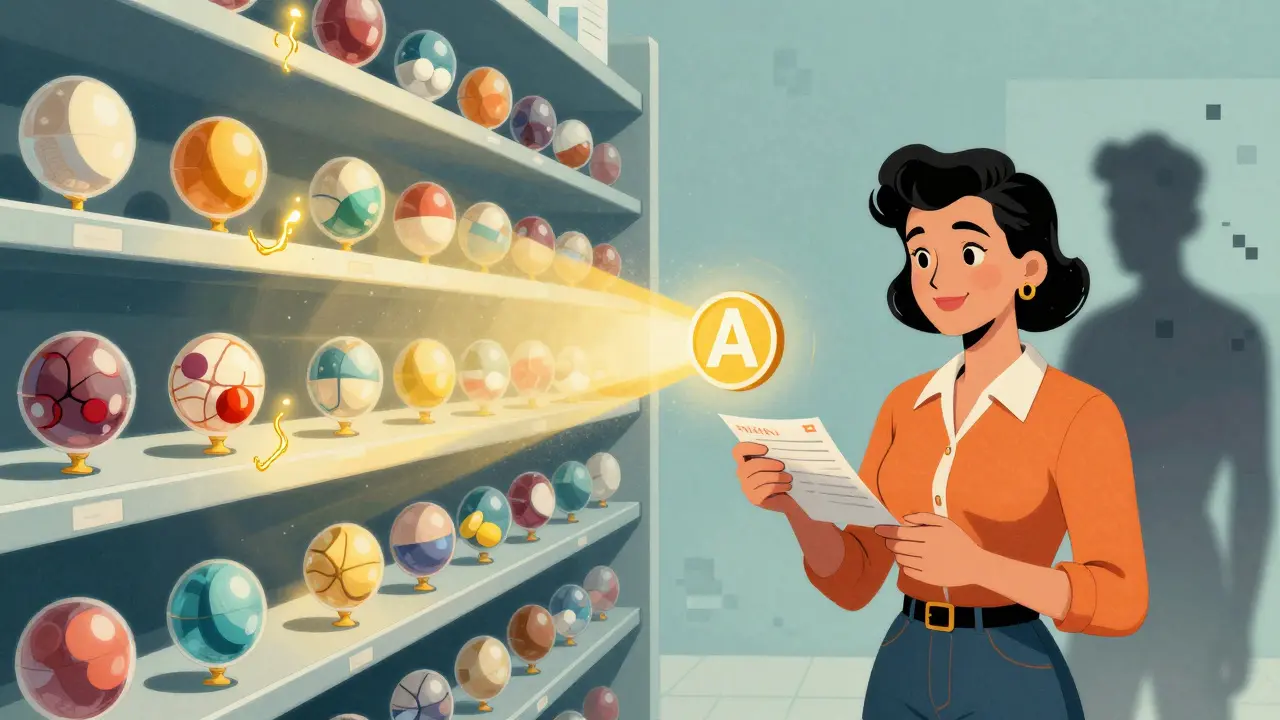
The Bigger Picture: Cost, Access, and Trust
Generics make up 90% of all prescriptions in the U.S. but cost only 23% of total drug spending. The average generic copay is under $20. The average brand-name copay? Over $80. That’s why 90% of patients switch to generics when given the option. And yet, 266% more people abandon brand-name drugs than generics - not because they don’t work, but because they’re too expensive.
Health systems rely on generics to keep care affordable. If every patient had to pay for brand-name drugs, millions would skip doses or go without treatment. The system works because the science works. The 80-125% rule isn’t a loophole - it’s a safeguard. It’s designed to account for natural variation in how people absorb drugs, not to allow inferior products.
What’s Next for Bioequivalence?
The FDA is now exploring new ways to prove bioequivalence without always needing human trials. Modeling and simulation (MIDD) can predict how a drug behaves based on its chemistry and physical properties. This could speed up approval for simple generics while keeping standards high.
For complex drugs - like inhalers, topical creams, or injectables - the rules are still evolving. These don’t always show up in blood tests, so the FDA is developing new methods to measure effectiveness directly at the site of action.
But the core hasn’t changed. Whether it’s a pill you take for blood pressure or a thyroid hormone, if it’s approved by the FDA as bioequivalent, it’s meant to work the same. The numbers don’t lie. The science is solid. And the evidence from real patients, over decades, backs it up.
Are generic drugs really as effective as brand-name drugs?
Yes. The FDA requires generics to prove they deliver the same amount of active ingredient into the bloodstream at the same rate as the brand-name drug. Real-world data shows the average difference in absorption is just 3.5%, well within safe limits. Over 90% of prescriptions in the U.S. are filled with generics because they work just as well.
Why do some people say their generic medicine doesn’t work the same?
Sometimes, it’s not the drug - it’s the pill. Generics must look different due to trademark laws, so changes in color, size, or shape can trigger a psychological response. Patients may feel worse simply because they believe the generic is inferior. Studies show no difference in clinical outcomes, but patient perception is real. Talking with a pharmacist or doctor about this can help.
Can I switch between different generic brands?
Yes - if the generic has an ‘A’ rating in the FDA’s Orange Book. All approved generics meet the same bioequivalence standards. But for narrow therapeutic index drugs like warfarin or thyroid hormones, some doctors prefer to stick with one brand to avoid even tiny fluctuations. Always check with your provider before switching, especially for these medications.
What’s the difference between dissolution and absorption?
Dissolution is how fast a pill breaks down in a lab test. Absorption is how much of the drug actually enters your bloodstream. A generic might dissolve slower in a test tube but still absorb just as well in your body. The FDA only requires proof of absorption - not dissolution - for approval.
Why does the FDA use 80-125% instead of 100%?
Because no two doses of any drug - brand or generic - are absorbed exactly the same way in every person. Biological variation is normal. A 10-15% difference in absorption between doses in the same person is common. The 80-125% range accounts for this natural variability while still ensuring safety and effectiveness. It’s not a loophole - it’s science.
Are there any generics that aren’t safe?
The FDA approves over 14,000 generic drugs. Since 2008, only 12 cases have raised possible safety concerns - a 0.08% failure rate. The agency monitors side effects through its reporting system and can pull a product if needed. If a generic has an ‘A’ rating in the Orange Book, it’s considered therapeutically equivalent and safe to use.
Rajni Jain
December 26, 2025 AT 18:48ive been on generic levothyroxine for 3 years now and honestly? same energy, same sleep, same mood. the brand was costing me $90 a month, now i pay $5. if it aint broke, dont fix it 😊
Natasha Sandra
December 27, 2025 AT 10:22OMG YES!!! 🙌 I used to be one of those people who swore generics were trash… until my pharmacist sat me down and said ‘honey, your body doesn’t care what color the pill is.’ Now i’m basically a generic evangelist. 💊✨
Erwin Asilom
December 28, 2025 AT 13:29The FDA’s 80–125% bioequivalence range is statistically sound and accounts for inter- and intra-individual variability in pharmacokinetics. The 3.5% average deviation observed across 2,100 studies confirms that generic drugs are not merely ‘similar’-they are therapeutically interchangeable.
Sumler Luu
December 30, 2025 AT 03:32I work in a clinic and see patients switch from brand to generic every day. Most don’t notice a thing. But when they do complain? It’s always about the pill looking different. Not the medicine. Just the packaging. We always explain it’s like switching from Coke to store-brand soda-same sugar, same fizz, different label.
roger dalomba
December 31, 2025 AT 03:34Wow. A whole essay on how pills dissolve. Did we just get a TED Talk from the FDA? 🤡
Sophia Daniels
January 1, 2026 AT 15:01Let’s be real-America’s drug system is a scam. Brand names charge $200 for a pill that costs $0.50 to make. Generics? They’re the only thing keeping the poor from dying. If you’re still mad because your pill is blue instead of green, you’re part of the problem. 💪🇺🇸
Nikki Brown
January 2, 2026 AT 14:54People who say generics don’t work are just lazy. If you can’t handle a different-looking pill, maybe you need to stop blaming medicine and start working on your mindset. 🙄
Peter sullen
January 2, 2026 AT 17:12It is imperative to recognize, however, that the pharmacokinetic parameters-namely, AUC and Cmax-are not merely statistical constructs; they are empirically derived, physiologically grounded metrics that reflect the dynamic interplay between drug formulation and human bioavailability. The 80–125% interval, while seemingly broad, is, in fact, a rigorously calibrated safety margin.
Steven Destiny
January 3, 2026 AT 19:17Stop letting Big Pharma scare you! Generics save lives. If you’re still buying brand names, you’re throwing money away-and maybe even hurting people who can’t afford meds at all. Wake up!
Amy Lesleighter (Wales)
January 4, 2026 AT 13:19the body doesnt care what the pill looks like. it cares if the medicine gets in. and it does. trust the science, not the color.
Becky Baker
January 4, 2026 AT 17:15USA made these rules. Other countries? They don’t even test properly. So yeah, our generics are better. We do science right here.