Finding Pharmacies and Medication Help Abroad: A Traveler’s Guide
 Jan, 28 2026
What You Need to Know Before You Leave
If you take prescription meds regularly, flying overseas isn’t just about packing clothes and chargers. It’s about packing medications the right way-because what’s legal in Portland might be banned in Bangkok, and what’s over-the-counter in Paris could require a local doctor’s note in Tokyo. The CDC estimates that nearly half of all travelers face a health issue abroad, and nearly one in three of those involve medication problems. You don’t need to panic, but you do need to plan.
Carry Medications the Right Way
Never pack pills in a Ziploc bag labeled "vitamins." Customs agents in 89% of Schengen countries will flag that. Your meds must be in their original bottles with the pharmacy label showing your name, the doctor’s name, the drug name, and dosage. This isn’t just advice-it’s law in places like Germany, Italy, and Spain. Even if you’re only staying three days, bring the full prescription bottle, not a pill organizer. If you’re carrying insulin, keep it in a cooler with ice packs. The International Air Transport Association says insulin must stay between 36°F and 46°F during travel. A thermal bag with a reusable ice pack costs less than $15 and can save you from a medical emergency.
Know the Rules Before You Land
Not all countries treat medications the same. The U.S. Department of State says 78% of countries restrict medications that are legal here. For example, Adderall is a controlled substance in Japan and Australia. Codeine is banned in Singapore. Even common painkillers like tramadol are regulated in many European countries. Before you go, check the U.S. embassy website for your destination or use the CDC’s free MedAbroad tool. It covers 195 countries and tells you exactly what’s allowed, what’s restricted, and whether you need a special permit.
Bring Extra-At Least 10 Days
Flights get delayed. Trains get canceled. You miss your connection. That’s why the International Society of Travel Medicine recommends carrying at least 10 extra days’ worth of medication. Their 2022 study found this simple step cuts medication-related trip disruptions by 65%. If your trip is two weeks, bring three weeks’ worth. If you’re on insulin or blood thinners, this isn’t optional. Running out of these can land you in the hospital. Don’t rely on finding replacements abroad. In Japan, only 24 pharmacies are certified to serve foreigners. In Cambodia and Thailand, nearly 70% of meds sold in open markets are fake or weak, according to the WHO.
Language Is a Hidden Barrier
One traveler in Thailand spent three hours at a pharmacy because the pharmacist couldn’t read "Lexapro" on her prescription. She didn’t know the generic name-escitalopram-was what they used locally. Always write down the generic name of your meds, not just the brand. If you’re on multiple drugs, make a simple list: Drug Name (Brand), Generic Name, Dosage, Frequency. Print it out and carry it in your wallet. Translation apps help, but written notes are faster and more reliable. A 2022 Johns Hopkins study showed that travelers who carried a translated doctor’s note had 73% fewer issues with customs or pharmacists.
How to Find a Pharmacy Abroad
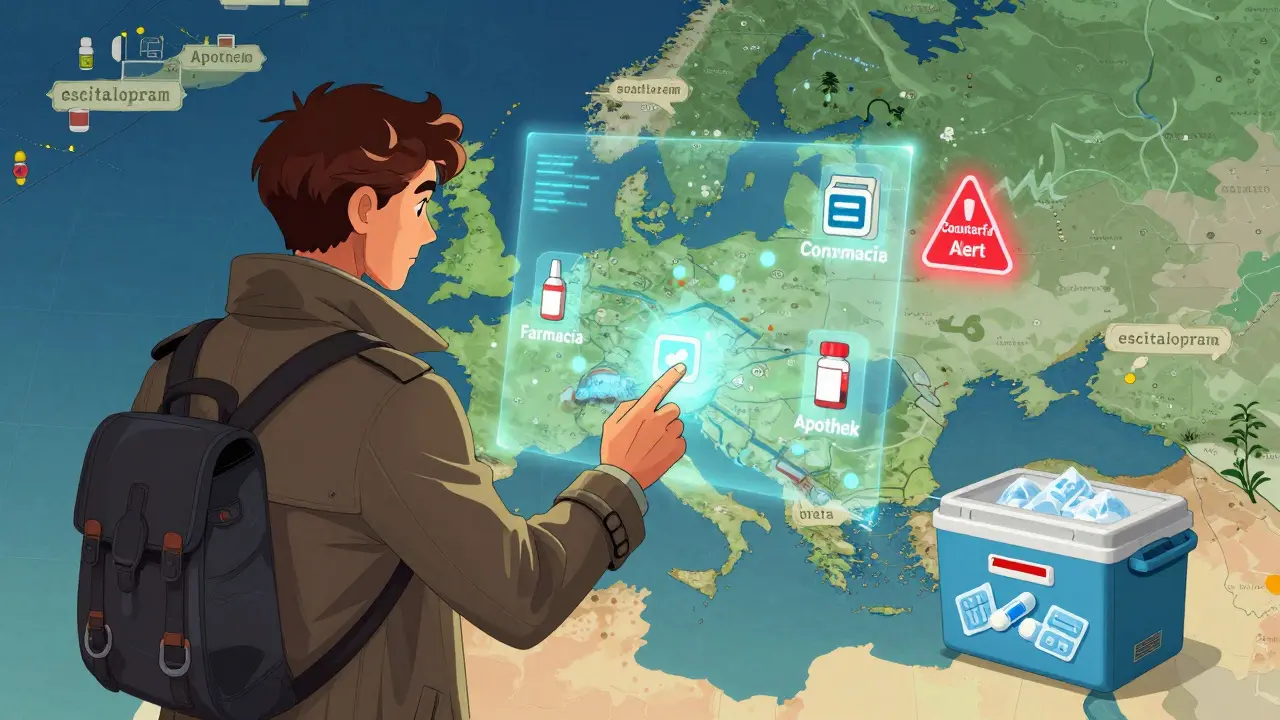
Don’t wander into the first shop with a red cross. In Europe, look for pharmacies marked with a green cross-that’s the official symbol. In France, you can get a 72-hour emergency supply of some meds without a prescription. In the UK, you can pay £9.65 for an NHS prescription if you’re in a bind. In countries like Mexico or Indonesia, avoid street vendors. Use Google Maps and search for "farmacia," "pharmacie," or "apothek." Then check reviews. On Trustpilot, 74% of reviews mention counterfeit meds as a top concern in Southeast Asia and parts of Latin America.
Use Trusted Networks
Walgreens and CVS have very few international locations-only 12 countries total. But Walgreens partners with pharmacies in 18 countries through its international network. If you’re in a pinch, call their helpline. Better yet, use IAMAT (International Association for Medical Assistance to Travelers). They offer a free, vetted list of English-speaking doctors and pharmacies in 110 countries. Their 2022 survey showed 89% satisfaction among users who needed help. You don’t need to be a member to access their directory-it’s online and free.
Time Zones Will Mess With Your Schedule
Changing time zones isn’t just jet lag. It’s a medication risk. The CDC says 47% of travelers on time-sensitive drugs like insulin or anticoagulants make timing errors. For once-daily meds, stick to your home time zone for the first 2-3 days. For example, if you take a pill at 8 a.m. in Portland and land in Rome (9 hours ahead), wait until 8 a.m. Rome time (which is 11 p.m. your body clock) to take it. For insulin, split your dose during the transition. Talk to your doctor before you leave-they can give you a schedule. Johns Hopkins found this method works for 78% of travelers.
Insurance Doesn’t Cover You
Medicare doesn’t cover meds overseas. Most U.S. private plans don’t either. Some travel insurance policies, like World Nomads, cover up to $2,000 for emergency meds-but only if you get a doctor’s note and keep receipts. Always check your policy before you go. Don’t assume your credit card’s travel insurance covers this. Most don’t. If you’re on expensive meds like biologics or specialty injectables, consider buying supplemental travel insurance that includes medication coverage. It’s cheaper than a hospital visit.
What to Do If You’re Turned Away
If a pharmacy says no, don’t argue. Go to a clinic or hospital. In many countries, you can see a doctor for a small fee and get a local prescription. In France, Spain, and Italy, emergency clinics are open 24/7. In Japan, you may need to go to a larger hospital in a major city. Carry your medical records. If you’re diabetic, bring a letter from your doctor explaining your condition and treatment. If you have a chronic condition like epilepsy or heart disease, wear a medical ID bracelet. It’s not just helpful-it’s life-saving.
What’s Changing in 2026
The European Medicines Agency is testing a new standardized prescription form in 12 countries. By 2026, it could make it easier to fill meds across borders. Meanwhile, 67% of major pharmacy chains plan to offer cross-border telemedicine by 2025. That means you might soon be able to video-call a pharmacist in your home country while abroad and get a refill approved. But for now, don’t wait for tech to save you. Do the work now.
Final Checklist Before You Fly
- Get prescriptions filled 2-3 weeks before departure
- Carry meds in original bottles with labels
- Bring 10+ extra days’ supply
- Write down generic names and dosages
- Print a doctor’s note in the destination language
- Check your destination’s medication rules on CDC’s MedAbroad tool
- Download IAMAT’s directory and save their emergency number
- Know where the nearest U.S. embassy is
- Carry a small cooler for insulin or temperature-sensitive drugs
- Don’t rely on local pharmacies for brand-name drugs-ask for generics
What Not to Do
- Don’t ship meds ahead-customs will hold them
- Don’t split pills unless your doctor says it’s safe
- Don’t assume your U.S. insurance covers you
- Don’t buy meds from street vendors or unlicensed shops
- Don’t wait until you’re sick to figure this out
kabir das
January 29, 2026 AT 14:14DHARMAN CHELLANI
January 29, 2026 AT 19:49Laura Arnal
January 30, 2026 AT 22:36Eli In
February 1, 2026 AT 04:13Ryan Pagan
February 2, 2026 AT 18:36Paul Adler
February 3, 2026 AT 00:48Robin Keith
February 4, 2026 AT 05:57Sheryl Dhlamini
February 4, 2026 AT 09:05Doug Gray
February 4, 2026 AT 20:27Kristie Horst
February 5, 2026 AT 23:27LOUIS YOUANES
February 6, 2026 AT 03:11Andy Steenberge
February 7, 2026 AT 02:12Laia Freeman
February 7, 2026 AT 15:04rajaneesh s rajan
February 8, 2026 AT 19:00