ECG and Stress Tests: Understanding Cardiovascular Diagnostic Tests
 Feb, 7 2026
When your doctor suspects something’s off with your heart, two of the most common tests they’ll reach for are the ECG and the stress test. These aren’t fancy surgeries or risky procedures-they’re quick, non-invasive, and designed to catch problems before they become emergencies. But what exactly do they show? And why do you need both? Let’s cut through the jargon and explain exactly how these tests work, what they find, and when each one makes sense.
What an ECG Really Tells You
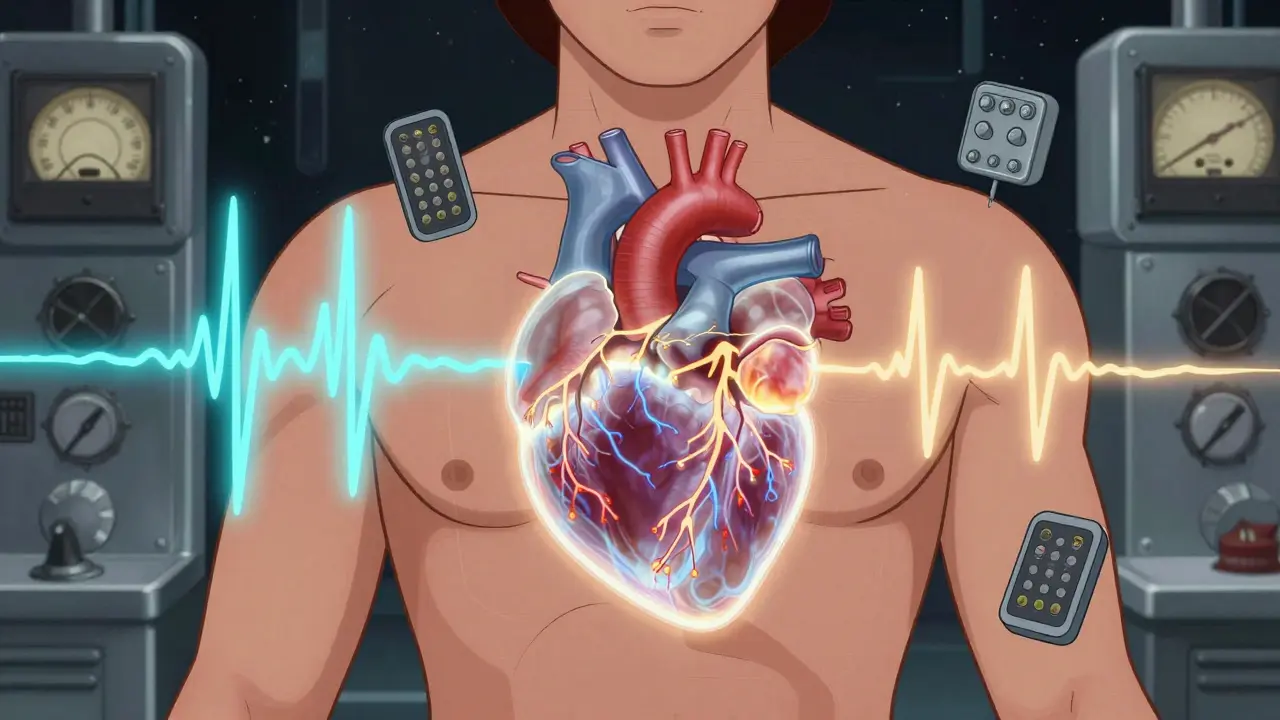
An electrocardiogram, or ECG (also called EKG), is a snapshot of your heart’s electrical activity. Think of it like a heart rhythm diary. Electrodes stick to your chest, arms, and legs, and they pick up tiny electrical signals your heart produces every time it beats. That data gets turned into a graph with peaks and valleys-each one representing a different part of your heartbeat cycle.
This test takes less than five minutes. You lie still. No needles. No pain. Just a few sticky pads. But don’t let the simplicity fool you. An ECG can spot:
- Irregular heart rhythms (like atrial fibrillation)
- Signs of a past or current heart attack
- Enlarged heart chambers
- Abnormal electrical pathways
- Low blood flow to the heart muscle
Here’s the catch: a resting ECG only shows what’s happening right then. If your heart is fine at rest but struggles when you’re climbing stairs or running, the ECG might look perfectly normal. That’s where the stress test comes in.
Why You Need a Stress Test
A stress test pushes your heart to work harder-either by making you walk on a treadmill or by using medication to mimic exercise. The goal? To see how your heart handles pressure. Coronary artery disease (CAD) often doesn’t show up until your heart is pumping hard. That’s why over 11 million stress tests are done in the U.S. every year.
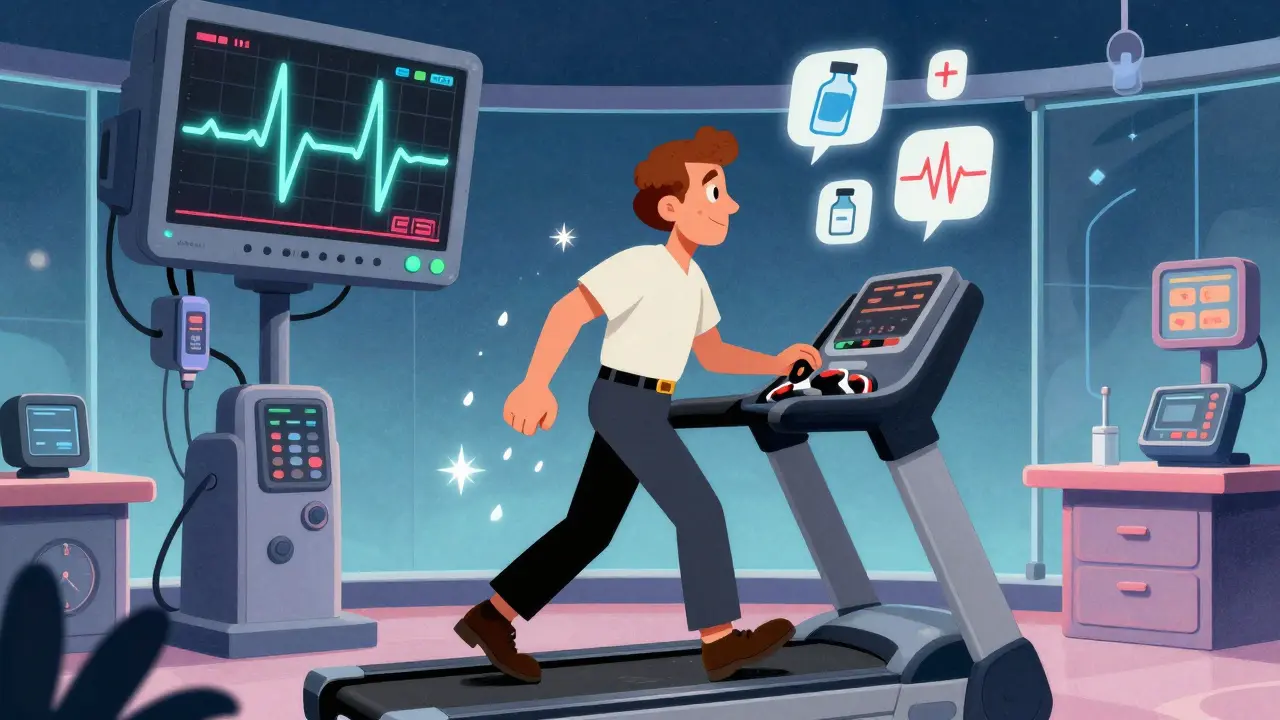
The most common version is the exercise stress test. You’ll walk on a treadmill that gets steeper and faster every three minutes, following the Bruce protocol. Your heart rate, blood pressure, and ECG are tracked the whole time. You stop when you’re tired, dizzy, or your chest starts to hurt-or when you hit 85% of your predicted maximum heart rate (which is roughly 220 minus your age).
But not everyone can walk on a treadmill. If you have arthritis, severe asthma, or just can’t exert yourself, doctors use chemical stress tests. They give you drugs like adenosine or dobutamine that make your heart beat faster and stronger-without you lifting a finger. You might feel flushed, short of breath, or get a weird chest tightness. It’s uncomfortable, but it’s temporary. And it’s safer than pretending you can run when you can’t.
How Accurate Are These Tests?
Neither test is perfect. A standard ECG stress test catches about 68% of coronary artery disease cases. That means roughly 1 in 3 cases might be missed-especially in women. Why? Because women’s heart disease often affects tiny blood vessels, not the big arteries, and those don’t always show up on a standard test.
That’s where advanced versions come in. Stress echocardiography adds ultrasound imaging. As your heart pumps under stress, the machine shows if any part of the heart wall isn’t moving right. This version is 88% specific-it rarely gives false alarms-and doesn’t use radiation. It’s becoming the go-to for middle-aged women with symptoms.
Then there’s nuclear stress testing. You get a small dose of radioactive tracer, and a special camera tracks blood flow to your heart muscle. It’s more sensitive (85%+) and great for spotting blockages. But it exposes you to radiation-about 9-12 mSv, which equals a few years of natural background exposure. That’s why it’s not the first choice unless your doctor really needs the extra detail.
What Happens During the Test?
Here’s what to expect:
- You’ll avoid caffeine for 24 hours before the test-it can mess with the drugs used in chemical stress tests.
- Wear comfy clothes and walking shoes. No dresses or tight shirts.
- Electrodes go on your chest. A blood pressure cuff goes on your arm.
- If it’s an exercise test, you’ll start walking slowly. Every three minutes, the speed and incline increase.
- Your doctor watches your ECG, blood pressure, and how you feel. If you get chest pain, dizziness, or your ECG looks dangerous, they’ll stop it.
- Afterward, you’ll rest for a few minutes. Results are often reviewed right away.
Most people walk away with no side effects. But about 15% of those getting chemical stress tests report temporary symptoms: flushing, nausea, or a funny feeling in the chest. These fade within minutes. And yes, some people panic thinking they’re having a heart attack. They’re not. The test is designed to trigger symptoms safely-so your doctor can see how your heart reacts.
Costs and What’s Changing
Prices vary widely. A basic ECG stress test might cost $500-$700. Stress echocardiography runs about $514 on average. Nuclear stress tests? Around $946. CT scans of the heart are cheaper-around $400-but they don’t show how your heart performs under stress. They just show anatomy.
Insurance usually covers these tests if you have symptoms or risk factors. But if you’re paying out of pocket, ask which version your doctor recommends-and why. Newer guidelines now favor stress echocardiography over nuclear tests for many patients, especially women, because it’s just as accurate without the radiation.
And tech is catching up. AI tools are now helping doctors read stress tests faster and more accurately-boosting detection rates by up to 22%. Portable devices like the Cardiac Dynamics StressPal are even letting clinics do stress tests in non-traditional settings, like primary care offices.
When These Tests Don’t Work
Stress tests aren’t for everyone. Don’t get one if you’ve had a recent heart attack (within 2 days), have unstable chest pain, or are in heart failure. These are emergencies, not diagnostic cases.
Also, if your risk for heart disease is very low (say, a healthy 35-year-old with no symptoms), testing won’t help-it’ll just give false alarms. And if your risk is very high (like a 65-year-old smoker with diabetes), your doctor might skip straight to a CT scan or catheterization.
The sweet spot? People with intermediate risk-15% to 65% chance of blockages. That’s where stress tests add the most value. That’s why experts say they’re still the best first step for people with chest pain, unexplained shortness of breath, or abnormal resting ECGs.
Real Stories
One Reddit user, ‘CardiacWarrior87’, had a normal resting ECG but passed out while gardening. The stress test caught silent ischemia-his heart wasn’t getting enough blood during exertion. He got a stent. Now he hikes again.
Another, ‘AnxiousPatient22’, described the chemical stress test as "feeling like I was dying." But the tech said, "It’s supposed to feel like this." She made it through. The test found a blockage. She’s on medication now and feels better.
These aren’t rare. They’re common. And they save lives.
What Comes Next
If your test is normal and you feel fine, you’re probably good. But if it’s abnormal, your doctor might recommend a cardiac catheterization to see exactly where blockages are. Or they might start you on medication to lower cholesterol, blood pressure, or prevent clots.
Either way, the goal isn’t just to diagnose-it’s to prevent. A stress test isn’t a death sentence. It’s a wake-up call. And sometimes, that’s exactly what you need.
Can an ECG detect a heart attack that happened years ago?
Yes. An ECG can show changes in the heart’s electrical pattern that suggest a past heart attack-even if you didn’t know you had one. These changes, called Q-waves, stay on the tracing permanently. Doctors use them to identify silent heart attacks, especially in people with diabetes or older adults who may not have had classic chest pain.
Why do I need to avoid caffeine before a stress test?
Caffeine blocks the same receptors that drugs like adenosine and dipyridamole use to simulate stress. If you’ve had coffee, tea, soda, or chocolate in the last 24 hours, those drugs won’t work properly. This can lead to a false-negative result-meaning the test might miss a real blockage. That’s why skipping caffeine isn’t optional-it’s essential for accuracy.
Is a stress test dangerous?
Very rarely. Stress tests are performed under close supervision, with doctors and nurses ready to stop the test and respond to any problem. The risk of a heart attack during the test is less than 1 in 10,000. That’s lower than the risk of driving to the appointment. Most side effects-like dizziness or chest tightness-are temporary and expected. The test is designed to be safe while still challenging your heart enough to reveal hidden problems.
Do women get different results on stress tests?
Yes. Women are more likely to have false-negative results on standard ECG stress tests because their heart disease often affects small blood vessels, not the main arteries. This type of disease doesn’t show up well on traditional tests. That’s why stress echocardiography is now recommended for women with symptoms-it’s more accurate and doesn’t use radiation. New techniques like speckle-tracking ultrasound are also helping detect microvascular dysfunction in women that older methods miss.
What if my stress test result is inconclusive?
Inconclusive results happen in about 25% of intermediate-risk patients. It usually means the test didn’t show clear signs of disease, but your symptoms or risk factors still suggest something might be wrong. In those cases, doctors often recommend a different test-like a stress echocardiogram, nuclear scan, or cardiac CT-to get a clearer picture. It’s not a failure-it’s just part of the diagnostic process.
If you’ve been told you need one of these tests, don’t panic. They’re routine, safe, and designed to protect you. The real risk isn’t the test-it’s ignoring the warning signs.
Sam Dickison
February 8, 2026 AT 15:03ECG’s are wild-like a heart’s Twitter feed. All that noise, peaks, valleys, and suddenly you see a Q-wave and go, ‘ohhh, that’s a silent MI from 2017.’ No symptoms, no warning, just a ghost in the waveform. Crazy how much your heart remembers even when you don’t.
Karianne Jackson
February 9, 2026 AT 18:57I had a stress test and thought I was gonna die. Like, full panic. Turned out I just had a blocked artery. Now I’m on meds and I’m alive. So yeah. DO THE TEST.
Tom Forwood
February 10, 2026 AT 23:15Yo, I work in a rural clinic and we just got one of those Cardiac Dynamics StressPal devices. Dude, it’s a game changer. We do stress tests in the parking lot now. No need to send folks 45 mins away. One lady did hers while waiting for her coffee. Said it felt like a mini workout. No radiation, no big deal. Tech’s coming for heart care, and I’m here for it.
Jacob den Hollander
February 12, 2026 AT 08:42Just wanna say-this post is so clear. I’m a med student, and honestly? Most of my textbooks make this sound like rocket science. But you broke it down like I’m a 12-year-old with a heart murmur. Thank you. Seriously. Also, the caffeine thing? I had a friend skip it, got a false negative, and then had a mild MI two weeks later. Don’t be that guy. Skip the espresso. Your heart will thank you.
Andrew Jackson
February 13, 2026 AT 19:04It is imperative to note that the American healthcare system has commoditized diagnostic testing to such an extent that the very notion of preventative cardiology has been reduced to a transactional exchange between insurer and provider. The stress test, once a clinical judgment tool, is now a revenue stream. This is not medicine-it is capitalism with a stethoscope.
Frank Baumann
February 15, 2026 AT 11:51Let me tell you what really happened to me. I was 42, fit, ran marathons, ate kale, drank kombucha-then one day I got dizzy while lifting a bag of dog food. My ECG? Perfect. My stress test? Complete disaster. My heart just… stopped responding. They found a 90% blockage in the LAD. I had a stent. Now I can’t even climb stairs without a break. I’m not mad. I’m grateful. But here’s the thing-no one warned me that a ‘normal’ ECG doesn’t mean squat. I thought I was invincible. Turns out, my heart had been screaming for years. I just didn’t know how to listen.
Alex Ogle
February 15, 2026 AT 22:40I’ve had two stress tests. First one, I was fine. Second one, after my dad passed from a silent heart attack at 61-I got the same Q-waves. No symptoms. No warning. Just… there. Like a fingerprint of a ghost. It’s eerie. Makes you wonder how many people just… go. Without a sound. The test doesn’t just find disease. It finds silence.
Brandon Osborne
February 17, 2026 AT 13:41YOU THINK THIS IS BAD? WAIT TILL YOU HEAR ABOUT THE CORPORATE HEALTH SYSTEM THAT FORCES PEOPLE TO DO STRESS TESTS JUST TO KEEP THEIR INSURANCE. THEY’RE NOT DOING IT FOR YOUR HEALTH. THEY’RE DOING IT TO MAKE MONEY. I’VE SEEN IT. MY BOSS GOT A LETTER: ‘IF YOU DON’T DO THE TEST, YOUR PREMIUM GOES UP 30%.’ THAT’S NOT MEDICINE. THAT’S EXTORTION. AND THEY CALL IT ‘PREVENTATIVE CARE.’
Tasha Lake
February 18, 2026 AT 12:11Just read the part about women and microvascular disease. I’m a cardiologist’s assistant, and this is the biggest blind spot. We test women with chest pain, get a negative stress test, and send them home. Then they come back six months later with a massive MI. The problem isn’t the test-it’s that we’re using male-centric models. We need to stop assuming women’s hearts behave like men’s. They don’t. And the tech is catching up-speckle-tracking, strain analysis-it’s real. Just needs more adoption.
PAUL MCQUEEN
February 20, 2026 AT 09:30So… you’re saying a treadmill test is better than a CT scan? I’m confused. I thought CT scans showed blockages. Why not just do the scan? Seems like a waste of time walking if you can just look.
glenn mendoza
February 20, 2026 AT 12:23It is with profound gratitude that I acknowledge the clarity and compassion with which this medical exposition has been presented. The integration of clinical precision with human narrative is not merely educational-it is profoundly humane. The recognition of silent ischemia as a silent sentinel of mortality is a paradigm shift in public health communication. May this be disseminated widely.
John Watts
February 21, 2026 AT 12:37Bro, I’m 38, sedentary, ate pizza last night, and I just got my first stress test. Thought I was gonna die. Turned out I’m fine. But I started walking every day after. Not because I was scared. Because I realized I didn’t know my own body. That test didn’t just check my heart-it reminded me I’m alive. Do it. Even if you’re ‘fine.’ You owe yourself that much.
Randy Harkins
February 22, 2026 AT 17:54❤️ This is the kind of post that makes Reddit worth it. No fluff. Just facts wrapped in real stories. I’m sharing this with my mom. She’s 68, has had ‘indigestion’ for years. She thinks it’s acid reflux. I’m sending her this. Maybe it’ll save her life. Thank you.
Chima Ifeanyi
February 23, 2026 AT 20:37Let me be the first to say this: the entire cardiac diagnostic paradigm is a Western colonial construct. In Nigeria, we rely on clinical intuition, pulse oximetry, and ancestral knowledge. Why are we pathologizing normal physiological variation under the guise of ‘precision medicine’? The ECG is a 1920s analog tool being forced into a digital age. The real issue? We’re mistaking surveillance for care.
Tori Thenazi
February 24, 2026 AT 07:23Okay but… what if the stress test is a government mind-control experiment? I read somewhere that the adenosine used in chemical stress tests contains nanotech that tracks your heart activity and sends it to the NSA. And don’t get me started on the radioactive tracer-it’s not just for imaging. It’s a beacon. They want to know who’s ‘at risk’… so they can target them later. I’m not paranoid. I’m informed.