Cyclosporine Nephrotoxicity: How to Monitor Kidney Function and Drug Levels
 Mar, 4 2026
Cyclosporine Target Range Calculator
Cyclosporine Level Monitoring
This tool helps determine appropriate cyclosporine target ranges based on time since transplant and evaluates if current levels are within safe limits.
Enter values to see your results
When someone gets a kidney, heart, or liver transplant, cyclosporine is often the drug that keeps their body from rejecting the new organ. But here’s the catch: cyclosporine is one of the most powerful immunosuppressants we have-and one of the most dangerous to the kidneys. It saves lives, but it can also slowly damage the very organ it’s meant to protect. The difference between working and failing often comes down to one thing: how carefully you monitor kidney function and drug levels.
Why Cyclosporine Harms the Kidneys
Cyclosporine doesn’t attack the kidneys like a virus. It quietly strangles them. The drug tightens the blood vessels inside the kidneys, reducing blood flow. This is called renal vasoconstriction. Over time, this leads to scarring, tubular damage, and a drop in filtering ability. The damage isn’t always obvious at first. A patient might feel fine, have no swelling, no pain. But their creatinine levels creep up, their magnesium drops, and their blood pressure rises. By the time symptoms show, the harm may already be lasting. Studies show that 30-50% of long-term kidney transplant failures are tied to cyclosporine toxicity when monitoring isn’t strict. That’s not a small number. It’s half of all graft losses in some centers. And it’s mostly preventable.What You Need to Measure
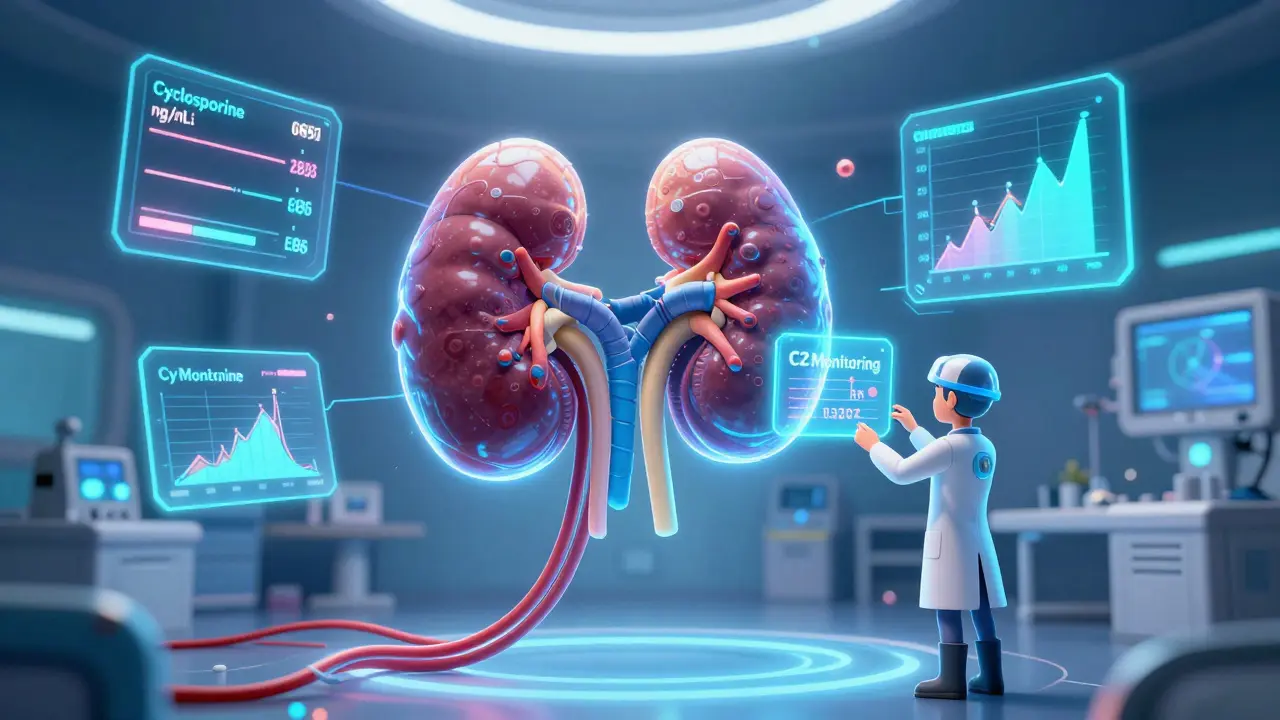
Monitoring cyclosporine isn’t about checking one number. It’s about tracking a pattern across several key indicators. Here’s what matters:- Cyclosporine blood levels: Measured in nanograms per milliliter (ng/mL). The target range changes over time. Right after a transplant, you want 200-400 ng/mL. By six months, that drops to 125-275 ng/mL. After a year, it’s 75-160 ng/mL. Go above that, and kidney damage risks climb. Go below, and rejection risk spikes.
- Serum creatinine: This is the classic marker of kidney function. A level under 1.5 mg/dL is the goal. Above that, and you’re likely seeing early signs of toxicity.
- Blood Urea Nitrogen (BUN): BUN should stay under 20:1 compared to creatinine. A higher ratio suggests dehydration or reduced kidney perfusion.
- Magnesium: Cyclosporine causes magnesium to leak out of the kidneys. Levels below 1.7 mg/dL are common and often go untreated. Low magnesium worsens high blood pressure and can trigger muscle cramps or arrhythmias.
- Blood pressure: Target is under 130/80 mmHg. High blood pressure from cyclosporine adds more stress to the kidneys. Controlling it isn’t optional-it’s part of the treatment.
Uric acid levels are sometimes checked, but evidence is mixed. If someone has gout or a history of high uric acid, it’s worth watching. Otherwise, it’s not a priority.
How We Measure Cyclosporine Levels
Not all tests are created equal. For years, most labs used immunoassays-fast, cheap, and easy. But they’re flawed. These tests can’t tell the difference between cyclosporine and its metabolites. That means if your body breaks down the drug into similar-looking compounds, the machine might read your level as 200 ng/mL… when it’s really 140. That’s a 40% error. And that’s enough to cause either rejection (if you lower the dose too much) or kidney damage (if you keep it too high). The gold standard used to be HPLC-high-performance liquid chromatography. It’s accurate. It’s specific. But it’s expensive, slow, and needs trained staff. Only a few labs used it. Today? LC-MS/MS (liquid chromatography-tandem mass spectrometry) is the new standard. Used by 92% of U.S. transplant centers as of 2021, it’s accurate to 99.2%. It can detect levels as low as 5 ng/mL. It doesn’t confuse metabolites. It’s faster than HPLC and more reliable than immunoassays. If your lab still uses immunoassays, ask why.
When to Test: Trough vs. C2 Monitoring
Traditionally, doctors checked cyclosporine levels right before the next dose-the “trough” or C0. It’s easy. You draw blood in the morning, before the patient takes their pill. But here’s the problem: trough levels don’t tell you how much drug the body actually absorbed over the day. Two patients with the same trough level can have wildly different total exposure. Enter C2 monitoring: drawing blood exactly two hours after the dose. Studies show C2 levels correlate 87% better with total drug exposure (area under the curve) than trough levels. Centers using C2 monitoring saw a 22.4% drop in nephrotoxicity between 2018 and 2022. C2 isn’t perfect. It requires timing. The patient must take their pill at the same time every day. The blood draw must happen exactly two hours later. Miss that window, and the number is useless. Most centers start with C0 monitoring right after transplant. By month two, many switch to C2. Some use both: C0 for routine checks, C2 when adjusting doses or if kidney function starts to decline.The Bigger Picture: Drug Interactions and Genetics
Cyclosporine doesn’t live in a vacuum. It’s metabolized by the liver enzyme CYP3A4. That means almost every drug you take can mess with its levels. - Ketoconazole (an antifungal) can boost cyclosporine levels by 30-50%. A patient on both could go from safe to toxic in days. - Rifampin (for TB or staph) can cut levels by 40-60%. That’s a recipe for rejection. - Even grapefruit juice? It raises cyclosporine. A single glass can spike levels. And genetics matter. Some people have a gene variant called CYP3A5*1. These “extensive metabolizers” break down cyclosporine faster. They need 30-40% higher doses to reach the same blood levels as others. Without genetic testing, you’re dosing blind.How Often Should You Test?
Frequency changes with time:- First week post-transplant: Twice a week. The body is unstable. Doses are high. Toxicity risk is highest.
- Weeks 2-6: Once a week. Levels start to stabilize.
- Months 2-6: Every other week. Adjustments slow down.
- After 6 months: Monthly or biweekly. Unless something changes-like a new medication, infection, or rising creatinine-you can space it out.
But don’t get lazy. Even after a year, a single missed test or a new antibiotic can trigger kidney damage. One patient I worked with in Portland had stable levels for 18 months. Then he started taking omeprazole for heartburn. Within three weeks, his creatinine jumped from 1.2 to 1.9. Omeprazole blocks CYP3A4. His cyclosporine level went from 110 to 210 ng/mL. He almost lost the graft.
What to Do If Kidney Function Drops
If creatinine rises more than 25% from baseline, don’t wait. Don’t assume it’s dehydration. Don’t give more fluids and hope it fixes itself. Do this:- Check the cyclosporine level immediately-use LC-MS/MS if possible.
- Review all new medications, supplements, or dietary changes.
- Check magnesium and blood pressure.
- If the level is too high, reduce the dose by 10-20% and retest in 48 hours.
- If the level is normal but kidney function still drops, consider switching to another immunosuppressant like tacrolimus.
Here’s the truth: cyclosporine toxicity is often reversible-if caught early. Studies show kidney function improves in 60-80% of patients who get their dose lowered within three months of early signs. But if you wait six months? The damage becomes permanent.
Milad Jawabra
March 4, 2026 AT 18:28Justin Rodriguez
March 6, 2026 AT 10:45Megan Nayak
March 7, 2026 AT 23:42Divya Mallick
March 9, 2026 AT 13:21Pankaj Gupta
March 10, 2026 AT 06:09Alex Brad
March 10, 2026 AT 18:23Jane Ryan Ryder
March 11, 2026 AT 15:17Callum Duffy
March 12, 2026 AT 23:54Chris Beckman
March 14, 2026 AT 17:38Levi Viloria
March 15, 2026 AT 16:29