Cost-Effectiveness Analysis: Measuring the Real Value of Generic Drugs
 Jan, 22 2026
Generic drugs aren’t just cheaper versions of brand-name medicines-they’re often the most powerful tool we have to cut healthcare spending without sacrificing outcomes. But how do we know which generics actually deliver value? That’s where cost-effectiveness analysis comes in. It’s not just about comparing sticker prices. It’s about understanding which drug gives you the most health for your dollar-especially when multiple generics are on the market, some costing 20 times more than others with the same effect.
Why Generic Drugs Don’t All Cost the Same
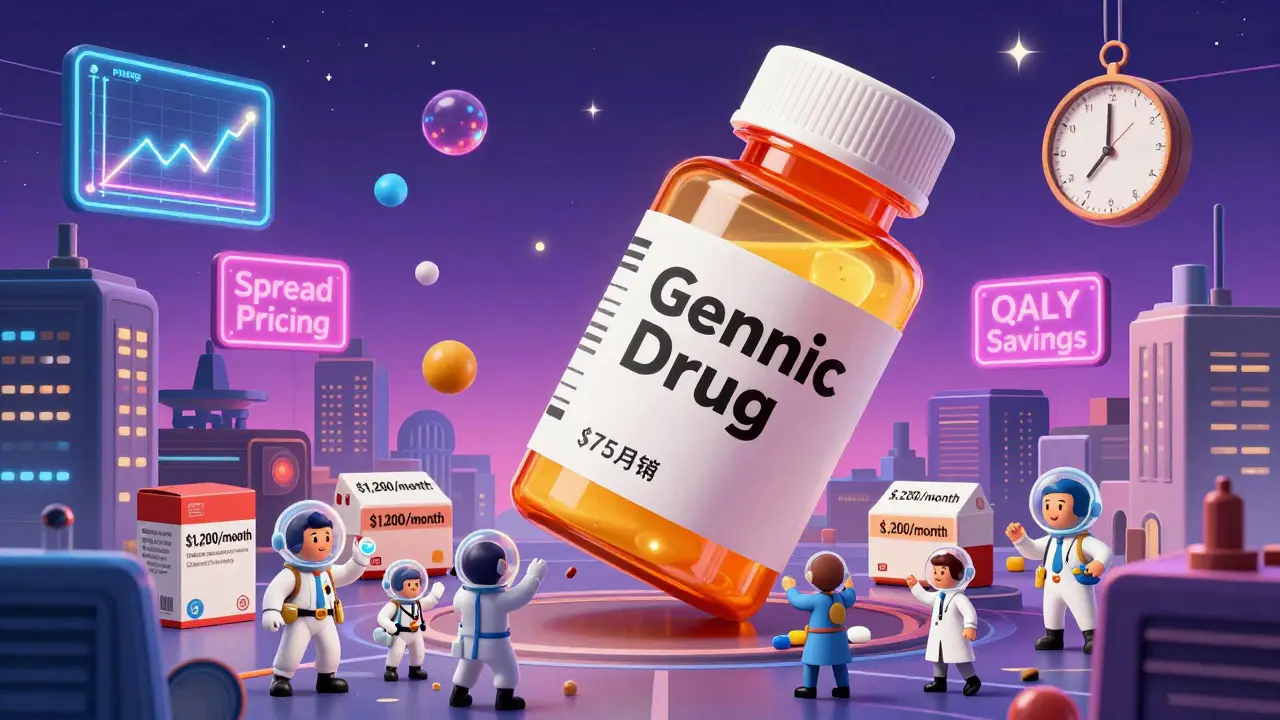
You might assume all generics for the same drug are priced similarly. They’re not. A 2022 study in JAMA Network Open looked at the top 1,000 generic drugs covered by major U.S. payers and found something surprising: 45 of them were priced more than 15 times higher than other drugs in the same therapeutic class that worked just as well. One drug, for example, cost $1,200 per month when a chemically identical alternative was available for $75. That’s not a pricing error. It’s a market failure. The reason? It’s not always about manufacturing. Some generic manufacturers charge more because they know insurers or Pharmacy Benefit Managers (PBMs) will pay it. PBMs profit from the gap between what they pay pharmacies and what they charge insurers-a practice called “spread pricing.” If a high-priced generic is on the formulary, the PBM pockets the difference. The patient and the insurer lose. The system rewards inefficiency.How Cost-Effectiveness Analysis Works
Cost-effectiveness analysis (CEA) measures the trade-off between cost and health outcomes. The standard metric is the incremental cost-effectiveness ratio, or ICER. It tells you how much extra it costs to gain one additional quality-adjusted life year (QALY). For example, if Drug A costs $10,000 and gives 1.2 QALYs, and Drug B costs $15,000 and gives 1.5 QALYs, the ICER is ($15,000 - $10,000) / (1.5 - 1.2) = $16,667 per QALY gained. For generics, the goal isn’t to prove they’re better than brand drugs-they’re usually just as effective. The real question is: Which generic gives you the most health for the least cost? A 2021 NIH report showed that when two generic competitors enter the market, prices drop 54% on average. With four competitors, they drop 79%. But most CEA studies ignore this. In fact, 94% of published analyses don’t account for future generic price drops, making their conclusions outdated before they’re printed.The Hidden Cost of Ignoring Generic Dynamics
If you’re running a CEA and assume a generic will stay at $100 per month, but in reality, six competitors enter next year and the price crashes to $3, you’ve made a terrible decision. You might have blocked a cheaper, equally effective drug because your model was blind to market forces. The VA Health Economics Resource Center points out that failing to model patent expiration biases analysis against pharmaceuticals. Why? Because brand-name companies set prices knowing they’ll soon face generic competition. They price just below the threshold where payers would switch. Once generics arrive, prices collapse. If your analysis doesn’t account for that, you’ll think the brand drug is “cost-effective” when it’s really just a temporary monopoly. This isn’t theoretical. The FDA estimates that generic drugs saved the U.S. healthcare system $1.7 trillion between 2007 and 2017. That’s $250 billion a year. But if we’re still paying 15x more for the same pill because our analysis doesn’t track market entry, we’re leaving billions on the table.
Therapeutic Substitution: The Biggest Opportunity
The real savings aren’t always in switching from brand to generic. They’re in switching from one generic to another. The JAMA study found that when you swap a high-cost generic for a lower-cost drug in the same therapeutic class-say, switching from one statin generic to another-the price difference can be 20 times. Even when the drugs are identical except for dosage form (like a tablet vs. capsule), prices can be 20 times higher. The smallest gap? Between the same drug made by different manufacturers-only 1.4 times higher on average. This means the biggest opportunity isn’t just promoting generics. It’s promoting the right generics. Health systems that actively audit their formularies for therapeutic alternatives see savings of up to 88% in some cases. But few do. Why? Because formularies are often built on historical contracts, not real-time pricing data.Who’s Doing It Right?
In Europe, over 90% of health technology assessment agencies use formal CEA to decide which drugs to cover. In the U.S., only 35% of commercial payers do. Medicare Part D is slowly catching up thanks to the 2020 Drug Pricing Reduction Act and the 2022 Inflation Reduction Act, which now require more transparency and encourage generic substitution. The Institute for Clinical and Economic Review (ICER) leads the way in the U.S. with detailed, public CEA reports that include scenario analyses for future generic entry. They model what happens when a patent expires in six months, nine months, or a year. They factor in the number of generic manufacturers likely to enter. They adjust for pricing trends from the Federal Supply Schedule and Veterans Affairs data. Most private payers don’t. They rely on vendor-provided tools that assume static prices. That’s like trying to navigate a highway using a map from 2015.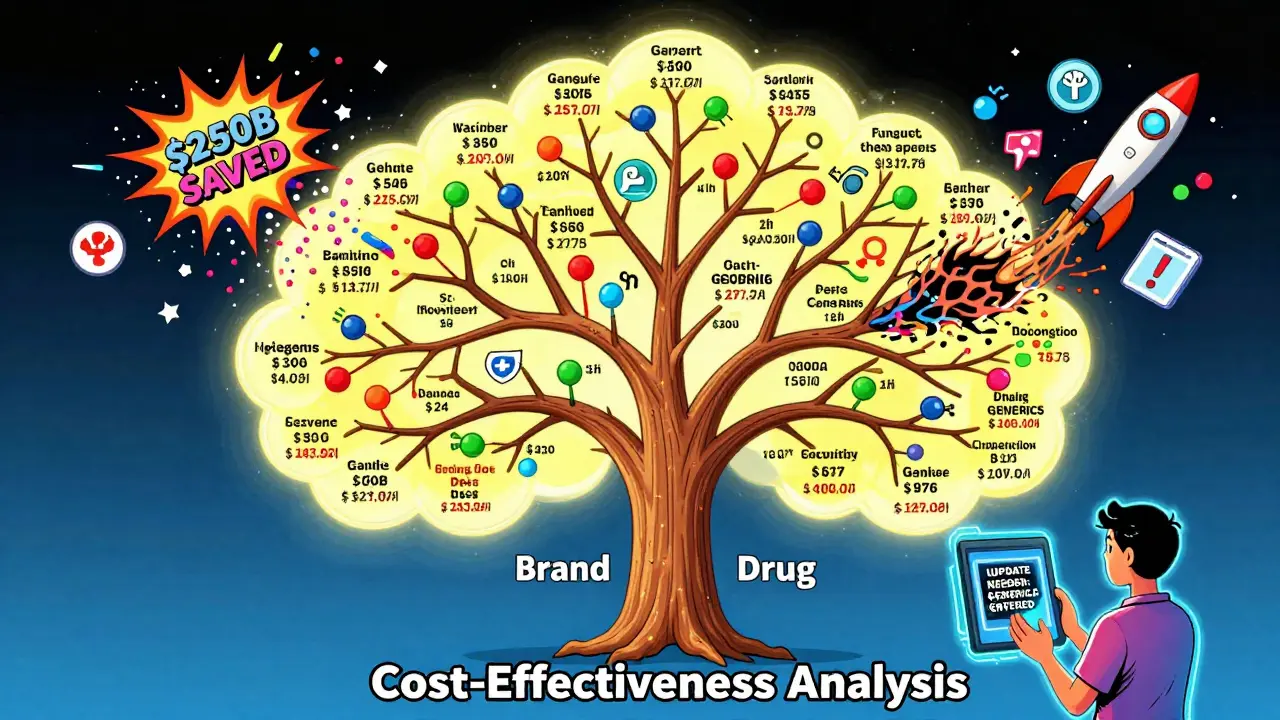
What Needs to Change
For CEA to work for generics, three things must happen:- Model future generic entry. Analysts must build in assumptions about how many competitors will enter and when. Don’t assume the price stays flat.
- Use real pricing data. Don’t rely on Average Wholesale Price (AWP)-it’s inflated and outdated. Use VA pricing, FSS, or actual claims data. Generic drugs are priced at just 27% of AWP, according to VA data.
- Focus on therapeutic substitution. Look beyond brand vs. generic. Compare generics to each other. The cheapest option isn’t always the one you think it is.
Why This Matters to You
If you’re a patient, you’re paying more than you need to. If you’re an insurer, you’re wasting money. If you’re a policymaker, you’re missing a chance to save billions. The data is clear: generics are the most effective tool we have to control drug costs. But only if we use them right. A $100 pill isn’t cheaper than a $1,500 pill if it’s the wrong $100 pill. The goal isn’t just to use generics-it’s to use the right generics. The system isn’t broken. It’s just outdated. And fixing it doesn’t require new laws or fancy tech. It just requires better analysis-and the will to act on it.How do you know if a generic drug is truly cost-effective?
You compare its price to other drugs in the same therapeutic class that have the same clinical effect. Use real-world pricing data from sources like the VA or Federal Supply Schedule, not inflated lists like AWP. If a generic costs 10x more than another drug that works just as well, it’s not cost-effective-even if it’s technically a “generic.”
Why do some high-cost generics stay on insurance formularies?
Pharmacy Benefit Managers (PBMs) often profit from the price gap between what they pay pharmacies and what they charge insurers. This “spread pricing” creates an incentive to keep expensive generics on formularies-even when cheaper alternatives exist. It’s not about patient care; it’s about profit margins.
Does cost-effectiveness analysis always favor generics?
Not always-but it should. Most generics are equally effective as brand-name drugs and cost far less. But CEA doesn’t just pick the cheapest option. It picks the one that delivers the best health outcome per dollar. Sometimes, a newer brand drug with fewer side effects might be more cost-effective than a cheap generic that causes hospitalizations. But in most cases, especially for chronic conditions, the right generic wins.
What’s the biggest mistake in cost-effectiveness analysis for generics?
Assuming prices won’t change. Most analyses ignore patent expirations and future generic entry. If you model a drug at $50/month today but six competitors will enter in six months and drop the price to $5, your analysis is wrong. You’ll block the right drug because your model is stuck in the past.
Can patients benefit from cost-effectiveness analysis?
Absolutely. When payers use CEA to choose lower-cost generics, it lowers premiums and out-of-pocket costs for everyone. Patients also benefit when formularies are updated to reflect real pricing-meaning they get access to the most affordable, equally effective options without needing special appeals.
How often should cost-effectiveness analyses be updated for generics?
Whenever a new generic enters the market, a patent expires, or a major price change occurs. At a minimum, reviews should happen annually. For high-spending drug classes, quarterly updates are ideal. The market moves fast-your analysis shouldn’t be frozen in time.
Sharon Biggins
January 23, 2026 AT 12:45this made me realize i’ve been overpaying for my blood pressure med for years 😅 i had no idea generics could be 20x different in price and still be the exact same chemical. thanks for breaking it down so simply.
John McGuirk
January 25, 2026 AT 11:12pbms are just middlemen who profit off your suffering. this isn’t capitalism, it’s a rigged casino where the house always wins. they don’t care if you die of hypertension as long as the spread pricing keeps flowing. wake up people.
Michael Camilleri
January 27, 2026 AT 08:03we’ve turned healthcare into a numbers game while real people suffer. cost-effectiveness sounds cold but it’s the only thing keeping us from collapsing under medical debt. if you think pricing should be based on compassion then you’ve never had to choose between insulin and rent
the system doesn’t need fixing it needs burning down and rebuilding with actual human values not spreadsheets
why do we let corporations decide who lives and who dies
because we let them
lorraine england
January 28, 2026 AT 05:50so true about the VA data being more reliable than AWP - i work in pharmacy and we use VA pricing for our formulary reviews now. it’s night and day. also, therapeutic substitution is such an underrated tool. switching from one generic statin to another saved our clinic $40k last year. nobody talks about this but it’s huge.
Himanshu Singh
January 29, 2026 AT 09:42so many people think generics are just "cheap stuff" but they’re actually the unsung heroes of public health 😊
we need to stop treating medicine like a luxury and start treating it like a right. the math is clear - cheaper doesn’t mean worse. sometimes it means smarter.
thank you for sharing this. it’s a wake-up call for everyone who thinks healthcare is just about pills and doctors.
Jenna Allison
January 31, 2026 AT 04:36the 94% stat about CEA ignoring future generic entry is terrifying. if you’re modeling drug costs without accounting for patent cliffs, you’re not doing analysis - you’re doing guesswork with a fancy spreadsheet. this is why so many payers end up locking in expensive drugs for years. they’re flying blind.
also, AWP is a joke. it’s like using the MSRP of a car to determine what you actually pay at the dealership. the VA and FSS data are the only real benchmarks.
Vatsal Patel
February 1, 2026 AT 05:30oh so now we’re supposed to be impressed that someone figured out generics can be priced differently? wow. groundbreaking. next you’ll tell me water is wet and oxygen is necessary for life
the real scandal is that this isn’t common knowledge yet. and the fact that you need a 2000-word post to explain why we shouldn’t pay $1200 for a $75 pill says everything about how broken this system is
Tommy Sandri
February 2, 2026 AT 15:07the international contrast between U.S. and European HTA practices is stark. while the U.S. continues to rely on fragmented, vendor-driven models, European agencies integrate dynamic pricing projections into their evaluations. this is not merely a technical difference - it reflects a fundamental divergence in health policy philosophy.
Luke Davidson
February 3, 2026 AT 08:51i used to think generics were all the same until my buddy got prescribed the same pill from two different pharmacies and got billed $90 vs $5. he called the pharmacy, they said "oh that’s just the one the insurance likes" - turns out it was the same exact pill from the same manufacturer
it’s wild how the system rewards confusion. we’re supposed to trust the system but the system is literally designed to confuse us
if you’re not checking your prescription prices every time you refill, you’re leaving money on the table. and honestly? it feels kinda gross to realize your insurance might be profiting off your ignorance
Shanta Blank
February 4, 2026 AT 12:57so let me get this straight - the same damn pill, same active ingredient, same manufacturer - but one costs 20x more because some PBM’s bonus depends on it?!
THIS IS NOT HEALTHCARE. THIS IS A SCAM. A FANCY, DATA-DRIVEN, WHITE-COLLAR SCAM WHERE PATIENTS ARE THE VICTIMS AND CORPORATE EXECUTIVES ARE THE VILLAINS
and now they want us to applaud them for "cost-effectiveness"?!
NO. JUST NO.
Viola Li
February 5, 2026 AT 03:51you say "the system isn’t broken, it’s outdated" - but what if it’s working exactly as intended? what if the whole point was to make healthcare so confusing and expensive that only the rich can afford it? maybe this isn’t a flaw - it’s the feature
Dolores Rider
February 6, 2026 AT 12:19they’re literally making money off people’s illnesses 😭 i cried reading this. my mom had to pick between her heart meds and her rent last year. and now i find out it’s because some guy in a suit decided to keep the expensive generic on the formulary because he got a kickback???
how do we fix this??
Elizabeth Cannon
February 6, 2026 AT 13:43just checked my last prescription - $110 for a generic that’s listed at $18 on the VA site. i called my pharmacy and asked why. they said "oh that’s what the system says" - no explanation, no options. i’m switching to mail-order now. this is ridiculous and nobody talks about it
we need to start demanding transparency. if you’re paying more than $25 for a common generic, you’re being ripped off. and if your insurer doesn’t know that, they’re not doing their job