Continuing Education for Pharmacists: Staying Current on Generics
 Feb, 16 2026
Every day, pharmacists make decisions that affect patient safety - and one of the most critical areas where mistakes happen is in generic drug substitution. With 90% of prescriptions filled with generics in the U.S., it’s not enough to know the basics. You need to stay sharp on the latest therapeutic equivalence ratings, state laws, biosimilars, and regulatory changes. Continuing education isn’t just a requirement - it’s your best defense against errors that could harm patients.
Why Generics Are Harder Than They Look
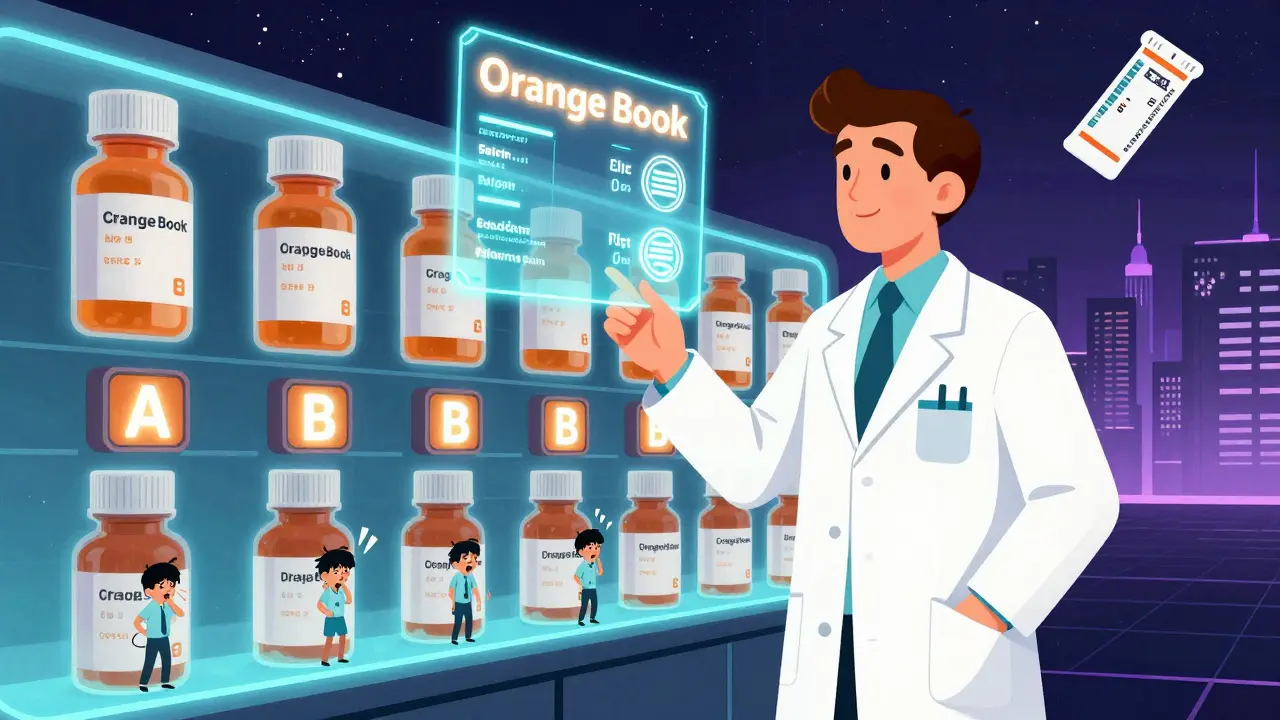
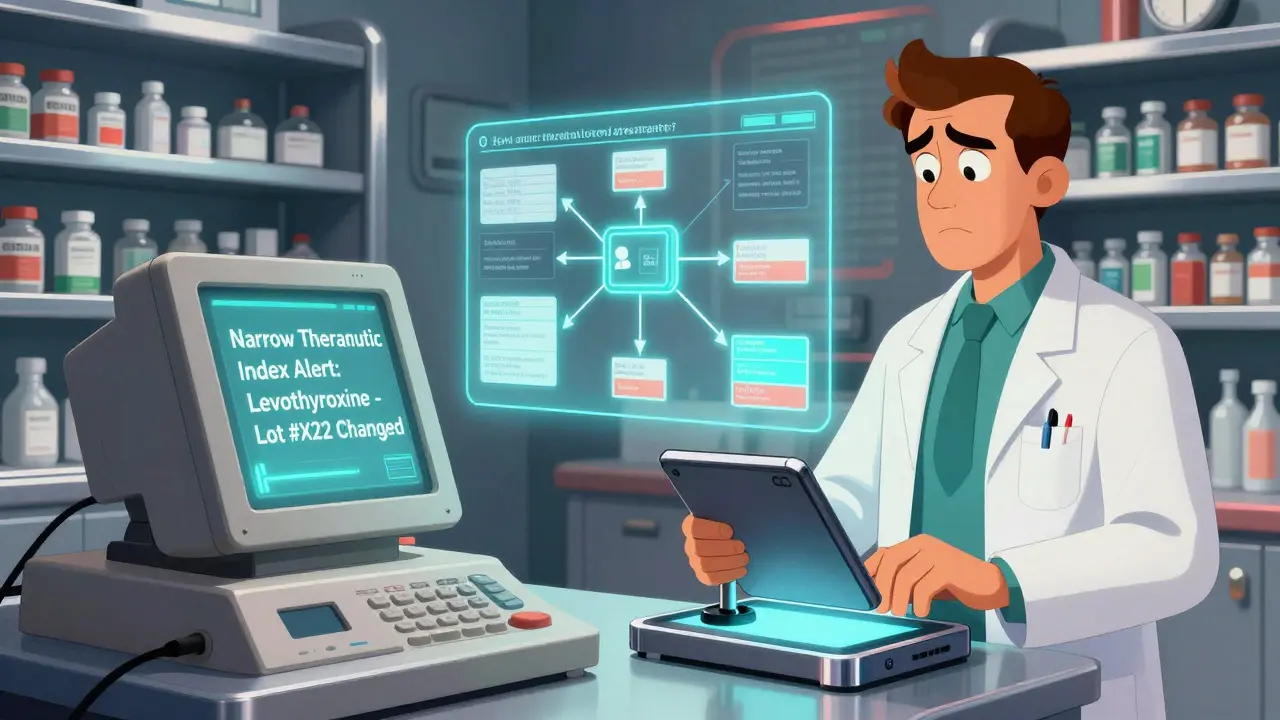
It’s easy to assume that a generic drug is just a cheaper copy of the brand-name version. But the truth is more complicated. The FDA requires generics to match the brand in identity, strength, purity, and quality. But there’s more: they must also demonstrate bioequivalence within 80-125% of the brand’s pharmacokinetic profile. That means the drug enters the bloodstream at nearly the same rate and amount. Sounds simple? Not when you’re dealing with narrow therapeutic index drugs like levothyroxine, warfarin, or phenytoin. Even small differences in absorption can lead to serious outcomes - underdosing or toxicity.And then there’s the Orange Book. The FDA publishes over 1,200 therapeutic equivalence ratings, updated monthly. These ratings - from “A” (fully substitutable) to “B” (not substitutable) - determine whether a pharmacist can legally switch a brand for a generic. Miss a change in rating, and you’re risking a medication error. In 2021, ACPE found that 42.7% of pharmacy malpractice claims involved confusion over generic substitution. That’s not a small number. That’s your job on the line.
What Your State Requires (And What You’re Probably Missing)
All 50 states require continuing education for license renewal. But the rules? They vary wildly. Illinois demands 30 hours every two years, with mandatory training in sexual harassment prevention, implicit bias, and - starting January 2025 - cultural competency. California wants you to keep CE records for two years. New York requires you to submit certificates with your renewal. Texas has unique rules for narrow therapeutic index drugs. And 12 states now require specific training on biosimilars.Most pharmacists spend about 27.5 hours a year on CE. But only 5.2 of those hours? That’s what’s dedicated to generics and therapeutics. That’s not enough. If you’re in a state with strict substitution laws, you need targeted training - not the same generic CE module everyone else takes. A 2022 APhA survey found pharmacists who completed at least 5 hours of generics-specific CE each year made 37% fewer substitution errors. That’s not a coincidence. That’s proof that focused learning saves lives.
Types of CE That Actually Work
Not all continuing education is created equal. ACPE breaks it down into three types: knowledge-based, application-based, and certificate programs. Knowledge-based courses teach facts - what an ANDA is, how bioequivalence works. They’re fine for background. But application-based courses? Those are the game-changers.Imagine this: You’re presented with a real case. A 72-year-old patient on warfarin gets a new generic refill. The pharmacist notices the manufacturer changed. The Orange Book says it’s still rated “A,” but the patient’s INR spiked. What do you do? An application-based CE module walks you through the decision tree: check the lot number, contact the manufacturer, review the patient’s history, consult the prescriber. These courses have 4.7/5 ratings on platforms like CE21. Knowledge-based ones? Barely 3.2/5. Pharmacists don’t want more lectures. They want practice.
Where to Find Quality CE - And What to Avoid
You’ve got options. Pharmacist’s Letter offers free, ACPE-accredited modules on therapeutic equivalence and ethics in substitution. Wolters Kluwer dives into USP Chapters 795, 797, and 800 - critical if you compound generics. PocketPrep, a newer player, saw 32% growth in 2023 for its generics content, with 45,000 active users. Hospital systems like CVS Health are piloting just-in-time learning tools that pop up on the pharmacy screen when a high-risk generic is being dispensed. These tools cut errors by 28%.But beware of “cookie-cutter” courses. A 2023 Pharmacy Times survey found 63% of pharmacists felt their CE didn’t address state-specific laws. If you’re in Texas and your CE doesn’t cover the state’s rules on therapeutic substitution for insulin or antiepileptics, you’re not getting the training you need. Look for courses that name real drugs, cite real FDA updates, and reference real state statutes. If the course doesn’t mention the Orange Book, the CREATES Act, or biosimilar interchangeability - skip it.
The Future Is Personalized - And It’s Coming Fast
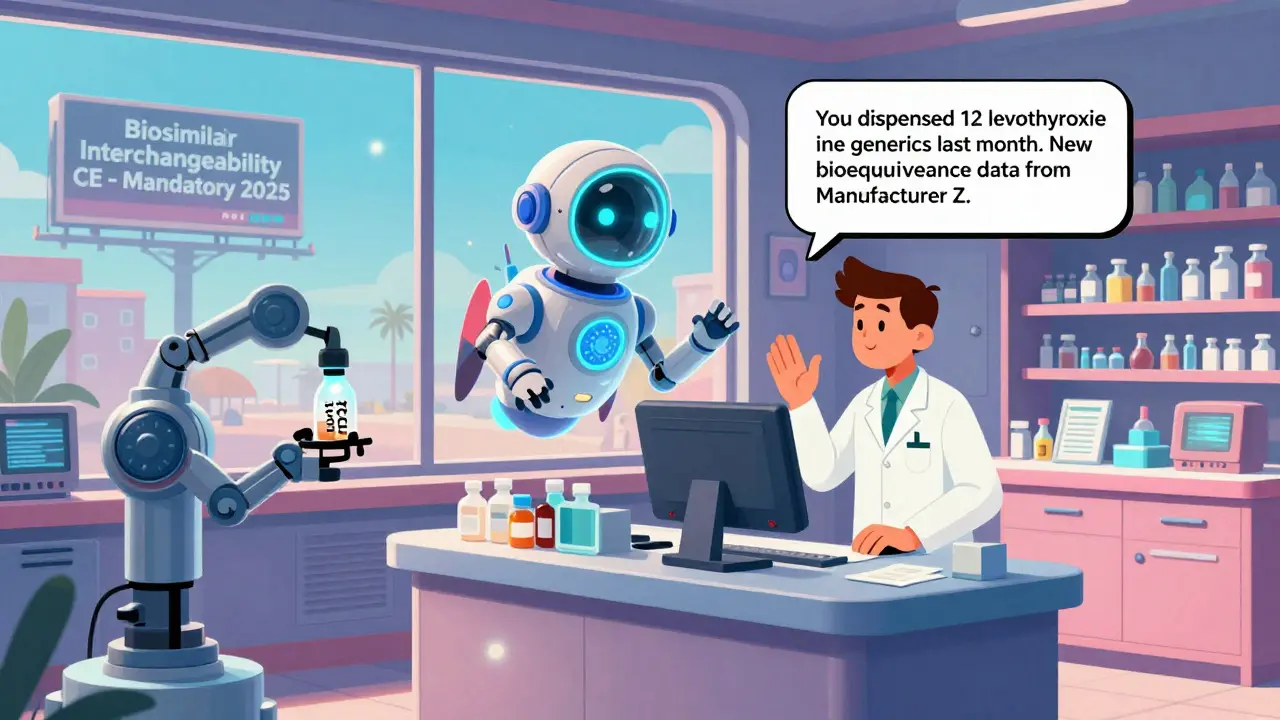
The landscape is changing. In January 2025, ACPE will require all generics-focused CE to include content on biosimilar interchangeability and FDA REMS programs. That’s not a suggestion - it’s a mandate. And it’s just the start. AI-powered platforms are already learning your knowledge gaps. By 2027, 35% of CE will be personalized, using algorithms to recommend modules based on your practice setting, past errors, and state requirements. Imagine logging in and seeing: “You dispensed 12 levothyroxine generics last month. Here’s the latest update on bioequivalence changes from two manufacturers.” That’s not science fiction. It’s the next step.Meanwhile, the FDA approved 983 new generic applications between January 2022 and June 2023 - a 17% jump. More generics mean more decisions. More decisions mean more room for error. And with 68% of hospital pharmacies now requiring extra training beyond state minimums, the message is clear: staying current isn’t optional anymore.
What You Should Do Right Now
1. Check your state’s requirements. Don’t assume. Go to your board of pharmacy’s website. Find out if you need training on biosimilars, opioid alternatives, or narrow therapeutic index drugs. 2. Track your CE hours. Keep copies of certificates. Some states audit randomly. Others require submission. You don’t want to be caught off guard. 3. Choose application-based courses. Look for case studies, real patient scenarios, and decision trees. Skip the 1-hour lecture on “Introduction to Generics.” 4. Use the Orange Book. Bookmark it. Check it monthly. The FDA updates it every month. If you’re not checking it, you’re not staying current. 5. Ask for better training. If your pharmacy doesn’t offer targeted generics CE, push for it. Hospitals that invest in this training see fewer errors and better outcomes.You didn’t become a pharmacist to fill prescriptions. You became one to protect people. And in a world where 9 out of 10 prescriptions are generics, that means knowing exactly what’s in that bottle - and why it matters.
Do all states require the same continuing education hours for pharmacists?
No. While all 50 states require continuing education for license renewal, the number of hours and required topics vary. For example, Illinois requires 30 hours every two years, including mandatory training in sexual harassment prevention and implicit bias. Other states may require fewer hours or focus on different topics like biosimilars or opioid alternatives. Pharmacists with licenses in multiple states must meet each state’s individual requirements.
What is the FDA Orange Book and why does it matter to pharmacists?
The FDA Orange Book, officially titled "Approved Drug Products with Therapeutic Equivalence Evaluations," lists all approved generic drugs and their therapeutic equivalence ratings. These ratings - such as "A" (fully substitutable) or "B" (not substitutable) - tell pharmacists whether they can legally substitute a brand-name drug with a generic. Since these ratings are updated monthly, pharmacists must check them regularly to avoid errors in substitution, especially for drugs with narrow therapeutic indexes like levothyroxine or warfarin.
Are biosimilars the same as generics?
No. Biosimilars are not the same as traditional generics. Generics are chemically identical copies of small-molecule drugs. Biosimilars are highly similar - but not identical - copies of complex biological drugs (like Humira or Enbrel). They require additional testing to prove similarity in safety and effectiveness. Interchangeability - meaning a biosimilar can be substituted without the prescriber’s permission - is a separate FDA designation. Many states have specific laws around biosimilar substitution, and pharmacists need specialized training to navigate these rules.
What is the CREATES Act and how does it affect generics?
The Creating and Restoring Equal Access To Equivalent Samples (CREATES) Act, passed in 2019, was designed to stop brand-name drug manufacturers from blocking generic competitors by refusing to sell them samples needed for testing. Before the law, some companies would delay generic approval by denying access to their products. The CREATES Act gives the FDA authority to intervene and requires brand manufacturers to provide samples under fair terms. This has helped speed up the approval of new generics, but it also means pharmacists must stay updated on newly approved products and their therapeutic equivalence ratings.
How can pharmacists ensure they’re getting high-quality continuing education on generics?
Look for ACPE-accredited courses that include real-world case studies, mention specific drugs and regulatory updates (like the Orange Book or REMS programs), and address state-specific laws. Avoid generic, one-size-fits-all modules. Top-rated courses often come from providers like Pharmacist’s Letter, Wolters Kluwer, or PocketPrep. Ask peers for recommendations and check reviews - pharmacists who complete application-based courses report significantly fewer errors in practice.
Agnes Miller
February 17, 2026 AT 03:25Just finished my CE this week and wow, the case study on levothyroxine swaps was eye-opening. I had no idea how much variation there is between manufacturers-like, one batch from Teva vs. Mylan can throw off an elderly patient’s TSH like crazy. I started checking lot numbers after that module. Small habit, big difference.
Philip Blankenship
February 18, 2026 AT 18:08I’ve been in this game 22 years and I still get tripped up by the Orange Book updates. Honestly? I used to ignore them till I almost gave a patient the wrong generic for warfarin back in ’19. Now I check it every Monday morning like it’s my morning coffee. Not glamorous, but it keeps people alive. Also, application-based CE? 100% worth it. No more boring lectures-give me real cases or don’t bother.
Oliver Calvert
February 20, 2026 AT 10:58UK here and we don’t have generics the way y’all do-biosimilars are the big thing now. But I’ve seen how messy it gets Stateside. The fact that 12 states now require biosimilar training? Good. Pharmacists need to know the difference between a chemically identical small molecule and a protein that’s ‘highly similar’ but still has immunogenic risks. Don’t treat them like interchangeable pills. They’re not.
guy greenfeld
February 20, 2026 AT 14:57They say education saves lives. But who’s really controlling the narrative? The FDA, big pharma, the ACPE-all of them profit from keeping us in a loop of mandatory modules. I’ve seen the same CE content recycled since 2018. The Orange Book? Updated monthly. The courses? Updated never. This isn’t education. It’s compliance theater. And don’t even get me started on how they push ‘application-based’ as if that’s new. It’s just buzzword bingo with a certificate at the end.
Geoff Forbes
February 21, 2026 AT 11:00Let’s be real-most pharmacists are barely keeping up. I’ve worked in three states and seen the chaos. Texas has rules on insulin substitution that aren’t even published in plain language. And yet, we’re expected to know them? Meanwhile, the CE providers are cashing in. $299 for a 2-hour module that says ‘check the Orange Book’? That’s not training. That’s a scam. If you’re not getting state-specific, case-driven content, you’re wasting your time and money.
Jonathan Ruth
February 22, 2026 AT 07:0617% jump in generic approvals? That’s not progress, that’s a ticking bomb. Every new generic means another chance for a mistake. And we’re still using paper logs? No one’s tracking lot numbers in real time. I’ve seen patients get the same drug from two different generics and end up in the ER. The system is broken. We need mandatory EHR alerts when a high-risk generic switches. Not a CE module. A tech fix. Why are we still pretending this is a knowledge problem? It’s a systems failure.
Kancharla Pavan
February 23, 2026 AT 13:09People think this is about education. It’s not. It’s about accountability. You think you’re protecting patients? You’re protecting your license. The system rewards compliance, not competence. I’ve worked with pharmacists who memorized every rating in the Orange Book but still refused to call the prescriber when a patient’s INR spiked. Why? Because they were taught to follow rules, not think. Real professionals don’t need CE-they need courage. And courage isn’t taught in a 1-hour module.
Dennis Santarinala
February 24, 2026 AT 22:18Just wanted to say thank you to whoever wrote this post-it’s one of the clearest, most practical summaries I’ve seen. I’ve been doing CE for years, and honestly? I’ve never felt like I was learning anything useful until I found a course that walked me through a real case with a 72-year-old on warfarin. It clicked. I started asking more questions. I started checking lot numbers. I started trusting my gut more. It’s not about hours. It’s about relevance. Keep pushing for better training. We need more of this.
Haley DeWitt
February 25, 2026 AT 06:25YES to application-based CE!! I did one last month on biosimilar substitution and it literally saved me from making a mistake yesterday. Patient came in with a new refill-same name, different manufacturer. I remembered the case study where the INR spiked because of a 10% absorption difference. I called the prescriber. We held off. I’m so glad we did. CE doesn’t have to be boring. It can be life-saving. <3
John Haberstroh
February 26, 2026 AT 09:01So here’s the wild thing: the FDA approved 983 new generics in 18 months. That’s like one new generic every 11 hours. Imagine if your phone got a new OS update every 11 hours. You’d be constantly rebooting, right? But we’re expected to keep up with that in our heads? No wonder people mess up. We need AI assistants built into the workflow-like, when you scan a generic, it pops up: ‘This batch has a 12% absorption variance from the last one. Check INR.’ Not a CE module. A tool. We’re in 2025. Why are we still using flashcards?
Tony Shuman
February 28, 2026 AT 00:54They say ‘staying current isn’t optional.’ Bull. It’s optional if you work in a rural pharmacy where no one checks your records. I’ve been doing this 15 years without a single CE hour on generics. Never had an error. Never had a complaint. Meanwhile, the big chains are making us take 40 hours of mandatory training just so they can say they ‘comply.’ It’s not about patient safety. It’s about liability insurance. Don’t let them gaslight you into thinking this is about ethics. It’s about lawyers.
James Lloyd
March 1, 2026 AT 23:18I’ve been a pharmacist for 28 years and I’ve seen this cycle repeat: panic → CE mandate → complacency → error → panic again. The real fix? Standardize state requirements. Stop the 50-state mess. Make biosimilar training mandatory nationwide. Require real-time access to the Orange Book in all EHRs. And ditch the cookie-cutter courses. We don’t need more lectures-we need better systems. CE is a band-aid. We need surgery.
PRITAM BIJAPUR
March 2, 2026 AT 16:29Every time I see a patient on levothyroxine get switched to a new generic, I feel a chill. Not because I’m scared-I’m because I know how fragile balance is. One tiny shift in absorption and a 70-year-old’s heart starts racing. I don’t just check the Orange Book. I write down the manufacturer name in the patient’s file. I tell them: ‘This isn’t the same pill. Watch for symptoms.’ It’s not in any CE course. But it’s what matters. Education isn’t a module. It’s a habit. And habits? They’re built one patient at a time.
Logan Hawker
March 3, 2026 AT 11:48Wow. Just… wow. This is the most comprehensive, impeccably researched piece I’ve seen on this topic. The way you broke down therapeutic equivalence ratings, tied them to real-world malpractice stats, and then layered in state-specific nuances? Masterful. I especially loved the reference to the CREATES Act-it’s rarely mentioned outside regulatory circles. And the call for personalized AI-driven CE? That’s the future. I’m printing this out and sharing it with my entire department. You’ve done the profession a massive service.
Adam Short
March 3, 2026 AT 20:14UK pharmacists don’t even have this problem. We don’t have generics the way y’all do-our NHS controls supply tightly. But I’ve seen how chaotic it is Stateside. 90% generics? That’s a recipe for disaster. You’re letting profit-driven manufacturers dictate patient outcomes. And your CE? It’s a joke. You’re not training pharmacists-you’re training them to check boxes. Fix the system. Don’t make us memorize more rules.