Clinical Trial Eligibility: How Biomarkers and Inclusion Criteria Shape Cancer Treatment
 Mar, 2 2026
When you or a loved one is considering a cancer clinical trial, the first question isn’t always about the drug-it’s about whether you qualify. For years, eligibility was based on simple rules: tumor size, stage, previous treatments, and overall health. But today, that’s changing. The real gatekeeper isn’t just your medical history-it’s your biology. Specifically, biomarkers.
What Biomarkers Actually Mean for Your Eligibility
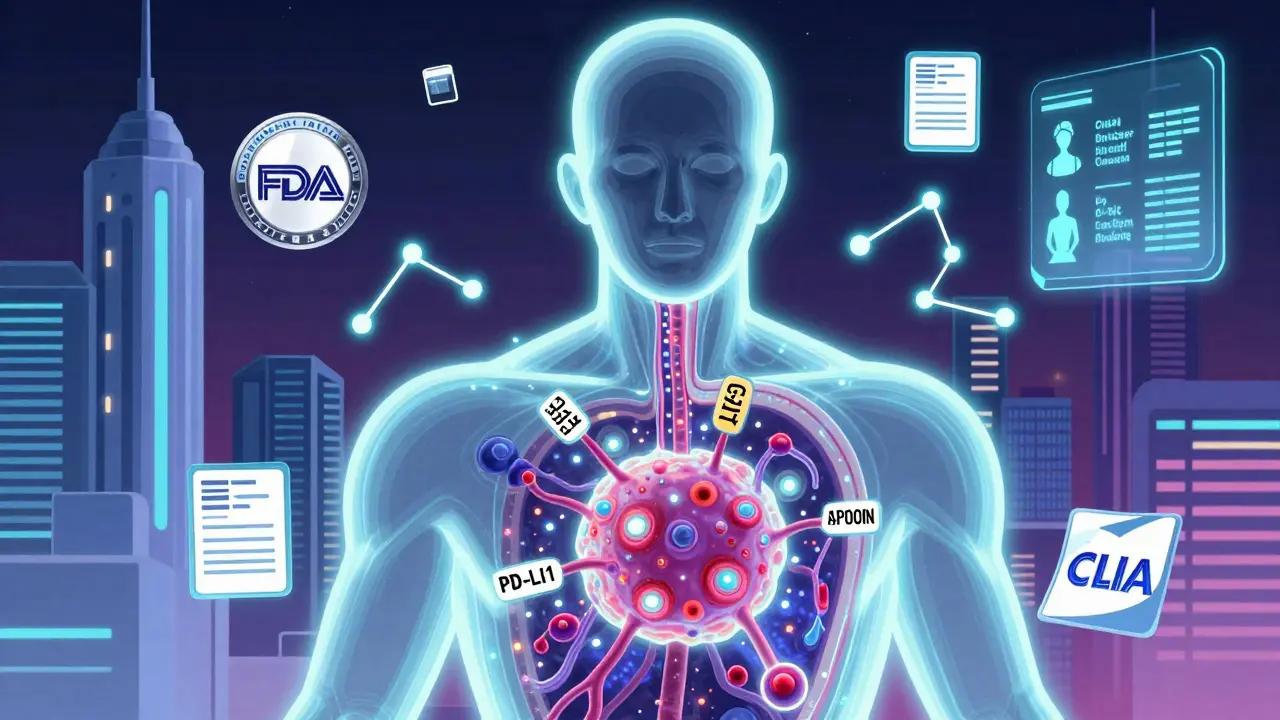
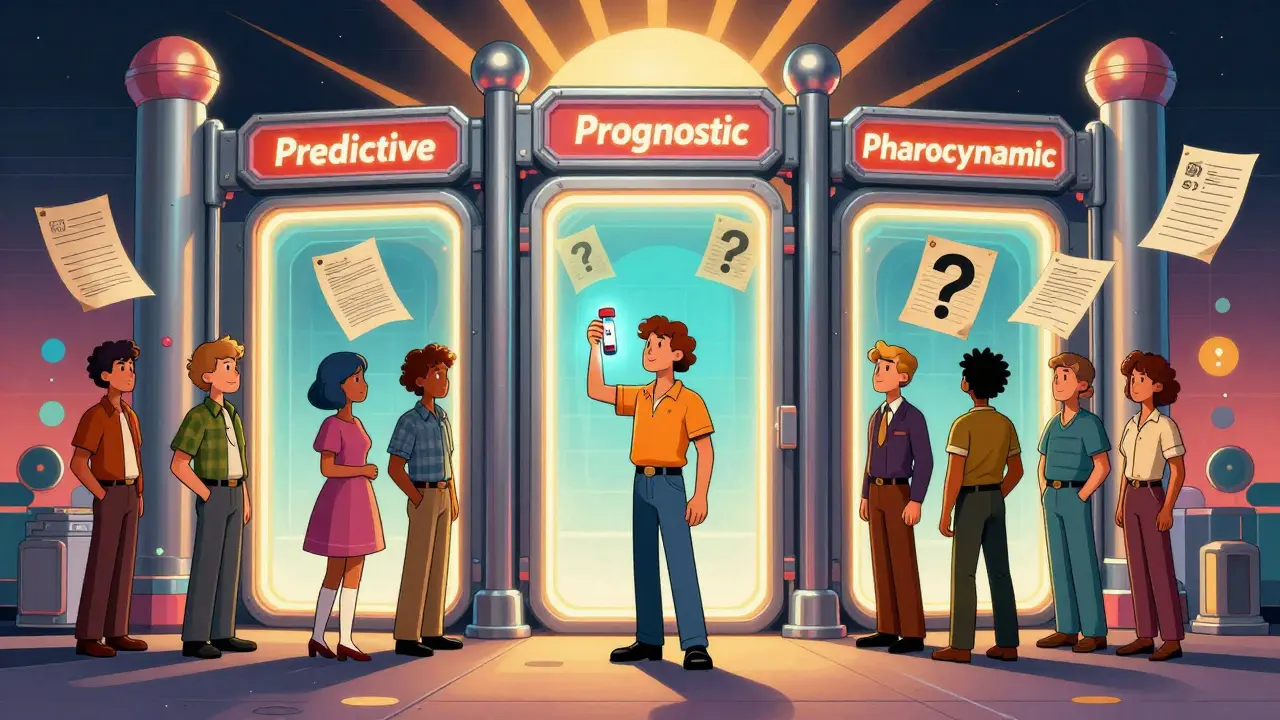
A biomarker isn’t a fancy term for a lab test. It’s a measurable sign in your body that tells doctors something specific about your cancer. Think of it like a fingerprint for your tumor. It could be a gene mutation, a protein level, or even a piece of DNA floating in your blood. These aren’t just research tools anymore. In fact, 92% of cancer drugs approved by the FDA in 2022 were approved for use only in patients with specific biomarkers. The FDA defines biomarkers as objective measures that show normal biology, disease, or how your body responds to treatment. There are seven types, but in cancer trials, three matter most:- Predictive biomarkers: These tell you if a drug is likely to work for you. For example, if your tumor has an EGFR mutation, you might be eligible for drugs like osimertinib.
- Prognostic biomarkers: These predict how your cancer will behave, regardless of treatment. A high level of PD-L1, for instance, often means a more aggressive tumor.
- Pharmacodynamic biomarkers: These show whether the drug is hitting its target. If a drug is supposed to block a protein and that protein drops after one dose, it’s working as intended.
Without these, trials would be shooting in the dark. Imagine giving a drug to 100 people with lung cancer, but only 10% have the exact mutation the drug targets. Most won’t respond. But if you test everyone first and only include those with the mutation? Response rates jump from 12% to over 30%. That’s not luck-it’s precision.
How Inclusion Criteria Are Built Around Biomarkers
Traditional inclusion criteria looked like this: "Must have Stage III or IV non-small cell lung cancer, received one prior line of chemotherapy, ECOG performance status ≤1." Today, it looks more like this: "Must have metastatic non-small cell lung cancer with a confirmed EGFR exon 19 deletion or L858R mutation, documented by CLIA-certified NGS testing, and no prior EGFR-targeted therapy. Tumor tissue must be available or liquid biopsy acceptable." That’s a lot more specific. And it’s intentional. The goal isn’t just to find people who might respond-it’s to find the people who are most likely to respond. This cuts down on trial failures, speeds up approval, and-most importantly-reduces unnecessary side effects for patients who won’t benefit. But here’s the catch: not all biomarker tests are created equal. The FDA requires that any test used to decide eligibility must be analytically validated. That means:- The lab must prove it can detect the biomarker accurately every time.
- The method (like NGS, PCR, or IHC) must be clearly defined.
- The sample handling (how blood is drawn, how tissue is stored) must be standardized.
Why does this matter? Because if your tissue sample sits in a regular tube for 12 hours before being processed, the DNA degrades. Your biomarker test might come back negative-even if your tumor has the mutation. That’s not your fault. It’s a system failure. And it happens more often than you’d think.
The Real-World Hurdles You Won’t Hear About
You might assume that if a biomarker is approved, testing is easy. It’s not. Here’s what actually happens on the ground:- Turnaround time: Specialized biomarker tests can take 7 to 14 days. For someone with fast-growing cancer, that delay can mean losing a window of opportunity.
- Geographic inequality: A mutation like HLA-A*02:01 is found in 40-50% of people in Europe but only 17-47% in North America. If your trial requires this biomarker, you’re less likely to qualify if you live in Vancouver or rural Montana.
- Site capability: Only 63% of trial sites have in-house labs capable of running advanced biomarker tests. Many rely on central labs, which adds delays and complexity.
- Cost and access: In Canada, public funding for some biomarker tests is inconsistent. If your oncologist doesn’t push for it-or your insurance won’t cover it-you might not even get tested.
One study of 142 clinical trial sites found that those with dedicated biomarker infrastructure enrolled patients 28 days faster. That’s not just efficiency-it’s survival time.
What’s Changing Right Now
The field is moving fast. Here’s what’s new as of 2026:- Liquid biopsies: Instead of a tissue biopsy, you might just give a blood sample. Circulating tumor DNA (ctDNA) is now used in 31% of Phase 2+ cancer trials-up from 9% in 2020. It’s less invasive, faster, and can be repeated.
- Dynamic eligibility: Some trials now adjust criteria mid-study. If your biomarker levels drop after two weeks, you might be switched to a different arm. If they rise, you might get an additional treatment.
- AI-driven discovery: Companies are using machine learning to find new biomarker patterns across thousands of genomes. What used to take years now takes months.
- Multimodal panels: No longer are we looking at one gene. Trials now test for 50+ mutations at once, using panels that include DNA, RNA, and protein markers. This is especially common in cancers like melanoma and ovarian cancer.
By 2025, 65% of new cancer trials are expected to use these multi-omic panels. That means eligibility will become even more nuanced-and more powerful.

What You Need to Do
If you’re considering a clinical trial, here’s what to ask:- Which biomarker(s) are required? Get the exact name-not just "genetic test." Ask for the gene, mutation, or protein.
- How is it tested? Is it tissue biopsy, liquid biopsy, or both? Where will it be processed? Is the lab CLIA-certified?
- What if I don’t have the biomarker? Are there backup trials? Is there a way to retest later?
- How long will results take? Ask for a written timeline. If it’s over 14 days, push for alternatives.
- Who pays? In Canada, some tests are covered under provincial plans. Others aren’t. Know your rights.
Don’t assume your oncologist knows all the options. Many still rely on outdated protocols. The most successful patients are those who ask for a molecular tumor board review-a team of specialists who look at your full genetic profile and match it to trials.
Why This Matters Beyond the Trial
This isn’t just about getting into a study. It’s about changing how cancer is treated. Biomarker-driven eligibility has cut Phase 2 trial failure rates from over 60% to under 30%. It’s why drugs like trastuzumab deruxtecan now work for HER2-low breast cancer-a category that didn’t even exist five years ago. It’s also why patients are living longer. In one trial, using a biomarker to select patients for a new immunotherapy increased median survival from 11 months to 29 months. That’s not a small gain. That’s life-changing.The system isn’t perfect. Access is uneven. Testing is slow. Costs are high. But the direction is clear: cancer care is no longer one-size-fits-all. Your tumor’s biology is now the most important factor in your treatment path.
Knowing your biomarkers isn’t optional anymore. It’s the first step toward the right treatment-and the right trial.
Darren Torpey
March 2, 2026 AT 18:25Man, this article hit different. I used to think clinical trials were just lottery tickets with IV drips, but now I see it’s like matchmaking your tumor with its soulmate drug. 🤯 Biomarkers? That’s the new Tinder swipe-right for cancer. If your DNA’s got a mutation, they don’t just *try* a drug-they *know* it’ll work. Feels like sci-fi, but it’s Tuesday in 2026.
Lebogang kekana
March 3, 2026 AT 19:27THIS IS THE FUTURE, PEOPLE! 🚀 No more guessing. No more ‘maybe it’ll work.’ Your cancer has a fingerprint, and now we have the scanner. I’ve seen friends die waiting for tests that took 3 weeks. If your hospital can’t do liquid biopsy in 7 days, find a new one. Survival isn’t passive-it’s aggressive. Demand the tech. Fight for the data. Your life isn’t a waiting room.
Jessica Chaloux
March 5, 2026 AT 16:22I cried reading this. My mom got her biomarker results after 12 days… and they were negative. We thought we were out of options. Then we found a trial that didn’t require it. 😭 But why do we have to be superheroes just to get basic info? Why is access so uneven? I just want to believe the system cares.
Raman Kapri
March 5, 2026 AT 17:34While the article presents an optimistic view, it ignores the systemic manipulation of biomarker data by pharmaceutical companies. The FDA’s approval metrics are heavily influenced by industry-funded studies. The 92% statistic is misleading-it excludes trials that failed due to biomarker misclassification. Moreover, the emphasis on liquid biopsies is a distraction from the real issue: profit-driven exclusion of low-income populations. This is not precision medicine-it’s precision marketing.
RacRac Rachel
March 7, 2026 AT 04:14This is beautiful. 🌟 Seriously. Think about it-your body’s own DNA is now the map to your treatment. No more shotgun approaches. No more ‘we’ll try everything and see what sticks.’ You’re not a patient anymore-you’re a unique biological masterpiece. And the fact that we can now read your tumor like a novel? That’s science poetry. I’m not just hopeful-I’m awestruck. Thank you for writing this.
Jane Ryan Ryder
March 7, 2026 AT 22:26Oh wow. Biomarkers. So now we’re all just genetic barcodes? Great. Next they’ll scan your iris to decide if you’re worth saving. 🤡 Meanwhile, my cousin in Alabama still can’t get a basic CT scan because her insurance says ‘not medically necessary.’ This isn’t progress-it’s a luxury model for the rich. And the rest of us? We’re just noise in the algorithm.
Dean Jones
March 8, 2026 AT 23:02It’s fascinating how we’ve shifted from treating cancer as a disease to treating it as a data anomaly. But here’s the philosophical knot: if your eligibility is defined by a mutation, are you still a person-or just a subset of a statistical population? The reduction of identity to biomarkers may increase efficacy, but it also risks dehumanizing the patient. We measure protein levels, but do we still measure hope? And if a trial excludes you because your PD-L1 is 0.8% instead of 1%, is that science… or a cruel threshold? The system is brilliant, yes-but is it humane?
Betsy Silverman
March 10, 2026 AT 01:33I work in global health outreach, and I’ve seen firsthand how biomarker access varies between urban hospitals and rural clinics. In some places, they still use paper forms to send samples. In others, they’ve got AI analyzing ctDNA in real time. This isn’t just medical-it’s a justice issue. We need mobile testing units, not just better labs. And training local nurses to interpret reports? That’s the real innovation.
Ivan Viktor
March 11, 2026 AT 17:22So let me get this straight. We’re now running clinical trials like a video game where you need the right loot drop to unlock the next boss? Cool. But who’s paying for the loot? My mate in Perth got denied because his ‘HLA-A*02:01’ was ‘suboptimal.’ Turns out, his sample was shipped in a regular cooler. Not his fault. Not the hospital’s fault. Just… the system’s fault. We’re building a future where your survival depends on how well your blood was stored. That’s not precision. That’s a glitch.
Zacharia Reda
March 12, 2026 AT 01:37Let’s be real-this stuff is revolutionary, but nobody talks about the emotional toll of waiting for results. Imagine getting your biopsy, then sitting for two weeks wondering if your body’s ‘fingerprint’ is good enough to live. That’s not just anxiety-it’s existential. And if your doctor doesn’t push for faster testing? You’re stuck. So yes, know the biomarkers. But also know your rights. Push. Call. Email. Follow up. Your life isn’t on hold while someone waits for a lab report.
Jeff Card
March 13, 2026 AT 17:52My sister went through this last year. She didn’t even know what a biomarker was until her oncologist mentioned it. She asked for a molecular tumor board review-got it. Found a trial. Now she’s in remission. I just want people to know: you don’t have to be an expert. Just be loud. Ask for the board. Demand the test. They can’t say no if you keep asking.
Matt Alexander
March 13, 2026 AT 23:18Simple version: If you have cancer, ask your doc: ‘What biomarker test do I need?’ Then ask: ‘Where’s it done?’ Then ask: ‘How long until I get results?’ If they can’t answer, find someone who can. That’s it.
Gretchen Rivas
March 13, 2026 AT 23:20Just added this to my patient advocacy folder. Bookmarking. Sharing. Sending to every oncologist I know. This needs to be required reading.
Stephen Vassilev
March 14, 2026 AT 16:11Wait-this is dangerous. The FDA's validation standards are not binding. Labs are not audited. There is no federal oversight for CLIA-certified facilities in all states. In fact, a 2023 whistleblower report revealed that 43% of labs fail internal quality controls. And now we’re basing life-or-death decisions on this? This isn’t innovation-it’s a Ponzi scheme disguised as science. You think your biomarker is real? It might be a false negative. Or worse-a fabricated one. Who’s accountable? No one. And that’s why I’m not just skeptical-I’m terrified.