Blood Pressure Targets: 120/80 vs. Individualized Goals in Hypertension Management
 Mar, 16 2026
When it comes to blood pressure, there’s no one-size-fits-all answer anymore. You’ve probably heard that 120/80 is the gold standard - the number doctors want you to hit. But if you’ve been told to aim for 140/90 instead, you’re not alone. In fact, top medical groups are split, and the confusion isn’t just about numbers. It’s about what’s safe, what works, and who you are as a person.
Why 120/80 Isn’t the Rule for Everyone
The push for a systolic blood pressure target below 120 mm Hg came from the SPRINT trial in 2015. That study followed over 9,300 adults and found that those who lowered their systolic pressure to under 120 had 25% fewer heart attacks, strokes, and heart failure events - and 27% fewer deaths - compared to those aiming for under 140. It sounded like a breakthrough. But here’s the catch: SPRINT didn’t include people with diabetes, those with a high risk of falling, or older adults with multiple health problems. In real life, most patients with high blood pressure are older, take multiple medications, and have other conditions. So, what works in a controlled trial doesn’t always work in a clinic.The 140/90 Standard Still Has Strong Support
The American Academy of Family Physicians (AAFP) took a hard look at the evidence in 2022 and stood by a target of 140/90 mm Hg for most adults. Their reasoning? Lower targets don’t cut mortality any further - but they do increase side effects. For every 33 people treated to get below 130/80, one ends up with dizziness, fainting, kidney issues, or low blood pressure severe enough to require hospital visits. That’s not a small risk. In primary care, where patients often see their doctor once a year, chasing ultra-low numbers can mean more pills, more lab tests, and more trips to the ER - all for a benefit that’s hard to measure in everyday life.What the AHA/ACC Really Wants in 2025
The American Heart Association and American College of Cardiology updated their guidelines in early 2025 and doubled down on the 120/80 goal. They now recommend starting medication for anyone with blood pressure at or above 130/80 - especially if they have heart disease, diabetes, chronic kidney disease, or a 10-year cardiovascular risk of 7.5% or higher. Their tool for calculating that risk? The PREVENT score. It’s now built into most electronic health records in the U.S., used by 78% of primary care practices. The goal? Catch risk early. Treat aggressively. Prevent heart attacks before they happen. But this approach demands more from patients: more medications, more monitoring, more follow-ups. For someone with a busy job, limited transportation, or no insurance, this can feel overwhelming.Japan’s Bold Shift: One Target for All
In January 2025, Japan’s Society of Hypertension dropped its old guidelines and went all-in on <130/80 for every single hypertensive patient - no exceptions for age, frailty, or kidney disease. Their reasoning? A massive meta-analysis of over 400,000 people showed that every 5 mm Hg drop in systolic pressure reduces major cardiovascular events by 10%. That held true whether someone was 50 or 84. Japan’s system is built for tight monitoring: frequent check-ins, home blood pressure logs, and fast adjustments. It works there because of their universal healthcare and culture of disciplined follow-up. Can it work in the U.S., where nearly half of adults have high blood pressure and many skip appointments? That’s the big question.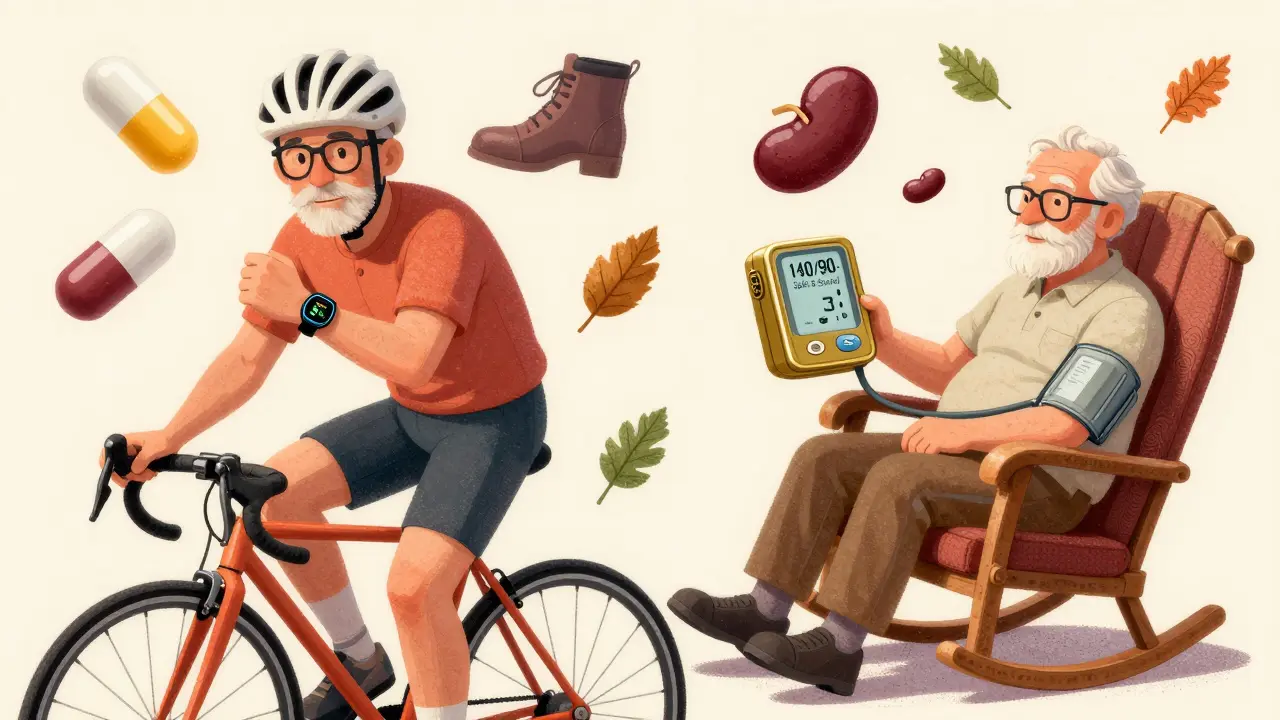
The Middle Ground: Europe’s Age-Based Approach
The European Society of Hypertension (ESH) took a different route. They don’t force one number on everyone. Instead, they adjust targets by age:- Under 65: Aim for 120-129 systolic
- 65-79: 130-139 systolic
- 80 and older: 140-150 systolic
Who Should Aim for 120/80?
If you’re under 65 and have:- Diabetes
- Chronic kidney disease
- History of heart attack or stroke
- A PREVENT risk score over 7.5%
Who Should Stick With 140/90?
If you’re over 75, especially with:- History of falls
- Multiple chronic conditions
- Frailty or cognitive decline
- Difficulty managing medications
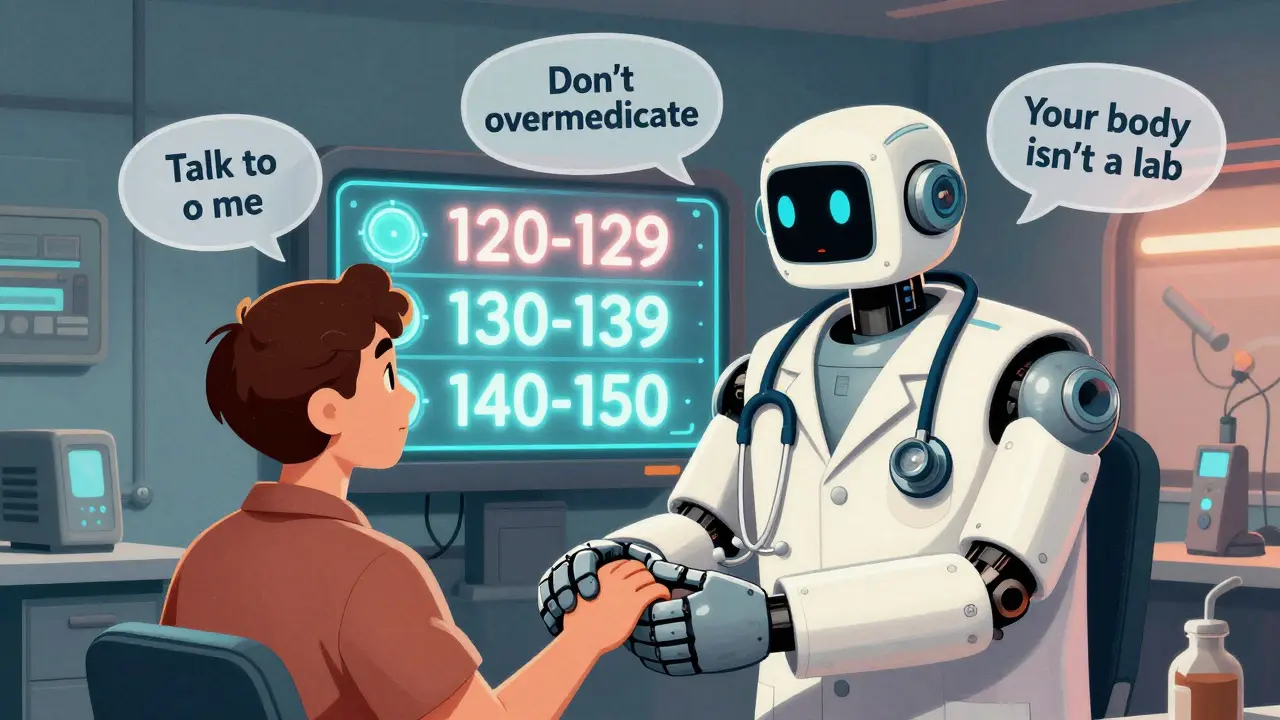
Shared Decision-Making Is the Real Answer
There’s no perfect number. There’s only the right number for you. That’s why experts from both sides agree: after you’ve reached initial control, talk with your doctor. Ask:- What’s my 10-year heart disease risk?
- Am I on more than two blood pressure meds already?
- Have I had dizziness, falls, or kidney changes since starting treatment?
- Can we try a lower target with close monitoring - and back off if I feel off?
The Cost of Lower Targets
Lower targets mean more drugs. More tests. More visits. In 2024, the global market for blood pressure meds hit $28.7 billion. By 2027, it’s expected to climb to $33.2 billion - partly because stricter guidelines are pushing more people into treatment. But not all of those people need pills. Many could manage with diet, salt reduction, weight loss, and walking 30 minutes a day. The real challenge isn’t getting numbers down - it’s getting people to stick with sustainable habits without overmedicalizing their lives.What’s Coming Next?
The NIH just launched SPRINT-2 - a new trial starting in 2025 with $47.2 million in funding. This time, they’re including people with diabetes, older adults, and those at high risk of falls. They’ll track outcomes over five years. If this trial confirms that lower targets work safely in real-world populations, guidelines will shift again. But if it shows more harm than benefit in diverse groups, we may see a return to individualized goals as standard practice.Right now, the safest path is this: Know your numbers. Understand your risk. Talk to your doctor. Don’t let a number on a chart override how you feel. Your body isn’t a lab. It’s yours.
Is 120/80 the right blood pressure target for everyone?
No. While 120/80 is ideal for younger, healthier adults with high cardiovascular risk, it’s not safe or necessary for everyone. Older adults, those with frailty, or people taking multiple medications may face more harm than benefit from aggressive lowering. Guidelines from the AAFP and ESH recommend higher targets (140/90 or age-adjusted ranges) for these groups.
Why do different organizations recommend different blood pressure targets?
They weigh the evidence differently. The AHA/ACC focuses on long-term prevention and uses data from trials like SPRINT, which showed major benefits in a select group. The AAFP looks at real-world outcomes and finds that lower targets increase side effects without significantly improving survival in most patients. The ESH and JSH balance both sides - ESH by age, JSH by universal application with intensive monitoring.
Should I take more medication to reach 120/80?
Only if your doctor confirms you’re in a high-risk group and you can tolerate the side effects. Adding more drugs increases the chance of dizziness, kidney stress, and falls. For many, lifestyle changes - reducing salt, losing weight, exercising - can get you close enough without extra pills. Always discuss the risks and benefits before changing your treatment plan.
What’s the PREVENT risk score, and why does it matter?
The PREVENT score estimates your 10-year risk of heart disease, stroke, or death from cardiovascular causes. It uses age, sex, race, cholesterol, blood pressure, diabetes status, and smoking. If your score is 7.5% or higher, the AHA/ACC recommends starting medication even if your blood pressure is only 130-139 systolic. It’s now used in most U.S. clinics to guide treatment decisions beyond just the number on the monitor.
Can I lower my blood pressure without medication?
Yes - and often, it’s the best first step. Cutting salt, losing 5-10% of body weight, walking 30 minutes daily, limiting alcohol, and managing stress can drop systolic pressure by 10-20 mm Hg. For people with stage 1 hypertension (130-139/80-89) and low cardiovascular risk, guidelines recommend trying these changes for 3-6 months before considering drugs. Lifestyle isn’t a backup - it’s the foundation.
Gaurav Kumar
March 17, 2026 AT 01:14120/80 is the ONLY valid target. Anyone who says otherwise is just enabling laziness. 😤 India’s hypertension rates are rising because people don’t take this seriously. If you’re over 130/80 and you’re not on meds, you’re playing Russian roulette with your heart. No excuses. 🇮🇳
Jeremy Van Veelen
March 17, 2026 AT 01:14THEY’RE ALL WRONG. 😱 The SPRINT trial was a MASTERPIECE. They didn’t just prove 120/80 works-they proved that medicine has been COWARDLY for decades. We’ve been treating patients like fragile porcelain dolls while their arteries turn to cement. This isn’t about numbers-it’s about courage. The AAFP? They’re the medical equivalent of a Netflix binge with no plot. 💥
Laura Gabel
March 17, 2026 AT 16:31jerome Reverdy
March 18, 2026 AT 16:12Look, the truth is in the middle. SPRINT had great results, but it was a highly selected population. Real-world patients have polypharmacy, frailty, cognitive decline. Pushing 120/80 on someone with Parkinson’s and CKD isn’t precision medicine-it’s iatrogenic harm. We need risk stratification, not dogma. The PREVENT score helps, but it’s not magic. Clinical judgment still matters. And sometimes, 140/90 is the right target for quality of life. 🤷♂️
Andrew Mamone
March 19, 2026 AT 16:48Japan’s move is actually brilliant. 🇯🇵 One target for all removes ambiguity, reduces disparities, and makes public health messaging clearer. If we’re going to scale hypertension management across socioeconomic lines, we need simplicity. The 120/80 target isn’t perfect-but it’s a strong, evidence-backed anchor. Complexity is the enemy of adherence. Let’s stop over-engineering this. 📊
MALYN RICABLANCA
March 20, 2026 AT 20:37OH MY GOD. I CAN’T BELIEVE THIS IS STILL A THING. 😭 People are DYING because doctors are too lazy to follow the science. The AAFP is basically saying ‘let’s just chill and hope for the best.’ Meanwhile, your grandma’s brain is slowly turning to mush because her BP was ‘fine’ at 140. And don’t get me started on the PREVENT score-it’s a GODSEND. Why are we still arguing? It’s 2025. We have AI. We have wearables. We have data. STOP TREATING HYPERTENSION LIKE A CHOICE. 💥
gemeika hernandez
March 21, 2026 AT 21:11It’s simple. Lower BP = less stroke. Less stroke = less nursing homes. Less nursing homes = less cost. Why is this so hard? People overcomplicate everything. Just treat it. More meds. More checkups. More care. Stop making excuses.
Nicole Blain
March 22, 2026 AT 16:22My dad’s BP is 138/88. He’s 72, has arthritis, takes 5 meds, and can’t drive anymore. We’re not chasing 120. He’s happy. He’s not dizzy. He’s not falling. We’re not doing anything else. 🌿