Authorized Generics vs. Traditional Generics: What’s the Real Difference?
 Jul, 30 2026
You’ve probably seen a prescription bottle with a name you don’t recognize, priced lower than the brand-name medication your doctor prescribed. It says “generic” on the label, but it might not be the generic you’re thinking of. This is where authorized generics come in-a confusing corner of the pharmaceutical world that saves money for some patients while baffling others.
If you’ve ever wondered why two different companies sell what looks like the same pill at different prices, or why your pharmacist couldn’t find a match in the standard database, you’re not alone. The distinction between an authorized generic and a traditional generic isn’t just semantics; it affects cost, availability, and even how your insurance pays for it.
What Exactly Is an Authorized Generic?
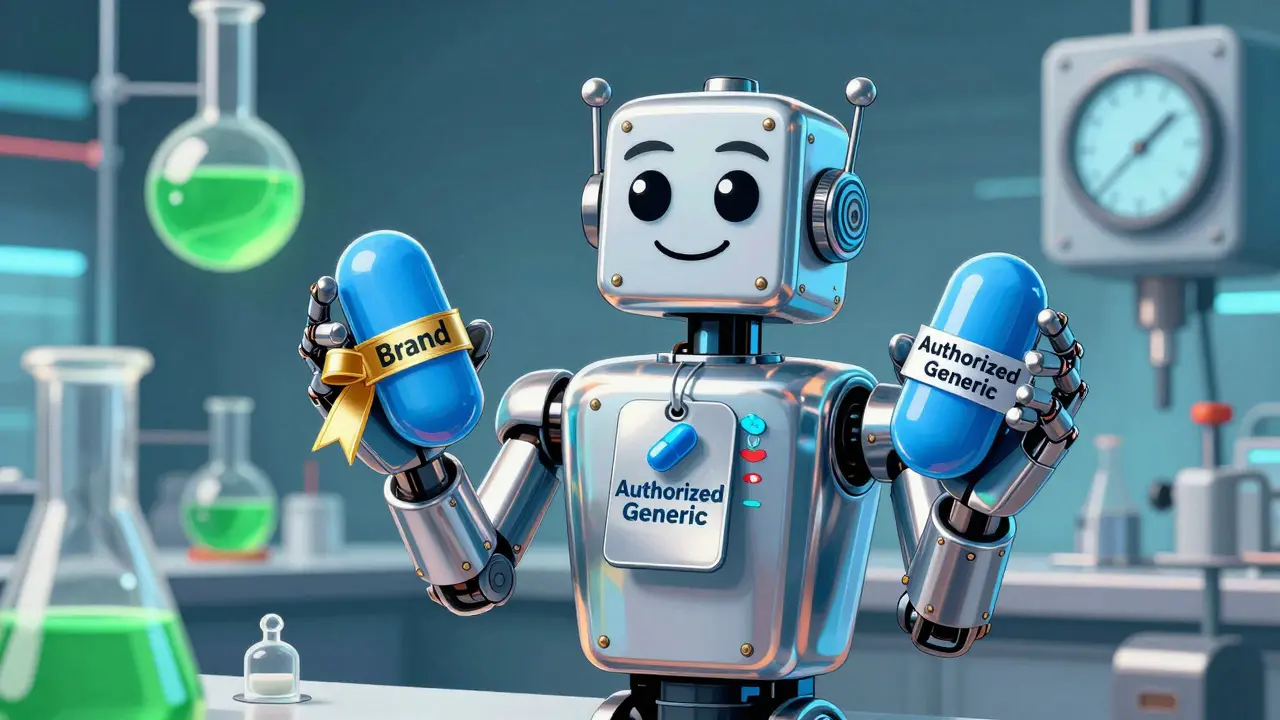
An authorized generic is exactly what it sounds like: a brand-name drug sold without the brand name. Think of it as a store-brand version of a high-end product, made by the original manufacturer. According to the U.S. Food and Drug Administration (FDA), an authorized generic is "an approved brand name drug that is marketed without the brand name on its label." Other than the label, packaging, or color, it is the exact same drug product as the branded version.
The key here is the source. A traditional generic is made by a different company that has proven their version works the same way as the brand. An authorized generic is made by the brand-name company itself (or a subsidiary they hire) and uses the original New Drug Application (NDA). Because it’s the identical product, it doesn’t need to go through the rigorous bioequivalence testing that traditional generics do. It’s already been approved because it *is* the brand-name drug.
The Critical Differences: Authorized vs. Traditional Generics
While both types of drugs aim to provide affordable alternatives to expensive brand-name medications, they differ significantly in regulation, composition, and market entry. Understanding these differences helps you navigate pharmacy counters and insurance bills more effectively.
| Feature | Authorized Generic | Traditional Generic |
|---|---|---|
| Manufacturer | Brand-name company or its partner | Different company from the brand |
| FDA Approval Path | Leverages existing Brand NDA | Requires separate ANDA approval |
| Bioequivalence Testing | Not required (it is the brand) | Required to prove sameness |
| Ingredients | Identical active & inactive ingredients | Same active; may differ in inactive fillers/dyes |
| Orange Book Listing | Not listed | Listed with therapeutic equivalence code |
| Market Entry Timing | Any time, even before patent expiry | Usually after patent expiry or challenge |
Regulatory Hurdles and the Orange Book
One of the biggest practical differences lies in documentation. Traditional generics must submit an Abbreviated New Drug Application (ANDA) to the FDA. They have to prove bioequivalence-meaning the drug reaches your bloodstream at the same speed and amount as the brand. Once approved, they appear in the FDA’s “Orange Book,” which lists all approved drug products with therapeutic equivalence ratings.
Authorized generics skip this step entirely. Since they are chemically identical to the brand, they don’t need to prove anything new. Consequently, they do not appear in the Orange Book. This can cause confusion for pharmacists and doctors who rely on the Orange Book to check if a substitution is safe. If you ask your pharmacist about an authorized generic, they might say it’s not listed as a generic equivalent because, technically, under federal law, it’s still considered part of the brand’s NDA family.
Composition and Inactive Ingredients
For many patients, the difference in inactive ingredients matters. Traditional generics must contain the same active ingredient as the brand, but they can use different binders, fillers, dyes, or preservatives. Some people experience mild side effects or allergies due to these variations.
Because an authorized generic is the same product as the brand, it contains the exact same inactive ingredients. If you’ve had trouble tolerating a traditional generic due to a filler or dye, an authorized generic offers the peace of mind of the original formulation at a potentially lower price. However, the packaging will look different, often simpler, to distinguish it from the premium brand version.
Why Do Companies Launch Authorized Generics?
You might wonder why a big pharma company would undercut its own profitable brand-name drug. The answer is strategy and market share. When a patent is nearing expiration, brand manufacturers know they will lose exclusivity soon. By launching an authorized generic, they can capture a portion of the cost-conscious market themselves rather than losing all those customers to third-party competitors.
Data from IQVIA shows that authorized generics accounted for approximately 12.7% of all generic drug units dispensed in the United States in recent years. Major players like Greenstone LLC (a Pfizer subsidiary), Prasco Laboratories, and Patriot Pharmaceuticals dominate this space, handling the distribution for brands that want to stay anonymous in the generic market.
Critics argue this practice can be anti-competitive. Under the Hatch-Waxman Act, the first company to successfully challenge a brand’s patent gets 180 days of marketing exclusivity. Sometimes, brand companies launch authorized generics right alongside or just before the traditional generic enters the market. This can dilute the profits of the challenger, potentially discouraging future patent challenges. A 2022 Health Affairs study found that over a third of brand-name drugs with expired patents saw authorized generics launched simultaneously with traditional ones.
Impact on Patients and Insurance Coverage
For you, the patient, the most immediate concern is cost and coverage. Generally, authorized generics are cheaper than brand-name drugs, often saving 15-30%. However, they are usually more expensive than traditional generics, which benefit from intense competition among multiple manufacturers.
Insurance coverage can be tricky. Many Pharmacy Benefit Managers (PBMs) classify drugs based on their regulatory status. Since authorized generics are tied to the brand’s NDA, some insurers treat them as “brand” medications. This means you might pay a higher copay for an authorized generic than you would for a traditional generic, even though the pills inside are functionally similar to the brand. Always check with your insurer or pharmacist to see how they categorize the specific drug you’re prescribed.
Confusion is widespread. A GoodRx analysis revealed that nearly 80% of patients cannot tell the difference between an authorized generic and a traditional generic when looking at the bottles. Pharmacists play a crucial role here. If you have sensitivities to certain fillers, ask your pharmacist specifically if the generic they are dispensing is an authorized version or a traditional one. They can check the manufacturer’s name on the box or consult the FDA’s List of Authorized Generic Drugs.
How to Identify an Authorized Generic
Spotting an authorized generic requires a bit of detective work since the label won’t explicitly say “Authorized Generic.” Here’s what to look for:
- Check the Manufacturer: Look at the bottom of the box or the bottle insert. If the manufacturer is a subsidiary of the brand-name company (e.g., Greenstone for Pfizer brands), it’s likely an authorized generic.
- Consult the FDA List: The FDA maintains an updated list of authorized generic drugs on its website. You can search by drug name to see if an authorized version exists.
- Ask Your Pharmacist: Pharmacists have access to detailed drug information databases. Ask directly: “Is this a traditional generic via ANDA, or an authorized generic?”
Remember, the absence of a listing in the Orange Book is a strong indicator. If a drug has no traditional generic competitors yet, but you’re offered a low-cost alternative from a related entity, it’s almost certainly an authorized generic.
Future Outlook and Regulatory Changes
The landscape for authorized generics is evolving. The FDA updated its guidance in January 2023 to clarify notification requirements, ensuring transparency when brand companies switch to selling authorized versions. Additionally, the CREATES Act of 2019, fully implemented in 2022, aimed to curb tactics that delay generic competition, indirectly affecting how authorized generics are deployed.
As specialty pharmaceuticals become more complex, the demand for formulation consistency grows. Patients on narrow-therapeutic-index drugs (where small changes in dosage matter greatly) may prefer authorized generics to avoid the variability of different inactive ingredients found in traditional generics. Analysts predict that authorized generics could grow to represent over 15% of the $117 billion U.S. generic drug market by 2027.
Understanding these nuances empowers you to make better healthcare decisions. Whether you prioritize the lowest possible cost or the exact formulation of your brand-name drug, knowing the difference between authorized and traditional generics ensures you get the value and safety you expect.
Are authorized generics as safe as brand-name drugs?
Yes. Authorized generics are the exact same product as the brand-name drug, containing identical active and inactive ingredients. They undergo the same quality control standards because they are manufactured by the brand company or its direct partners. The only difference is the labeling and packaging.
Why aren't authorized generics listed in the FDA Orange Book?
The Orange Book lists drugs approved via the Abbreviated New Drug Application (ANDA) process, which is used for traditional generics. Authorized generics leverage the original brand’s New Drug Application (NDA). Since they don’t require a separate ANDA approval or bioequivalence study, they are not included in the Orange Book listings.
Will my insurance cover an authorized generic?
Coverage varies by plan. Some insurers treat authorized generics as brand-name drugs because of their regulatory link to the NDA, resulting in higher copays. Others may cover them as generics. It is essential to check with your pharmacy benefit manager or pharmacist to understand how your specific plan categorizes the medication.
Can I request an authorized generic instead of a traditional generic?
Yes, especially if you have experienced side effects from inactive ingredients in traditional generics. Since authorized generics contain the same fillers and dyes as the brand, they may be better tolerated. Ask your pharmacist to check if an authorized version is available from manufacturers like Greenstone or Prasco.
Do authorized generics help lower drug costs?
Yes, they typically cost 15-30% less than the brand-name equivalent. While they are often more expensive than traditional generics due to less competition, they provide a middle-ground option for patients who want savings but prefer the brand’s exact formulation.